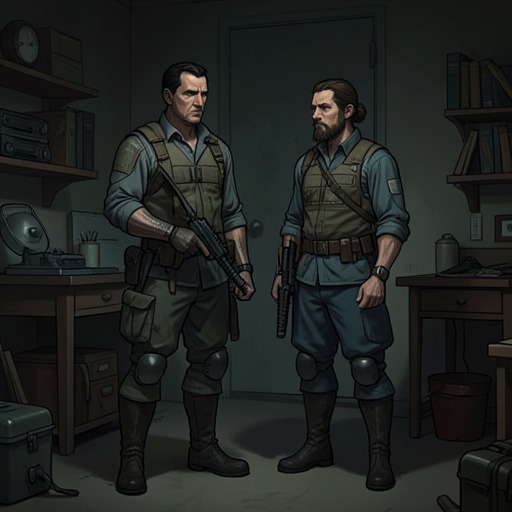
Detringer
The Robot Who Looked Like MeDetringer is a Ferlang exile whose journey turns disgrace into an unlikely first contact with another intelligent people. Banished for violations that range from insolent gestures to public violence, he is set adrift in an underpowered spacecraft with only his loyal mechanical servant, Ichor. His survival depends on endurance and caution; when he reaches a planetary system and encounters Earth, he conceals the reason for his exile, presenting himself instead as a stranded scout. By the end, the man sent away from home is once more travelling toward an unknown world, with no assurance that it will offer refuge rather than death.
Identity and Offenses
Detringer’s punishment follows a series of acts classified by Ferlang society as profound breaches of social order. During the Meditation Frolic, he sucked his teeth insolently; when the Regional Grand Ubiquitor condescended to spit at him, Detringer switched his tail widdershins. These acts would ordinarily have brought only a few dozen years of Plenary Ostracism. Their presentation makes his offence both bodily and ritual: a small gesture of disrespect is legible as defiance because it violates the expected performance of deference.
He compounded those impertinences by persisting in audible reminiscences about his sexual exploits during Godmemory Meeting, an act described as Willful Disobedience. His final offence was more consequential still. Detringer committed overt public violence against a Ukanister, causing minor bodily injury but, in the account’s pointed distinction, major damage to the victim’s ego. It was the unprecedented public aggression—not simply the accumulation of earlier rudeness—that brought down the supreme penalty. Ferlang’s response casts his conduct as a threat to a society that had not experienced Open Public Aggression since the primitive era of the Death Games.
Banishment and Loss
Ferlang is the fourth planet from its sun in a fifteen-planet system near the edge of the galaxy. Detringer is carried far beyond his home world in a starship, then released into the intergalactic void in a tiny, underpowered Detringer's Sportster. Ichor voluntarily accompanies him. The contrast between the immense ship that delivers him and the inadequate craft left to him makes the punishment tangible: the authorities do not merely remove Detringer from society but leave him with sharply limited means of surviving beyond it.
His family is formally severed from him as part of that exclusion. His three wives—Maruskaa, described as gay and flighty; Gwenkifer, tall and thoughtful; and Uu, floppy-eared and irrepressible—divorce him in a solemn Act of Eternal Revulsion. His eight children perform the Office of Parental Repudiation. Yet the ritual does not describe every private feeling: after it, the youngest, Bethanie, is heard to say that she still loves her father regardless of what he has done. Detringer is deliberately kept from knowing this. The official rejection is therefore not the whole emotional truth, but the punishment ensures that he experiences it as if it were.
Survival in the Void
Alone in the dead expanse between galaxies, Detringer faces hunger, cold, thirst, and the throbbing headache of oxygen deprivation. He imposes stringent rations on himself, while the craft’s inadequate energy systems run down. He switches off its engines immediately, judging that its small fuel supply would be wasted in a void that taxes even enormous starships. He reserves the remaining fuel for planetary maneuvering, an opportunity he recognizes as unlikely. His response is practical rather than triumphant: survival means conserving resources for a possibility that may never arrive.
The craft eventually encounters a storm front. Its very inadequacy helps preserve it: driven without resistance by the storm, it yields, and its hull remains intact after the storm passes. Detringer and Ichor survive, though both endure a period of unconsciousness. When Detringer wakes, he looks around, then out through the ports and at the navigational instruments. The sequence turns a return to consciousness into a search for bearings. He discovers that they have crossed the Void and are approaching the outer limits of a planetary system whose sun is O type. The crossing that began as a sentence has carried him to an opening, though not to safety already secured.
First Contact and Concealment
Ichor recognizes the historical importance of their arrival: a representative of the Ferlang People is about to meet the first intelligent aliens their race has encountered. The irony is inseparable from Detringer’s status as a criminal; the first envoy is not an appointed representative but an exile who has reached the encounter by force of circumstance. Detringer insists that he did not seek the opportunity and resolves not to disclose his differences with the Ferlang authorities. His first response to the prospect of contact is therefore not confession but control of what the other side can know.
In his interview with Kettelman, Detringer gives a fabricated account of his presence. He claims to be an advance scout for Ferlang’s spatial forces, says a storm blew him far off course, and explains that he landed when his fuel ran out. He accepts Kettelman’s description of him as marooned, while insisting that the condition is temporary: a relief ship, he says, will eventually come, although it will take a long time. He asks instead for fuel. The story turns the truth of his predicament into a strategic falsehood: he really is isolated and short of fuel, but he invents an official mission and a future rescue to hide his banishment.
When challenged, Detringer admits that he lied. He explains that Ferlangers also have security concerns and that, until they know more about those they encounter, it is common sense to reveal as little as possible. His invented claim about relying on radio is intended to create a small advantage in the event that the two sides meet again under unfriendly circumstances. The explanation does not erase the deception; it frames it as reciprocal caution between unfamiliar powers. Detringer has concealed his personal disgrace, but he presents the concealment as a defense of Ferlang’s interests rather than a bid to escape accountability.
Departure and Narrative Significance
At nightfall, Detringer blasts off with Ichor. The servant is now more faithful than ever because he has discharged his compulsion, a change that reinforces the pair’s continued dependence on one another without turning their bond into a guarantee of safety. Asked where they are going, Detringer names a marvelous new world; Ichor immediately raises the alternative that they may be going to their deaths. The ending leaves the destination unresolved and places hope beside a blunt recognition of danger.
Detringer’s trajectory is built from reversals of status. Ferlang’s rituals define him as an intolerable social offender, yet his exile makes him the accidental bearer of his people’s first encounter with intelligent aliens. He is resourceful enough to conserve fuel, read the risks of his situation, and manage information, but none of those abilities undoes the abandonment or assures a return. His story’s final movement—from punishment, through survival and calculated self-presentation, into another uncertain departure—keeps the promise of a new world inseparable from the possibility of extinction.