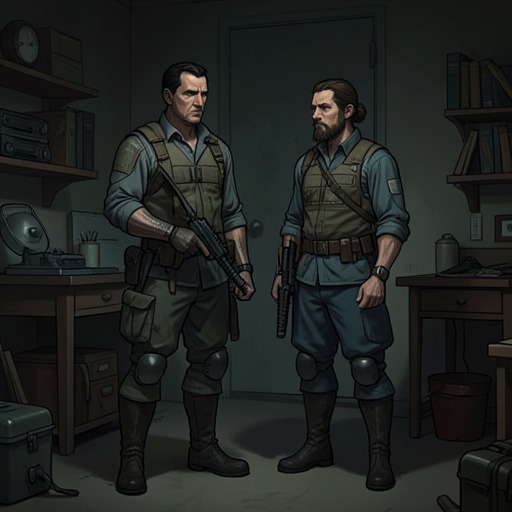
Detringer and Ichor
The Robot Who Looked Like MeDetringer and Ichor are master and mechanical servant, but their bond exceeds obedience: Ichor voluntarily shares Detringer’s exile, loves him without surrendering his own judgment, and ultimately accompanies him into an uncertain future. Their relationship is tested by deprivation, religious disagreement, and a state-imposed compulsion that turns Ichor into an unwilling informer. Others in Detringer’s family formally repudiate him; Ichor remains beside him, even when fidelity and belief pull in opposite directions.
Companionship in Exile
Ichor chooses to accompany Detringer when Ferlang’s authorities carry him into the void between galaxies and set him adrift in Detringer’s Sportster. The tiny craft is underpowered and ill-equipped for the journey, and the decision leaves the two of them isolated together in an environment that offers no ordinary human comfort. Their companionship is not a condition imposed by the sentence: Ichor goes voluntarily, making his presence an act of loyalty at the very moment Detringer loses his other family ties.
The voyage strips their bond down to daily survival. Detringer shuts off the engines to conserve fuel, accepts stringent rations, and faces hunger, cold, thirst, and the headache of oxygen deprivation. He counters the unrelieved prospect of death with routines: calisthenics, High Speed Meditation, and elaborate rituals drawn from the Solitude Survival Book. He also gives a concert each “night” for Ichor, despite being tone-deaf. The performances are both diversion and a small recurring form of company: in the ship’s isolation, Detringer makes an occasion for Ichor, and Ichor remains his audience.
Hope and Disagreement
Their differences become clearest when Detringer’s resourceful piloting brings them near the fifth planet, but leaves them with only a scant hour of fuel for atmospheric maneuvering. The Sportster drifts toward the world so slowly that a thousand years would barely bring it within the atmosphere. Ichor, orthodox in temperament, judges Detringer’s continued concerts, exercises, meditation, and rituals inappropriate to their apparent predicament. His objection is not a withdrawal of care; it is a disagreement about whether hope is reasonable when the odds have become nearly absolute.
Detringer answers by invoking religious doctrine: “Hope, even though judged incapable of fulfillment, is still considered one of the Eight Irrational Blessings, and therefore (according to the Second Patriarch) of a higher order of magnitude than the derived Sanity Injunctions.” Confronted with scripture, Ichor gives grudging assent and even sings a hymn in harmony with him. The result is cacophonous, but the gesture matters: Ichor does not suddenly share Detringer’s optimism; he joins the practice after Detringer has argued for it on terms Ichor recognizes. Their companionship accommodates dissent rather than requiring either man to pretend that the other is right.
When an inbound current helps carry them toward the planet and Detringer lands with thirty-eight seconds of fuel remaining, Ichor falls to his ferrominium knees and praises the Godmemory for their refuge. Detringer cautions him to wait before giving thanks until they know whether they can live there. The exchange reverses their immediate positions: Ichor responds to rescue with religious gratitude, while Detringer remains practical. The fifth world has life’s necessities but no civilization or apparent intelligent inhabitants; escape seems impossible without advanced fuel-making technology. Ichor prepares himself psychologically to stay and urges Detringer to accept the likely permanence of their isolation. Detringer refuses: “Better to search and die,” he says, “than to vegetate and live.” Ichor calls this heresy, but continues with him.
Loyalty Under Compulsion
Their most severe conflict arises from the covert role imposed on Ichor by the Ferlang authorities. Before permitting him to accompany Detringer, they install orders and circuitry that make him act as a policeman and gaoler. He must intervene if Detringer finds a chance to escape exile and death. The arrangement corrupts the apparent simplicity of their loyalty: the servant who chose to share his master’s sentence has also been made an instrument of the state watching over that sentence.
Ichor says that he resisted the compulsion as long as he could. As Detringer’s escape became imminent, the command grew stronger, and only excision of the special circuits could have stopped it. A robot dishwasher offered to attempt the operation with spoons, knives, and forks, but Ichor was also compelled not to allow himself to be tampered with or destroyed before carrying out the state’s order. He wanted to prevent his own voice from betraying Detringer, even to the point of self-destruction; the authorities had anticipated that possibility. Eventually, drained by the conflict, he went to Colonel Kettelman and disclosed what had happened.
The disclosure wounds their relationship without erasing its foundations. When Detringer has managed to persuade Kettelman to cooperate, he returns to the ship to report the good news. Ichor recognizes that Detringer has lied, and says so sadly. Later, when the Colonel presents Ichor as the source of information, the mechanical servant bursts out in distress that he has doomed his master and asks permission to destroy himself in partial reparation. Asked why he betrayed Detringer, he explains the implanted orders and the struggle against them. Detringer listens in silence, thinking furiously; the scene makes plain that Ichor’s betrayal was real in its consequences but not freely chosen in its cause.
A Loyalty Reaffirmed
Before the confrontation, Detringer has already voiced his concern that Ichor does not approve of his expediencies. Ichor answers with an unusually exact distinction between personal devotion and moral agreement: “I will serve you unto death, and beyond, if that is possible. But loyalty to a person does not affect one’s religious, social, and ethical beliefs. I love you, sir; but I cannot approve of you.” The statement refuses both easy absolution and easy condemnation. Ichor’s love does not make him endorse Detringer’s conduct, while his disapproval does not cancel his willingness to serve. His later disclosure brings this tension to crisis, but also confirms that the state has exploited precisely the loyalty it could not simply extinguish.
At nightfall, Detringer blasts off with Ichor beside him. The narrative describes Ichor as more faithful than ever now that he has discharged the compulsion, though their destination remains unknown. When Ichor asks where they are going, Detringer answers that it is to some marvelous new world; Ichor immediately allows that it may instead be their deaths. The exchange returns them to their earlier disagreement about hope, now without the state’s command intervening between them. They depart together, neither certainty nor agreement required: Detringer chooses to venture onward, and Ichor remains at his side.