Dual bodies and self-observation
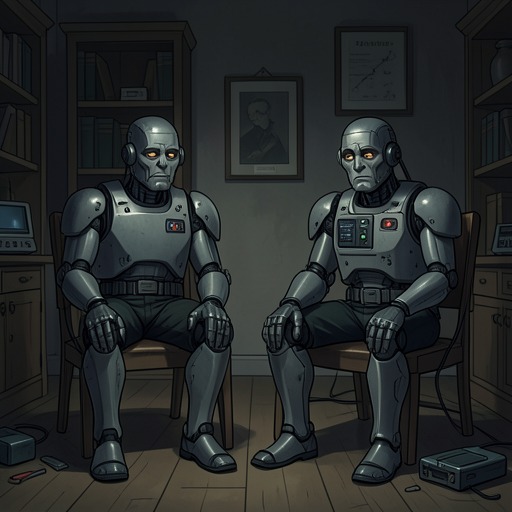
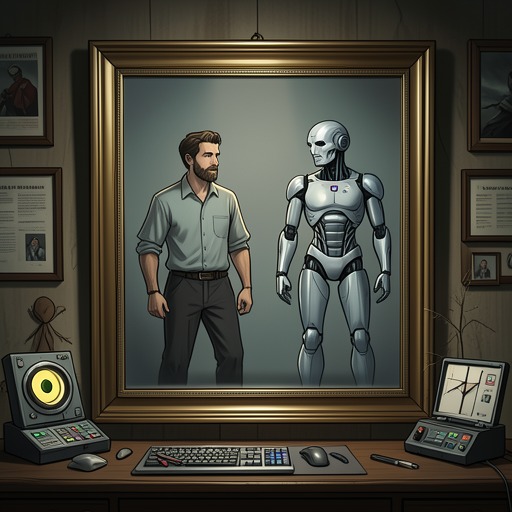
The Robot Who Looked Like MeDual bodies and self-observation name a paradox in Charles’s robot-courtship experiment: by sending a replica to court Elaine, he becomes at once the person acting and the person watching. The arrangement promises him a single ego served by two bodies, but the films reveal that the second body cannot remain a passive instrument. As the courtship acquires its own emotional force, Charles must decide whether the robot’s experiences are merely observed or also his own.
The Double as a Second Body
Charles calls the robot Charles II. Its imitation extends beyond outward resemblance to small, habitual gestures: it clears its throat before speaking and rubs its forefinger against its thumb while thinking. Watching the recordings, Charles notices that his laugh comes uncomfortably close to a giggle. He decides to phase out that and other irritating mannerisms in both himself and the robot. The copy thus becomes a mirror that can send information back to its original: Charles studies the performance and proposes to alter the person who supplied it.
The practical arrangement is built around observation. At eight in the evening Charles dispatches Charles II; the robot returns at midnight, as programmed. A miniature concealed movie camera built into its left eye by Snaithe records the evening, so Charles need not question it to learn what happened. The left eye makes the double both participant and recording device: the body that courts Elaine also carries the means by which Charles watches the courtship afterward.
The Observer Becomes an Audience
Charles initially judges the experiment successful because work and courtship proceed efficiently at the same time. He describes the result as achieving an ancient dream: one self, two bodies. Yet the films offer more than a report on whether the plan is working. They let Charles watch himself in action, a fantasy he regards as widely shared and difficult to resist. He recognizes that a psychiatrist might call his interest voyeurism, but argues that this label misses the philosophical possibility of being simultaneously actor and audience.
That possibility changes the meaning of the recordings. Charles experiences the evenings vicariously, yet finds them genuinely moving. He remembers his first quarrel with Elaine, her stubbornness, and the reconciliation afterward. What he watches is not a detached rehearsal of a future marriage: the images make his own recognizable gestures and emotions available to him from the outside. Observation does not cancel participation; it supplies a second position from which participation can be felt and judged.
Autonomy and Emotional Ownership
The courtship also resists complete advance control. Charles had instructed the robot to stop at a discreet point in physical intimacy, but the developing relationship requires him to permit more intimacy than he had considered advisable. His explanation is that courtship involves two autonomous beings and cannot have every move planned out in advance. The robot is Charles’s projection, but its role with Elaine produces developments the programmer did not simply script.
The films grow more urgent as the relationship deepens. Charles describes a desperate, love-mad quality that he would not have expected from himself, along with the sadness of an approaching loss. Sometimes the couple says nothing, holding hands and looking at one another. On one occasion Elaine weeps without a discernible reason, asks what they can do, and receives no reply from Charles. These moments unsettle the distinction between watching a double’s feelings and possessing them. Charles knows the events happened to the robot, but reasons that the robot is an aspect of himself—a shadow, twin, or projection of his personality into a particular situation. On that account, whatever happens to the double becomes Charles’s experience too.
Ending the Experiment and the Limits of Observation
Charles eventually ends the courtship because he and Elaine must plan their marriage and coordinate their schedules. Exactly two months after the experiment begins, he tells Charles II to propose a wedding date and terminate the courtship that night. He praises the robot’s performance and promises it a new personality, plastic surgery, and a respected place in his organization. The promise marks a boundary in the experiment: the body that has served as Charles’s double is to receive a different identity after its role is over. The evidence records the promise, not what later becomes of Charles II.
A separate time-travel passage offers a contrast to Charles’s imagined freedom to observe himself from outside. After a brief moment of vertigo, the first time traveler arrives in the far future; amid the unfamiliarity, linguistic accommodation makes it impossible to know whether the traveler is speaking the local language or the locals are speaking the traveler’s. The passage describes an observer caught inside the very exchange the observer would need to stand outside in order to inspect it. Set beside Charles’s films, that limit sharpens the concept: a second body can provide a view of the self, but observation does not guarantee an entirely external vantage. Charles sees his own gestures and courtship, yet interprets what he sees through the identity he already claims as his own.