Earth
The Robot Who Looked Like MeEarth is at once an imperial center and a world afraid of what may come from beyond it. Its reach extends to the Jenghik Palace, described as the furthest extent of Earth’s suzerainty, while its own expeditions seek out alien civilizations before those civilizations can arrive first. That tension gives Earth’s place in the story its defining significance: it is a power that has projected authority outward, yet imagines itself as the potential victim of a stronger neighbor.
Imperial Reach and the Fall of the Jenghik Palace
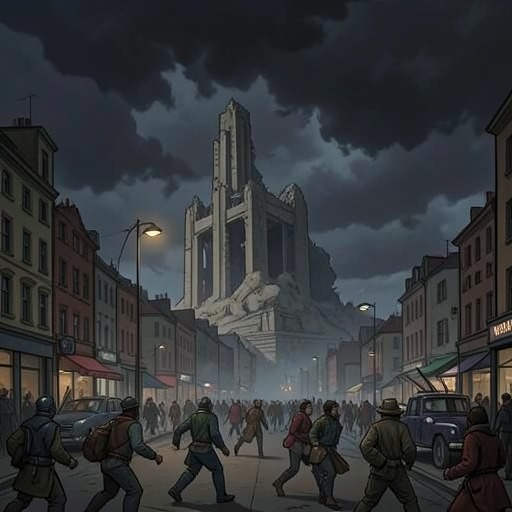
The Jenghik Palace gives Earth’s distant authority a concrete location. In the testimony of a robot whose identity remains uncertain, the palace is not merely a seat of government but a marker of how far Earth’s suzerainty has extended. Its destruction therefore registers as more than the loss of a building: the account presents it as the collapse of a boundary and of the political order that boundary represented.
The witness recalls the Megenth warriors entering the palace grounds, the ceremonial bronze cauldrons being overturned, and the governor dying with a sword in hand. The Terran Guard makes its last stand in Dolorus Keep and is destroyed; the ladies of the court defend themselves with small daggers before being granted quick passage. The robot also sees the fire consume Earth’s silver eagles and the palace topple into dust. These details make the defeat legible through the institutions and emblems that fail: the governor, the guard, the court, and the symbols of Earth all disappear from the scene.
The speaker’s uncertain identity complicates the testimony without erasing its force. The robot says that its true identity is a mystery and describes itself as crafted rather than born, yet declares itself loyal to Earth. Its account makes allegiance a matter of chosen identification rather than origin. From that position, the loss of the palace becomes a feared loss of Earth itself, extending in the speaker’s imagination from political defeat to the annihilation of the planet and even its memory. The episode thus presents Earth’s vulnerability through a voice that belongs to it by loyalty, not by birth.
The Anticipated Alien Threat
Earth’s outward expeditions are motivated by a strategy of first contact: if another civilization exists, Earth would rather find it than wait for it to arrive. The narrative describes this policy against a recurring fear called The standard nightmare. Its variations imagine aliens with mechanical superiority, extraordinary mental powers, or near-indestructible bodies, but the central sequence stays constant: Earth encounters a powerful civilization, and that civilization takes control.
This recurring scenario turns exploration into a defensive calculation. Contact promises knowledge, but it also risks giving a stronger society the opportunity to act upon Earth. The story’s list of possible alien forms broadens the imagined threat, while the unchanging outcome narrows it to a question of power. In this framing, Earth’s expeditions are not simply journeys of discovery; they are attempts to prevent the world from being surprised and subordinated.
Loris and the Reversal of Perspective
Johnny Bezique’s approach to Loris makes the fear of first contact immediate. After the ship’s course and velocity change, the planet appears in his viewplate, and he is about to meet its inhabitants. The narration shifts from the palace’s remembered defeat to an encounter not yet resolved. Earth’s familiar nightmare supplies the expectation, but the question of which civilization will dominate remains open at this point.
The encounter also changes meaning according to where it is viewed from. Earth’s perspective treats a more advanced neighbor as a potential conqueror; for the Lorians, who had previously been defenseless, Bezique is an aggressive alien general. They are soon to have mercenaries operating their spacefleet. The same arrival that threatens Earth’s assumptions offers Loris new military capacity. What looks like danger from one world can therefore look like advantage from another, and the narrative refuses to treat interstellar power as a one-sided abstraction.
Earth’s Position in the Outcome
By the end of the episode, Earth’s standard nightmare has taken place in the sense that an advanced alien civilization is about to impose its culture upon Earth. Loris, however, gains an opportunity: the Lorians acquire a general and the prospect of a force to operate their fleet. The outcome is not presented as a simple reversal in which one world’s disaster becomes another’s triumph without complication. It is a redistribution of power, with consequences that are bad for Earth and potentially beneficial for Loris.
The closing irony rests on the gap between intelligence and control. The Lorians are described as highly intelligent, and their new position allows them to pursue what they want more effectively; Earth, meanwhile, has spent its expeditions anticipating the very danger now approaching. The planet’s significance lies in that reversal. Earth is neither an invulnerable center nor merely a passive victim: it is a civilization whose outward reach and defensive fears meet in the same contact, while the political meaning of that encounter changes with the world observing it.