Egon Gleister becomes Emperor
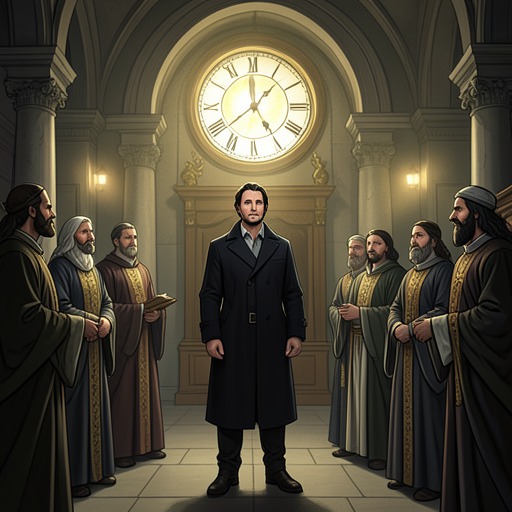
The Robot Who Looked Like MeEgon Gleister becomes Emperor through a sudden transfer of power that turns a confrontation over time travel into a new imperial succession. Egon argues that Mordecai Gleister ceased to be Emperor when he returned to the past; after Mordecai falls dead during an attempt to shoot Egon, Egon takes up the gun and accepts the title. He then renames himself Mingus, making the accession not a clean break with the old order but another turn in the cycle that produced it.
Causes and the time-travel paradox
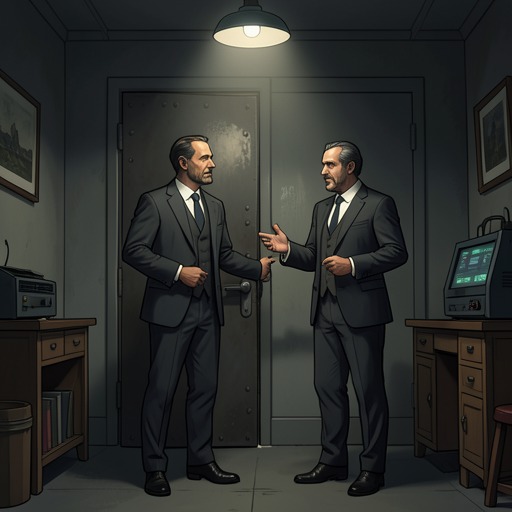
The succession begins as an argument over who can legitimately claim the imperial title. Egon, speaking as Chairman, tells Mordecai that returning to the past has ended his status as Emperor: the ruler who came from the future to seize power is no longer occupying the position he once held. Egon rejects the idea that there must be a single, original or “real” Emperor. Instead, he describes a sequence in which a Gleister travels to the future, takes power, faces an opposing organization, and returns to the past in an effort to take it over. In Egon’s account, that returning ruler is killed in the attempt.
Egon’s explanation rests on the rule that time travel necessarily produces duplication and that “nothing happens for the first time.” The first Emperor, he says, cannot remain the only Emperor: a second one must exist for the Emperor-line of probability to occur at all. The argument recasts succession as a structural requirement of the timeline rather than simply a prize that the strongest claimant can seize. The imperial line depends on repetition; the person presently holding the title is only one part of a sequence that demands another.
When Mordecai asks whether the first Emperor must die, Egon leaves room for another outcome, suggesting that he might instead retire. But the discussion quickly moves from abstract possibility to a practical demand. Egon asks Mordecai to hand over the gun and offers to let him go in peace, presenting the transfer as compatible with the future in which Egon becomes Emperor. His reasoning thus carries an immediate political consequence: if the timeline requires a second Emperor, Egon can claim the weapon and the office as the next legitimate link in the line.
The gun and the transfer of power
Mordecai questions whether Egon intends to crown himself. Egon answers that he is a Gleister and therefore a legitimate heir to the royal line. The scene gives that claim no separate ceremony or public ratification. Instead, its immediate test is the gun: Egon asks for it, and Mordecai says he will give it to him, adding that a future Emperor should not mind which end he gets first.
Hieronymous Gleister urges Mordecai to comply. He agrees with Egon’s interpretation, saying that time travel necessitates the overdetermination of events and that there must be a second Emperor. His intervention briefly makes the succession appear to follow from a shared understanding of the timeline: even a third participant accepts that the imperial role cannot end with Mordecai. But the physical action abruptly breaks the apparent agreement. Mordecai aims the gun at Egon and pulls the trigger. Mordecai’s face registers shock; he goes rigid and falls, while the gun drops from his hand and clatters across the floor to Hieronymous’s feet. The narrative does not explain the mechanism of the reversal, so the event’s decisive fact is the outcome rather than a stated account of how it occurred: Mordecai is dead, and Egon survives.
Hieronymous picks up the weapon, bends over Mordecai, and confirms that he is dead. Egon then observes that they seem to have a new Emperor. Hieronymous agrees and passes the gun to him butt-first. The gesture completes a transfer already prepared in words: the weapon that was supposed to secure Mordecai’s attack becomes the instrument of Egon’s authority. The scene’s value shifts from a threatened succession to an accomplished one in a few movements—Mordecai falls, Hieronymous verifies the death, and Egon receives the gun.
A second Emperor, under a new name
The accession is marked not by a crown but by the exchange of the gun and by the naming that follows. Egon asks Hieronymous whether he has imperial ambitions. Hieronymous admits that he has ambitions, though not imperial ones, and mentions a premonition. At this point Egon interrupts the continuity of his own name: “I’m not Egon anymore,” he says, and announces that, “For the sake of symmetry,” he is renaming himself Mingus. The new title therefore brings a change of name as well as a change of political position.
That renaming binds the new ruler to the previous imperial pattern even as it distinguishes him from the man who has just died. Egon’s earlier argument insists that there cannot be only one Emperor in a time-travel sequence; his assumption of the title gives that theory a visible consequence. By taking the name Mingus, he also makes the succession echo the identity associated with the imperial rule that the preceding discussion has just unsettled. “Symmetry” is his stated reason, and it makes the act sound less like personal self-invention than an effort to complete a recurring arrangement.
Hieronymous’s premonition, that he thought he heard the words “The Emperor is the slave of time,” places a warning beside the new name. The line does not undo Egon’s accession, but it sharpens its terms: the new Emperor has claimed power through an argument that time dictates repetition, and the final remark suggests that the ruler is subject to that same force. The scene ends not with an account of what Egon will do as Emperor, but with his new identity set against the possibility that the imperial role itself is governed by time.
Narrative significance
Egon’s accession is both a political reversal and a demonstration of the story’s time-travel logic. The contest is resolved not by a stable distinction between the rightful original and the later successor, but by Egon’s claim that there is no single “real” Emperor and that duplication requires the line to continue. Mordecai’s death turns that proposition into action; Egon’s receipt of the gun makes the transfer concrete; and his renaming as Mingus gives the new rule a deliberate resemblance to what came before.
The episode also leaves an important tension intact. Egon speaks as if the sequence makes a second Emperor necessary, yet the final premonition frames the Emperor not as master of the sequence but as its captive. His rise therefore carries no promise of freedom from repetition. The title passes to him, but the rule that legitimizes his claim is also the force that appears to constrain him.