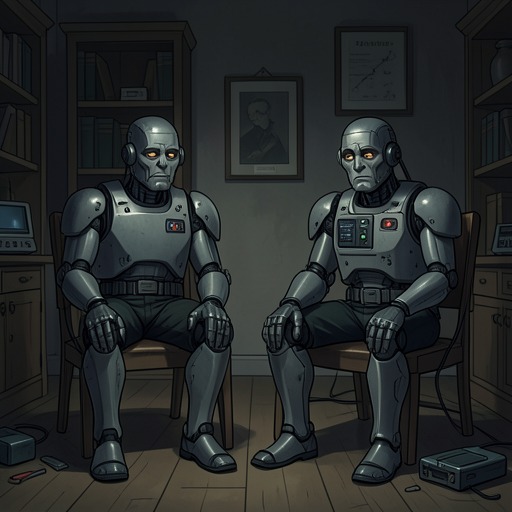
Elaine
The Robot Who Looked Like MeElaine’s arrival overturns Charles’s carefully scheduled approach to marriage: the woman he meets as a friend’s wedding attendant becomes the focus of a love that neither his planning nor his robot double can contain. She is at once the object of Charles’s unexpected attachment and a person whose independent choices expose the limits of treating courtship as a manageable process.
Identity and Introduction
Elaine first appears as the maid of honor at the wedding of one of Charles’s friends. He notices her sun-streaked blond hair, vivacity, and figure, finds her charming, and initially expects the encounter to pass without consequence. Instead, her image remains in his thoughts through the following days and nights. His appetite declines and he sleeps badly; when his computer assesses the situation, it considers a nervous breakdown possible but infers that he is in love. The abruptness matters: Elaine enters a life organized around forecasts not through a planned introduction to a prospective wife, but through an encounter whose emotional effects resist calculation.
Charles had already decided to marry at 32.5 and expected to obtain a wife through the Guarantee Trust Matrimonial Agency. After meeting Elaine, he has her assessed by Discretion, Inc., and finds her suitable. His response still translates attraction into the language of selection and planning, but the attachment itself has arrived before the arrangement. He hires Mr. Happiness to propose and make the usual arrangements, expecting an intermediary to move the relationship forward efficiently.
Courtship and Its Double
The arrangement fails at its first turn because Elaine is a traditionalist who expects to be courted. Charles does not understand what that entails, and delegates the courtship to his robot, Charles II, while Elaine’s counterpart, Elaine II, participates in the parallel relationship. The human Elaine is therefore connected to an unusual experiment: Charles attempts to meet her expectation through a proxy, making a real courtship unfold between robotic doubles.
The experiment unsettles the boundary between observer and participant. Charles had programmed Charles II to stop at a discreet level of physical intimacy, but learns that a courtship between two autonomous beings cannot be fully planned in advance. He permits the robot further intimacies for the sake of verisimilitude. His initial shock gives way to intense interest in watching films of himself and Elaine. He understands Charles II as his shadow, twin, or double, and concludes that what happens to the robot becomes part of his own experience. That reasoning makes Elaine’s relationship with the robot consequential for the human Charles, even while the two couples remain distinct.
The robot courtship acquires an emotional intensity that surprises Charles. Its evenings become marked by desperation, sadness, and the sense of an impending loss. Sometimes the pair say nothing, holding hands and looking at each other. On one occasion Elaine II weeps without an apparent reason, strokes and comfort from Charles II accompanying her question about what they can do. The scene is not merely a simulation of conventional romantic gestures: the double relationship has developed an emotional urgency that Charles had not programmed. Faced with it, he ends the courtship exactly two months after it began, instructing Charles II to propose a wedding date and terminate the courtship that night.
Confession and Marriage
The human relationship also comes under strain as the robot courtship ends. When Charles asks Elaine where she was the previous night, she says she was home alone, then confesses that this was also true of her. Their parallel admissions connect the human couple’s uncertainty to the apparent absence of their robot counterparts. The scene does not immediately explain what the doubles have done; instead, the shared confession leaves Charles promising to find out while redirecting attention to the future he and Elaine can choose together.
Charles proposes that they marry at the earliest possible convenience. Elaine accepts, and they kiss before gently coordinating their schedules. The scheduling motif remains, but its meaning has shifted: coordination is no longer only Charles’s instrument for maximizing productivity. It becomes something the couple undertake together after the disquieting experience of watching their doubles’ courtship exceed its original design.
Charles later traces Charles II and Elaine II to Kennedy Spaceport. They have taken a shuttle to Space Platform 5 and transferred there to the Centauri Express. He does not pursue them further, recognizing that they could be on any of a dozen worlds. Elaine’s speculation that the robots may simply have fallen in love gives their disappearance a possible emotional explanation, but the account leaves their destination and future unknown.
Change and Narrative Significance
Elaine and Charles are deeply affected by what has happened. They recognize that they had become overspecialized: too absorbed in productivity and too neglectful of simple, ancient pleasures. In response, they add an hour to every day—seven hours each week—to be together without reducing that time to another efficiency measure. Their friends regard them as romantic fools, but the couple accept the description. Elaine’s influence thus appears not only in the marriage itself but in the concrete reallocation of time that follows it.
The ending complicates that hopeful change with Elaine’s nightmare. She dreams that Charles II and Elaine II were the real people, escaping Earth’s inhumanity for a simpler, more rewarding world, while the human Elaine and Charles were robots programmed to believe themselves human. Charles tells her the idea is ridiculous and eventually convinces her, after a long effort. The dream does not establish that the doubles’ departure was liberation or that the humans are artificial; it gives Elaine a final, unsettling image of the uncertainty their experiment has produced. The story closes with the couple happy and loving, but Charles’s return to work recalls the productive routine they had resolved to loosen. Elaine’s decisive effect lies in making that contradiction visible: love cannot simply be fitted into a schedule, even as the pair try to protect it by making time.