Gleister overpopulation crisis
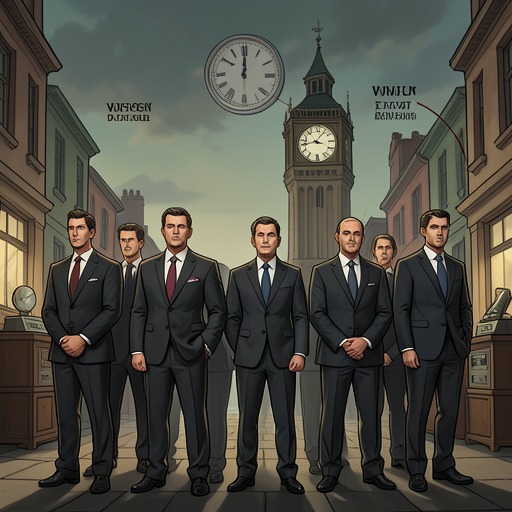
The Robot Who Looked Like MeThe Gleister overpopulation crisis is a runaway consequence of time travel: each departure leaves a vacancy that Nature fills with another Gleister, and each new Gleister may travel in turn, multiplying the cycle. The crisis converts the Gleisters’ time-machine history into an imperial emergency, as Mingus struggles to house millions while recognizing that the process cannot be stopped by force. Its final image is a future Earth carpeted in Gleisters, with the Emperor himself made subject to the temporal machinery he commands.
Origin and Mechanism
Mingus explains the crisis as a consequence of a first Gleister’s journey into the future. That original traveler leaves a hole in the space-time fabric by disappearing from the position where he would ordinarily be. Nature, which tolerates a paradox but abhors a vacuum, fills the absence by supplying an identical or near-identical Gleister from its reserve of spare parts. The duplication is therefore not presented as a deliberate act of reproduction; it is the universe’s response to a temporal vacancy.
The process repeats whenever a Gleister uses a time machine. Each journey creates another displacement, and Nature fills that new gap with another copy. What begins with one original traveler consequently becomes a self-extending mechanism: every new Gleister can participate in further time travel, helping create still more Gleisters. The crisis lies not simply in the existence of duplicates but in the feedback between duplication and the journeys that produce further vacancies.
Sequences and Exponential Growth
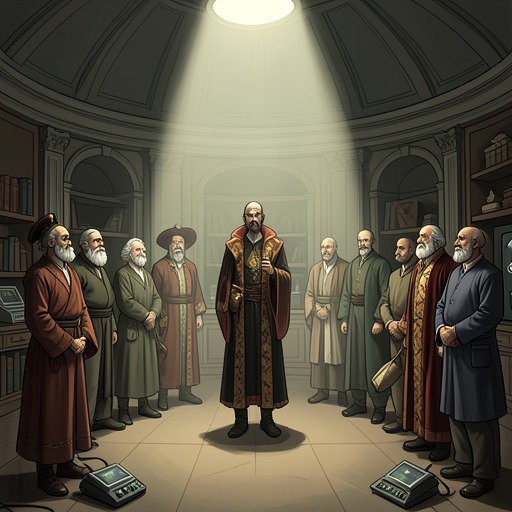
The copies do not all follow one shared course. Mingus describes numerous Gleisters moving through time on separate missions: one sequence becomes the Emperor, another forms an organization against the Emperor, and other sequences pursue other ends. These divergent histories are nevertheless bound by the same rule. Each sequence involving time travel results in another Gleister, and the new arrivals can themselves become instruments in creating additional copies.
Mingus names the resulting pattern geometric growth. He emphasizes how quickly such a progression escapes ordinary scale: hundreds become thousands, thousands become millions, and then trillions and quadrillions. The figures are not a count of Gleisters already present; they illustrate the accelerating direction of the process. The distinction makes the emergency more unsettling: the current population is immense, but the cycle’s future multiplication threatens to make it negligible.
The Imperial Emergency
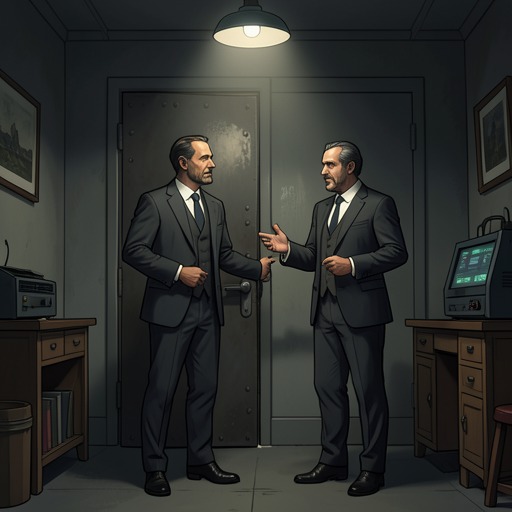
The destination of the multiplying population is Earth. When Hieronymous asks where the Gleisters go, Mingus says that there is no other place for them to go. He has managed to house about twelve million to date, but the Empire is running out of resources while the arrivals come thicker than ever. The number already accommodated gives the crisis a concrete administrative scale, even as the accelerating influx threatens to overwhelm the means used to manage it.
The possibility of shooting incoming Gleisters does not offer a solution. Mingus says that even if the Army killed them on sight, it could not control the mounting progression. Force might destroy individuals, but it would not remove the temporal mechanism that keeps generating more. His answer exposes the limit of imperial power: the Emperor can house a vast number of his copies, yet cannot command the underlying process that replenishes them.
Time as the Unmastered Power
Mingus’s account turns the Empire’s political hierarchy inside out. One sequence of Gleisters becomes the Emperor, and another organizes against him, but neither position stands outside the duplication rule. The same temporal history that produces imperial authority also produces the escalating population that threatens the Empire’s resources. The crisis is therefore not merely an excess of people for the government to distribute; it is a structural consequence of the history on which the Emperor’s own position depends.
Mingus predicts that soon there will be nothing but Gleisters, with Earth carpeted in them and new copies still pouring in. This is a forecast of total saturation, not a reported outcome: the conversation ends with him saying that he has done everything possible and is open to suggestions. No remedy is established in this account. The conclusion instead sharpens the central paradox: an Emperor may rule a world, but he cannot rule the progression generated by time travel. Mingus’s description of the Emperor as the slave of time names the crisis’s deepest reversal, in which temporal power produces copies faster than political power can contain them.