Gordon Simms
The Robot Who Looked Like MeGordon Simms is Washburn’s agent-manager, friend, and devoted backstage partner in the Never-Ending Western Movie. Wealthy from managing the gunfighter’s career, he has also come to live vicariously through Washburn’s Western persona: the star rides into danger, while Simms experiences that danger and triumph as if they belonged to them both. Their closeness is the story’s private counterpoint to the public legend, and Washburn’s retirement forces both men to confront how difficult it has become to tell the role, the friendship, and their shared ambitions apart.
Identity and Career
Simms travels with Washburn and Consuela in an air-conditioned Cadillac as they leave State Highway 101 for the dirt road leading to the Wells Fargo Station, one of the entrances to the Set. His title is agent-manager, but the relationship is older and more intimate than a business arrangement: he is Washburn’s friend, and their years together have made the gunfighter’s career a joint imaginative enterprise. While Consuela is quiet on the journey, Simms talks rapidly about a new seabed-mining investment and urges Washburn to join him.
The investment pitch reflects Simms’s financial success and his continuing habit of looking for another venture. He is already wealthy, in part because he receives thirty percent of Washburn’s earnings during the star’s ten biggest years. That commission makes the imbalance in their partnership plain: Washburn supplies the on-screen danger and fame, while Simms profits as his representative. Yet the story does not reduce Simms to a calculating manager. His wealth and business talk sit alongside a genuine emotional investment in Washburn’s career and a longing for the ending they never managed to give it.
Living Through the Gunfighter
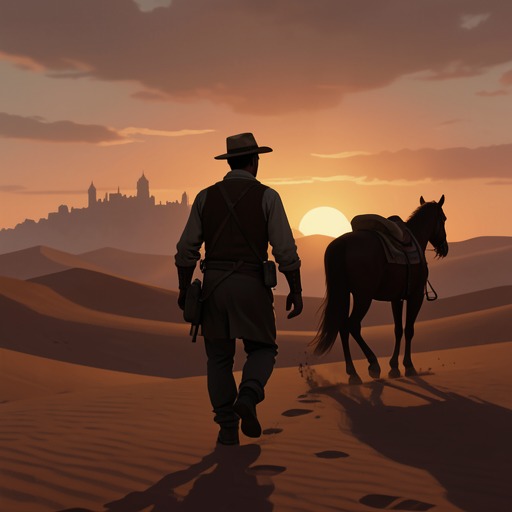
Simms’s connection to Washburn’s screen identity is expressed physically as well as emotionally. On the drive to the Set, he rubs the back of Washburn’s neck as if preparing a fighter to enter the ring. Before Washburn crosses into the Western world, Simms gives his client one last rub on the back, bouncing on his toes with excitement and envy. He wishes he could be the tall, mild-mannered gunman riding into the desert, but his own short, heavy, nearly bald appearance would not suit the heroic part.
Instead, Simms inhabits the role at a remove. Washburn understands himself as Simms’s manhood: the two have ridden the danger trail together in the shared language of the Western, and the gunfighter’s victories have become a substitute life for the man who cannot play him. Simms has even acquired a manly Western manner through years of associating with Washburn and, in a sense, being him. Their identification is so complete that Washburn finds it difficult to know where he ends and Simms begins, or which of them owns the wish for one last blaze of glory. The friendship is not simply admiration from the sidelines; it has blurred the boundary between the performer and the companion who lives through the performance.
The Ending They Wanted
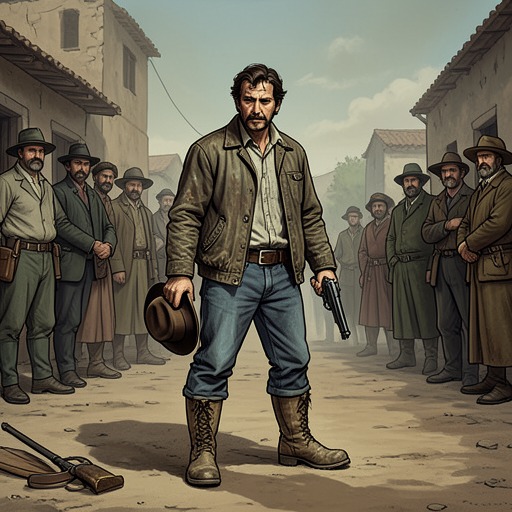
Simms had hoped for a definitive finale: a final walkdown on a dusty Main Street, with Washburn leaving the Movie in a blaze of gunfire at the height of his form. Washburn wanted that ending too. Instead, the opposition grew cautious, and he spent a final, absurd year riding around ready to draw without finding anyone willing to fight. By the time the star retires, there is no grand final duel to make their shared legend feel complete.
The new appearance is a cameo rather than the heroic conclusion Simms imagined. Washburn has a no-kill contract to perform a comic bit with Old Jeff Mangles and Natchez Parker, and the scene has no script. For Simms, this assignment mocks what their years in the Western have stood for; Washburn recognizes that it feels that way to him as well. The conflict is therefore not over whether Simms cares about the career, but over the form its ending should take. Simms still wants the old story’s decisive, violent closure, while the actual opportunity offers only a limited return and an improvised part.
Farewell at the Threshold
At the Wells Fargo Office, Simms grips Washburn’s hand and shoulder but says nothing, drawing on the restrained, manly style he has learned from years beside the gunfighter. Consuela hugs Washburn, kisses him, and asks him to come back soon; Simms’s silence makes a different kind of farewell. Washburn gives the two of them his familiar two-finger salute, crosses the creaking office, and steps from twentieth-century Western scenery into the blazing sunshine of the Set. Simms remains on the other side of that threshold, attached to the life Washburn is re-entering but unable to ride into it himself.
The farewell carries the weight of more than a workday’s separation. Washburn’s return to the Movie is also a departure from the partnership’s defining routine: Simms can continue to advise and invest, but the danger, costume, and public image belong to the actor who crosses into the landscape. The precise boundary between their desires remains unresolved. Washburn’s account makes that uncertainty part of the loss, rather than treating Simms as merely an observer of it.
Performance and Private Identity
The story’s nested view of performance deepens Simms’s significance. Washburn experiences himself both as the actor and as an audience watching the actor; the heroic images that he sees are also the images presented to viewers at home. Simms occupies another position in that circuit. He does not ride into the scene, but his gestures, aspirations, and sense of manhood have become bound to the star’s role. His life around the performance is neither wholly outside it nor identical with what the cameras show.
The separation between public action and private feeling appears elsewhere in the production’s off-camera spaces, including an outhouse used for practical conversations beyond the Western setting. Simms’s most important presence, however, is at the threshold before Washburn’s entrance: a manager’s touch becomes the gesture of a friend and a vicarious participant. When the story ultimately shows the audience turning off the screen after Washburn’s death, the performance ends in darkness; the account offers no further scene of Simms. That silence leaves the partnership’s defining contradiction intact. Simms helped make the gunfighter’s career a shared life, but he could not control its ending or follow Washburn into the last scene.