Harvest Falls
The Robot Who Looked Like MeHarvest Falls, Indiana, is the small-town setting where Charlie Gleister begins building a time machine and where one strand of his story returns to its starting point. Its Apple Street laboratory and the roads, fields, woods, and brook beyond town give the time-travel plot a concrete home: a place that remains recognizable even as the identity and history of the person moving through it become unstable.
Setting and Early Associations
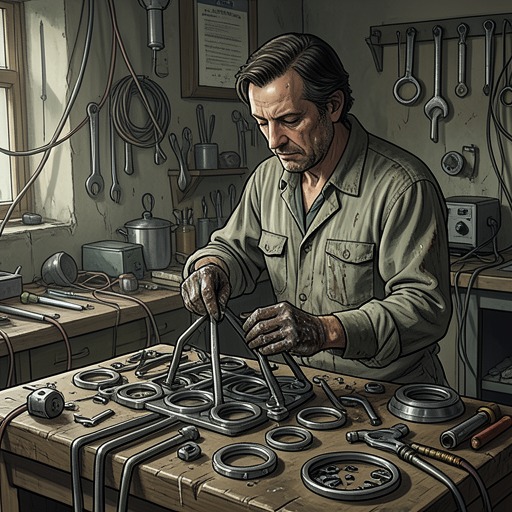
Harvest Falls is described as an unincorporated township. On a beautiful September afternoon, Charlie works in a basement laboratory on Apple Street, assembling and dismantling tiny components at his workbench. The house and its basement place his private experiment inside an ordinary local landscape rather than a distant institution or public laboratory.
The town also supplies the everyday relationships surrounding the invention. Charlie’s fiancée, Myra, is out driving with Carter Littlejohn, while her father is Harvest Falls’s leading banker and regards Charlie as eccentric. These details establish a small social world around the laboratory, even as the narration insists that Charlie will come to occupy an outsized place in the story. The contrast between the familiar town and the scale of the consequences to come makes Harvest Falls the point from which the narrative’s ordinary geography opens into a much stranger history.
The Laboratory and the Time-Travel Paradox
At the outset, Charlie’s machine is a small white plastic box covered in dials, switches, levers, and buttons. It flashes purple and green, makes odd noises, and tingles Charlie’s skin, but it does not yet travel through time. The distinction matters to Harvest Falls’s role: the town is where the machine first exists as an ineffectual object, before future knowledge makes it work in the present.
The sequence makes the invention’s paradox explicit. Charlie will get the machine working, travel into the future, and return to meet himself just before the invention. The other Gleister tells him that reality is positional and that nothing happens for the first time. Harvest Falls is therefore not simply a birthplace for an invention; it is the fixed local setting in which the supposed beginning is already entangled with later versions of the inventor.
Return to Apple Street and the Outskirts
In a later termination, Charlie again walks through Harvest Falls on a beautiful September afternoon. He passes Apple Street and looks wistfully at the white frame house that once held his laboratory. He considers going inside to speak with himself, then decides not to: he has had enough of Gleisters. The house persists as a recognizable marker of the past, but the returning Charlie no longer treats it as a place where he can safely resume his old life.
Instead, he continues out of town along Route 347. He does not try to hitch a ride, because he has only a short distance to go. Turning off the road, he crosses a stubbled field, passes through woods, and reaches a small brook where he used to fish for sunfish as a boy. The big oak tree is still there. He sits with his back against it, takes out a gun, and looks at it before rubbing his nose and watching sunlight on the water. The route from the former laboratory to this remembered landscape leads the narrative away from invention and toward the termination of this sequence.
Narrative Significance
Harvest Falls connects two sharply different moments in Charlie’s trajectory: the afternoon when he is still tinkering in his basement, and the later walk when he refuses to re-enter that house. Apple Street, Route 347, the brook, and the oak tree make the return legible as a return to the same locality, while the recurrence of September afternoon light echoes the opening scene without restoring the earlier Charlie or his earlier circumstances.
That tension resonates with the story’s account of time displacement. Each use of a time machine leaves a vacancy that Nature fills with another identical or near-identical Gleister; contact then changes the person who has arrived. The text also denies the possibility of returning to an untouched past: everything modifies everything, and no empty niche waits for a traveler to occupy it. Against that logic, Harvest Falls offers continuity of place but not a simple way back. Its familiar streets and outskirts remain, while the people who pass through them multiply, diverge, and change.