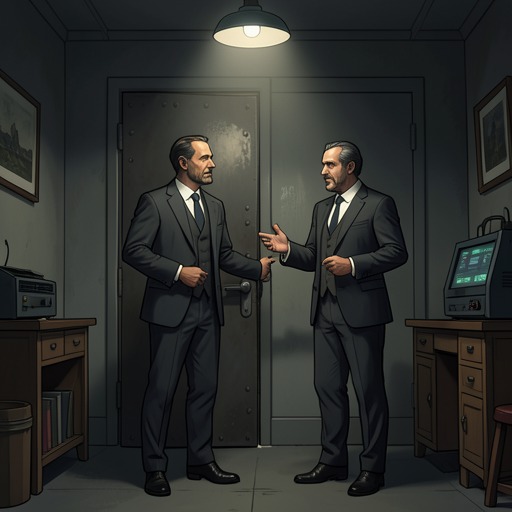
Hieronymous Gleister and Emperor Mingus
The Robot Who Looked Like MeHieronymous Gleister and Emperor Mingus are linked by a cycle of recognition and opposition that becomes, at its most intimate, a dispute over who must bear the cost of repairing time. Hieronymous identifies Mingus beneath a borrowed identity, rejects his attempt to impose imperial rule on another age, and later meets him again amid the catastrophic growth of the Gleister population. Their relationship is neither simple enmity nor lasting alliance: it moves from exposure and political challenge to an offer of cooperation, and finally to a contest over responsibility and sacrifice.
Recognition and Exposure
At a public gathering, a bearded man in his fifties introduces himself as Mordecai Gleister and asks to address the audience about urgent matters. He begins by questioning whether the Emperor and his aims have been judged impartially. Hieronymous recognizes him, though at first he cannot place where they have met. The recognition comes suddenly: Hieronymous stands, runs toward the stage, and alerts the others that Mordecai is Emperor Mingus.
The revelation is immediately dangerous. Egon Gleister hesitates, then moves with Hieronymous toward the stage as other Gleisters climb up after them. The crowd’s movement stops when Mingus draws a blue-steel automatic from his pocket and aims it at Egon. In this encounter, Hieronymous is the person who sees through Mingus’s adopted identity and acts on what he knows; Mingus, in turn, answers exposure with armed threat. The personal relation is therefore established in public, before an audience, as a collision between recognition and political force.
A Dispute Over Rule
Mingus later presents his case as an effort to change a regressed and savage Earth into the kind of society he believes they have all hoped for. Egon finds merit in the explanation, but Hieronymous challenges him to remember what he had seen in Mingus’s future: suspicion, misery, and police. Hieronymous’s objection is not confined to Mingus’s character or motives. He argues that even rulers with admirable intentions have chiefly served themselves, and that centralized power remains vulnerable to the ambitions of people like Mingus.
The exchange sharpens when Hieronymous identifies the political problem as one of time and position. Mingus has come from a happy and enlightened twentieth century, but he is imposing its obsolete political solutions on people living in another age. Hieronymous calls this conduct colonization. The charge unsettles Mingus. He admits that he must think about it and reflects on the strangeness that people who are all one person can represent widely differing viewpoints. Egon answers that a person contains many people even under ordinary circumstances. Their conversation thus makes the conflict more complicated than a struggle between a villain and an opponent: the versions of the same identity can disagree sharply about power, political order, and what counts as civilization.
Hieronymous is willing to consider anarchy as preferable to rule by an Emperor, while recognizing its vulnerability to someone like Mingus. His opposition is consequently wary rather than triumphalist. When he suggests a vote on what the Gleisters should do, he makes the legitimacy of their decision—and whether they can be called civilized enough to decide—part of the argument. Mingus’s response shows that Hieronymous’s criticism has reached him, but does not establish that he has abandoned his project.
The Offer and the Refusal
At a later turning point, Mingus asks Hieronymous to remain with him and help build a true civilization, promising that they can do it Hieronymous’s way. The offer converts their disagreement into a direct possibility of partnership: Mingus is prepared, at least in that moment, to give Hieronymous influence over the undertaking he had condemned. Hieronymous refuses and pushes a button.
That short exchange preserves the distance between them even when Mingus offers compromise. Hieronymous’s refusal is an action, not a further debate: he does not accept the chance to reform the Empire from within. Yet the later reunion prevents the relationship from ending with that rejection. The two meet again, and their shared history becomes the ground for confronting a crisis neither can solve by political persuasion alone.
The Empire’s Temporal Crisis
After being led through gray corridors and an elevator to a small white audience room, Hieronymous meets Egon-Mingus, who greets him as someone he is glad to see again. Hieronymous asks after the Empire. Mingus, now old, tall, gray-bearded, and visibly ravaged, says that it is not merely unsuccessful but disastrous. The contrast between the invitation to build civilization and the later condition of the Empire gives their earlier argument a material aftermath: whatever Mingus sought to achieve, his rule has not produced the success he hoped for.
Mingus explains that every Gleister who uses a time machine creates a displacement, a hole in the space-time fabric that Nature fills with another identical or near-identical Gleister. Hieronymous knows the initial account, but Mingus insists that its consequence must be followed through: each further use generates another arrival. He has already managed to house about twelve million Gleisters, yet the Empire is running out of resources as new ones come more thickly than before. Even killing them on sight would not control the progression. Mingus imagines an Earth carpeted in Gleisters, with more still pouring in, and concludes that the Emperor is the slave of time.
This explanation changes the terms of their opposition. The Emperor who once sought to reshape another age now faces a crisis produced by the mechanics of time travel and amplified by the very multiplication of Gleisters. Mingus remains the ruler responsible for the Empire, but his authority cannot halt the process. Their reunion is therefore less a restoration of trust than a renewed encounter in which Hieronymous can respond to a failure Mingus acknowledges openly.
Responsibility and Sacrifice
Mingus proposes that an early death outside the ordinary continuity of an individual time track might introduce a short-term recycling factor. He recognizes suicide as a possible final imperial act and claims the responsibility for carrying it out. Hieronymous counters that the act must be his, not Mingus’s, because a young Gleister must die as early in his time track as possible. The dispute repeats their earlier pattern in altered form: Mingus asserts the burden of office, while Hieronymous refuses to let imperial status settle who should act.
The relationship’s decisive tension is thus between power and responsibility. Hieronymous first rejects Mingus’s authority to impose a political future on other people; later, when Mingus invokes his imperial duty to address the temporal catastrophe, Hieronymous again contests his claim to decide alone. The story leaves the two connected by the consequences of time travel and by opposing judgments about who should bear them. Their history does not erase their disagreement; it makes that disagreement the means through which they confront the crisis.