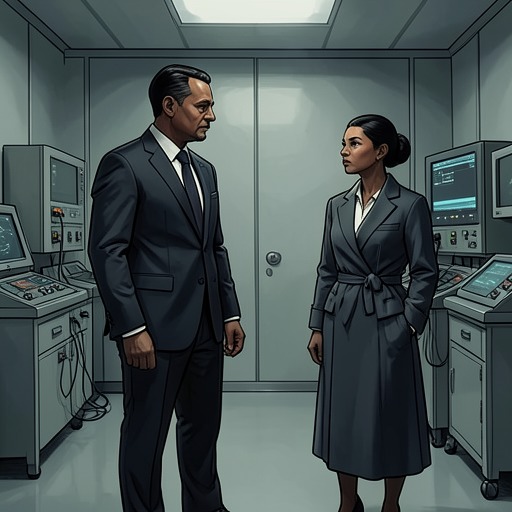
Honorious and Dinah Grebs’s simulated marriage
The Robot Who Looked Like MeThe simulated-marriage episode turns a state-organized system of pairing into a test of what prediction can and cannot know. Peter Honorious approaches the Political Factors Synthesizer and Simulator hoping to choose a future wife by previewing the life each candidate might bring. The machine supplies vivid five-year forecasts, but the decisive relationship emerges not from its calculations: the woman he selects is Dinah Grebs, the assistant who has quietly made herself one of the candidates.
Background and the predictive apparatus
Honorious first learns of the machine from Euler, who proposes applying a system built to predict interactions among groups and subgroups to the relationship between two individuals. Honorious knows it as a powerful computer hidden beneath a mountain in North Dakota, used to forecast the actions of one country toward another. He doubts that such a device could tell him anything useful about a future wife, but the prospect of testing it appeals to him. The fee is quickly settled, and Euler arranges ten minutes of computer time two days later because Honorious’s case is urgent.
Honorious arrives carrying fifteen candidate cards. A commercial matchmaking agency has selected the women from the National Availability Pool of American Single Women using their answers to 1,006 questions. The candidates remain anonymous until an official pair-bonding decision; each has chosen instant-available status, so Honorious need only indicate that he is willing to marry one of them. His own profile presents him as an attractive prospect: tall, curly-haired, good-looking, even-tempered, kind to children and small animals, and a high-earning young president of Glip Electronics with strong prospects. The system therefore promises to reduce a consequential choice to comparison between carefully prepared profiles and simulated outcomes.
The compressed trials
The computer is not encountered in a public research facility. Honorious is taken to a used-car lot on DeKalb Avenue, where the terminal is concealed inside a furniture van. Two technicians disguised as derelicts lead him into a darkened inner room, seat him at the command chair, and fasten psychometallic electrodes to his forehead and wrists. The procedure turns an abstract forecast into a private, immersive experience: five years of projected events are compressed into ten minutes of real time, and he can examine only one candidate at each appointment.
At first Honorious treats the cards as interchangeable and lets Dinah choose the one on top. The visions that follow give him sharply different possible domestic lives. One candidate begins as a shy, charming woman whose silences later exasperate him; another discovers a talent for roller derby. A further prospect is described as suicidal, though Honorious cannot remember whether she was candidate five or six. These scraps, alongside the larger sequence of forecasts, leave him increasingly alarmed rather than reassured. By September 29, after viewing fourteen possible marriages, he is gloomy and nearly resigned to choosing candidate eleven, whose profile at least seems less disastrous than the others.
Candidate 6903 and the projected future
For the final appointment, the terminal has been moved from the DeKalb Avenue van to a washroom down the hall from Euler’s office, ostensibly for security reasons. Honorious sees himself with candidate 6903, a pleasant-looking brown-haired woman who seems familiar. Their projected life unfolds through distinct places and moments: walking on a beach at Martha’s Vineyard, crossing the George Washington Bridge, sharing goat’s cheese and wine on a limestone outcrop beside the Aegean, and traversing a rocky plain beneath snow-capped mountains that he cannot confidently identify as Tibet or Pern. The sequence then shifts to Miami, where they run together in the rain, and finally to a low white house. There they appear deeply in love, and Honorious walks back and forth with their colicky baby. The forecast ends after that five-year span.
The vision changes his attitude at once. After weeks of discouraging projections, Honorious goes directly to Euler and says he believes he has fallen in love with 6903. He wants to make the pair-bond agreement immediately and asks for her name. Euler retrieves it through the Public Records Machine: candidate 6903 is Dinah Grebs, who lives in Flushing, Queens. Both men recognize that the name sounds familiar, but neither initially connects it to the assistant who has been guiding Honorious through the appointments.
Disclosure and the limits of prediction
Euler eventually recognizes the coincidence: Dinah herself is candidate 6903. He asks her how her card entered the selected list. Dinah refuses to explain in front of him and waits until Euler has left before telling Honorious what happened. She says she became attracted to him when he first came to the service, while the high-class matrimonial agency would not even process her card and Honorious had not noticed her. She arranged matters so that she could become one of his candidates, and insists that she has nothing to be ashamed of. Her admission reframes the apparent success of the matching process: the candidate who seems to have been discovered by a forecast has also acted to make the encounter possible.
Honorious responds by disputing any legal claim Dinah might have over him and offering financial compensation for her time and trouble. Dinah is offended by the offer. He then accuses her of trying to trap him and asks whether she tampered with the cards; she confirms that she did, and mockingly recommends candidate three, the woman who does not talk. The exchange makes clear that the computer’s sequence of candidates was not an untouched field of possibilities. Dinah had intervened in the process, while Honorious’s confidence in the system rested on the assumption that its inputs were independent of the people using it.
Their argument briefly becomes physical when Dinah swings at him and Honorious catches her wrist. They find themselves in contact, breathing hard, and looking at one another. The narration identifies the moment as love’s preview: unlike the machine’s orderly forecasts, this recognition is not generated by a calculation. In the society’s account of pair-bonding, love is an unofficial force that can supersede prior obligations and set the machinery of state-sanctioned mating in motion. The episode thus places spontaneous attraction inside a system designed to regulate and predict intimacy, without pretending the two are the same thing.
Later, Honorious asks whether the future he saw was real or whether Dinah altered the data herself. She leaves the question unanswered, telling him he will have to wait and find out. The event closes without confirming that the simulated five-year life will occur or that a formal agreement has been completed. Its resolution is instead a mutual moment of recognition—and a return of uncertainty precisely where the forecast had seemed to offer certainty.