Honorious uses the Political Factors Simulator to preview marriages
The Robot Who Looked Like MeThe episode follows Peter Honorious as he turns to the Political Factors Synthesizer and Simulator to choose a wife under a looming legal deadline. Its central reversal is that a machine built to forecast human relationships leads him to the woman who had already chosen him, while the forecast cannot settle whether their future is real. The story sets bureaucratic pairing and computerized prediction against an attraction that neither system can account for.
The deadline and the forbidden service
One bright September morning, Honorious receives a peremptory directive from his local Consanguinity Board: he must be married by October 1 or face contempt charges under the State and Federal Pair-Bonding Regulations, with penalties that could include one to five years at Lunaville. The order arrives despite his having filed an Extension of Current Status form in August. He had expected the routine extension to give him six more months to choose a wife; instead, he has barely two weeks. Leaving for Mexico is the alternative he considers, but not an attractive one in 2038.
Honorious asks whether there are exceptions to the predicament. His acquaintance Ungerfjord admits to having used an illegal way around the uncertainty and directs him to Mr. Euler, head of Clandestine Computer Services. Honorious, who says he tries to live ethically, is willing to bend that principle because the choice is urgent. The practical aim is not to evade marriage altogether, but to learn what life with a prospective wife might be like before making a legally binding selection.
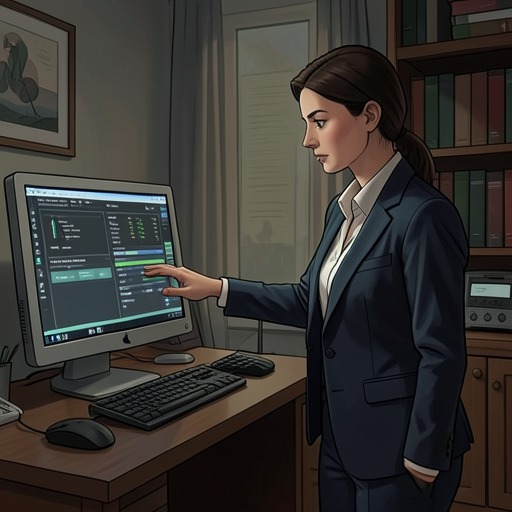
Mr. Euler explains that the service can use the Political Factors Synthesizer and Simulator, a supercomputer normally devoted to forecasting interactions among countries, to simulate interactions between two individuals. Its operators have found a way to turn the information channels on which the guarded system depends into output. Euler does not explain the method; he offers forecasts of Honorious’s probable future with any woman whose data is supplied. Honorious agrees, pays the fee, and receives ten minutes of computer time two days later.
Fifteen candidates, five years at a time
Honorious arrives carrying data cards for fifteen prospective wives. Computerized Marriage Matchup Services has selected the women from the National Availability Pool of American Single Women using answers to 1,006 questions. The candidates are identified by numbers rather than names until an official pair-bonding decision is made, and all have chosen instant-available status. Honorious’s own card presents him as a strong prospect: tall, curly-haired, good-looking, steady-tempered, kind to children and small animals, and earning $35,000 a year as the youngest president in Glip Electronics’ history, with promising prospects.
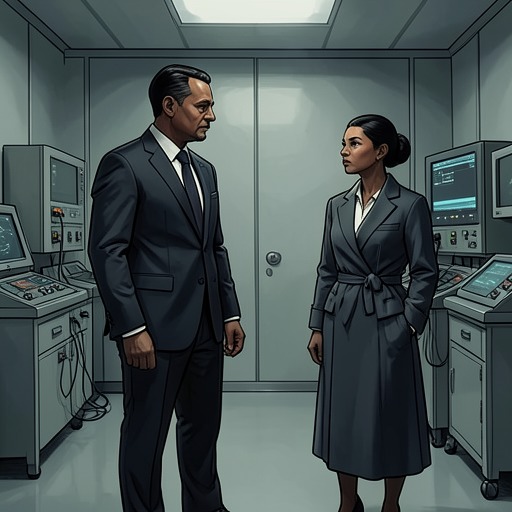
The clandestine terminal is moved for security reasons from its first location, behind a used-car lot on DeKalb Avenue, to a washroom down the hall from Euler’s office. At the original site, technicians disguised as derelicts escort Honorious into a blacked-out room, seat him in a command chair, and attach psychometallic electrodes to his forehead and wrists. For the final appointment, Miss Grebs tells him that he will see five years of events compressed into ten minutes of real time. He has fifteen cards but can examine only one candidate in that session. Since he regards the women as interchangeable at this stage, he asks her to use the top card.
The early forecasts do not bring him closer to a confident decision. One candidate appears as a quiet girl whose silences initially charm him; two years later, in a Tulsa hotel suite, he is frustrated by her inability to speak. Another discovers a talent for roller derby at twenty-seven. A different candidate is described as suicidal, though Honorious cannot even remember whether she was number five or number six. By September 29, after viewing fourteen possible marriages, he is alarmed and despondent. He is almost ready to settle for number eleven, the Giggler with the Two Stupid Brothers, because she seems less disastrous than the others.
Forecasting candidate 6903
The last appointment brings a different result. In the relocated terminal, Honorious sees himself with candidate 6903, a nice-looking, brown-haired woman who reminds him of someone he once knew. The five-year sequence moves through distinct places and episodes: the pair walk on a beach at Martha’s Vineyard, cross the George Washington Bridge happily, share goat’s cheese and wine on a limestone outcrop above the Aegean, and travel across a rocky plain beneath white-capped mountains. The forecast then places them in Miami, laughing as they run in the rain, with the woman wearing his raincoat. Its final image is domestic: they are in a low white house, apparently in love, and Honorious walks back and forth with their colicky baby. The simulated five years end there.
Unlike the previous scenarios, this one gives Honorious a future he wants to choose. He goes straight to Euler’s office and says he thinks he is in love with 6903. He is ready to make the Pair-Bond Agreement immediately, but first asks for the Public Records Machine to identify her. Euler finds that the candidate is Dinah Grebs, whose address is in Flushing, Queens. The name seems familiar to both men. When Dinah answers Euler from the other room, they recognize that the computer operator and the forecast’s candidate are the same person.
The person behind the prediction
Euler asks Dinah how her card entered Honorious’s candidate list. She waits until Euler has left before explaining herself to Honorious. She admits that she had fallen for him the first time he came to the office and believed they were suited to each other without needing a machine to tell her so. The high-class matrimonial service would not process her card, and Honorious had not noticed her. She therefore tampered with the cards to get herself considered. Her action reveals that the apparent discovery of a promising stranger was arranged, in part, by the woman who had already developed feelings for him.
Honorious responds first in legal and financial terms. He says Dinah has no valid legal claim on him, but offers a cash settlement for her time and trouble. She rejects the idea that he can pay her to release him. She also acknowledges having tampered with the cards and recommends candidate number three, the woman who does not talk. Honorious moves closer; Dinah swings at him, and he catches her wrist. The confrontation leaves them in contact, breathing hard, and looking at one another. Their shared look becomes the decisive turn: the story presents love as an unofficial force that prediction cannot master, even as the state depends on pairing to maintain its system.
Honorious later asks whether their forecast was genuine or whether Dinah doctored her own data. She does not resolve the uncertainty, telling him that he will have to wait and find out. The ending therefore withholds the very guarantee he had sought from the machine. The forecast may have shown a possible future, but it cannot certify the truth of the relationship or explain the feeling that arises between them in the present. Its final irony is that Honorious’s search for a calculated choice leads him not to certainty, but to Dinah—and to a future that must still be lived.