Hunger Strikes and Food Riots
The Robot Who Looked Like MeThe Hunger Strikes and Food Riots mark the point at which the postwar food crisis becomes open social conflict—and the limits of that conflict become clear. Ecological damage has stripped away sources of nourishment, while hunger itself rapidly erodes the strength needed to sustain resistance. The unrest gives way to cannibalism; only afterward do governments join forces to seek a technological answer to scarcity.
Background and Causes
The crisis follows the Third World War, which broke out after decades of preparation for a conflict people had come to regard as inevitable. During Cold War Phase II, governments built subterranean cities and other defensive infrastructure against the prospect of overwhelming attack. The war’s end did not restore ordinary life: survivors had developed remedies that saved millions, but those treatments could not be extended to crops, wild animals, or marine life.
The ecological damage was both broad and uneven. Some species survived while others disappeared, and the seas could not be protected simply by treating human beings. The result was a food system without the resilience that human survival required. The Hunger Strikes and Food Riots begin in this setting of hunger and disrupted food supplies, rather than as an isolated political disturbance.
Outbreak and Rapid End
The narrative gives the unrest a starkly compressed arc: the Hunger Strikes and Food Riots begin, then end quickly. The reason is not that the shortage has been resolved. People weakened by hunger cannot keep fighting, so the condition driving the unrest also deprives it of the strength to continue. The episode thus turns on a grim reversal: hunger is at once the cause of collective confrontation and the force that brings it to a halt.
The end of the riots does not mean the crisis has passed. Cannibalism follows, carrying the collapse of food supply into a more desperate phase. The sequence makes clear that the disappearance of open conflict is not evidence of recovery; social resistance has ebbed because people are too depleted, while the underlying need for nourishment remains.
Government Response and the Search for Food
Terrified by what they have done to themselves and one another, governments finally band together. The rebuilt United Nations commissions The Companies to develop artificial foodstuffs, but the work proceeds slowly. Political cooperation creates a coordinated response, not an immediate solution to hunger.
A discovery at Diamond Shoals eventually changes the prospects for food production. Pollution carried across the North American continent and over the Atlantic combines with sunlight and rain off the Carolinas, producing a mutation in plankton-rich waters. A decade after the war, this altered organism—called Goo by Outer Banks fishermen—has spread and developed in unpredictable forms. Experiments reveal that processed Goo can provide a broad range of nutrients and be prepared in many ways as artificial nourishment. The substance first appears as a possible menace to marine life, but its conversion into food becomes a means of feeding the population.
Aftermath and Significance
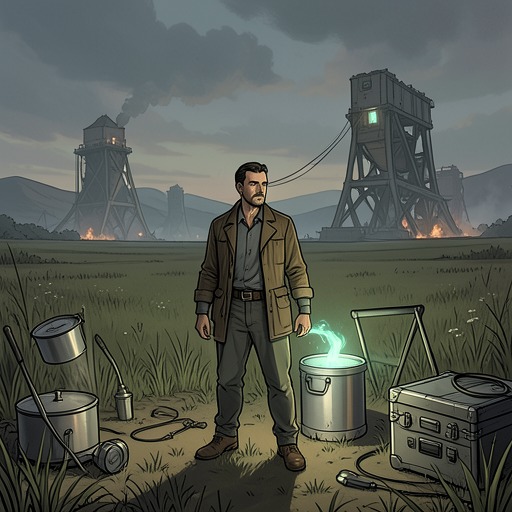
The response to the riots therefore extends beyond restoring order: it redirects a postwar society toward food manufactured from a transformed ecosystem. Harvesting factories known as TexasTowers are established by The Companies, and harvesters receive the highest wages of any nontechnical occupation, legally classified as high-hazard pay. Joe Pareti chooses this work after finding his education an unappealing path, though he does not yet understand why the pay carries that classification.
The event’s rapid ending and the slow development of its aftermath form a telling contrast. Hunger can extinguish collective resistance in a short time, but neither political unity nor technological research can undo ecological damage at once. The crisis helps explain why a society that has passed through war and food riots becomes dependent on an uncertain new resource—and why the labor of obtaining that resource is treated as hazardous.