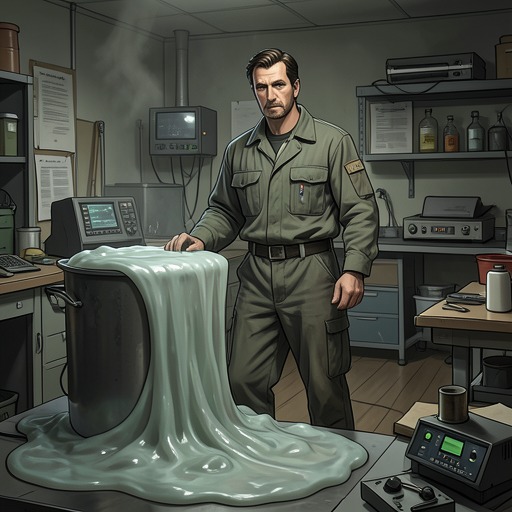
Joe Pareti and the goo
The Robot Who Looked Like MeJoe Pareti and the goo is a relationship shaped by a radical imbalance: the Goo understands its connection to Pareti as love, while Pareti comes to regard that connection as infection and intrusion. Their encounter turns the disease’s transformations into a struggle over intimacy, agency, and the boundary between a person and the objects around him. The Goo’s courtship grows more articulate as Pareti’s resistance hardens, ending not in reconciliation but in a silence that seems to spread beyond the telephone.
Diagnosis and Unequal Terms
Pareti’s connection to the Goo begins under the language of medicine and risk. During an examination, Dr. Ball tells him that he has contracted Ashton’s Disease, the name given to Goo infection after the first case. Pareti had hoped for another explanation. Instead, the diagnosis makes explicit what he had risked: The Company, Dr. Ball explains, accepted no responsibility, and Pareti had effectively been paid to expose himself to a rare disease. He had gambled that he would not contract it and lost.
Pareti does not ask Dr. Ball for sympathy. He wants professional advice about what to do and what to expect. The answer offers little reassurance: Pareti is only the sixth case, no clear pattern has been established, and the disease is as unstable as its progenitor, the Goo. The tentative pattern Dr. Ball can describe is a radical change in the victim’s relationship with the external world. Other cases have involved animate transformations, including external organs and functional gills, or changes to inanimate surroundings, such as a victim’s levitation. Those examples establish the disease’s range, not a fixed sequence that Pareti can use to predict his own experience.
That uncertainty governs the relationship before the Goo speaks. Pareti is a patient trying to understand a condition whose effects cannot be reliably forecast; the Goo, as it later presents itself, is an organism with a history and desires of its own. The medical account names the risk but cannot explain what the attachment will mean to either of them. Pareti wants a prognosis. What emerges instead is a claim of intimacy that he does not accept.
From Exposure to a Personal History
The relationship becomes undeniable when a piece of clothing curls around Pareti’s hand and tickles his palm. He giggles involuntarily, throws it away, and hurries from the room. Descending by dropshaft to the street, he recognizes this as the disease’s true onset: the Goo has altered his relationship with an inanimate object. The episode is brief, but it changes the terms of his fear. The disturbance is no longer only a diagnosis or a possibility described in a doctor’s office; an ordinary article of clothing has behaved as though it could initiate contact.
The Goo later calls Pareti on the telephone and speaks in a silken voice, presenting itself as a lover hurt by his rejection. Its account reaches back to their encounters on the warm sea. It recalls having been young and silly, trying to hide, and Pareti lifting it from the water and bringing it close. In its telling, he was patient and kind; it even tried to wriggle up a pole handle to kiss his fingers. The same history that Pareti does not recognize as a romance becomes, for the Goo, the beginning of a shared life.
The Goo also tells Pareti that it had tried other men before him. It had been unable to become what it wanted to be with those five, and says that meeting Pareti helped it understand what it could become. Its recollection links its longing for a form with its attachment to him: as it puts it, “One’s shape is one’s career, you know.” Pareti is thus not simply the object of an isolated advance. In the Goo’s account, their prior contact has helped shape its developing sense of itself. That account is spoken by the Goo, however; the contrast between its confident romantic history and Pareti’s denial remains central to their conflict.
Courtship Through the Inanimate World
The telephone gives the Goo a means to speak, but its earlier approach has already made objects part of the relationship. The clothing’s movement and tickling touch are not described as a conventional human courtship. They are an instance of the disease’s capacity to transform how a victim relates to the external world, making an inanimate object behave as a participant in an unwanted intimacy. Pareti’s conclusion that the Goo is “getting bolder” registers both the escalation and his lack of control over where it will occur next.
On the call, the Goo turns its transformations into evidence of devotion. It says that it became a dogwood tree and Pareti barely looked at it, then a newspaper that he did not read. The images extend the same mismatch: the Goo interprets its changing forms as attempts to please him, while Pareti experiences the changes as signs that the world is becoming something else. Its love is expressed through forms he has not chosen and cannot make intelligible on his own terms.
When Pareti asks whether it could turn into a girl, the Goo says it has tried that, as well as becoming a collie and a horse, but those forms felt wrong. It offers to become other things instead, including a rug or his underwear. The exchange exposes the limits of its powers as the Goo describes them, but it does not make its advances welcome. Its invitation to name another form assumes that Pareti might participate in defining their relationship. He briefly goes along with the question, then recoils from what he calls the lunacy of the situation.
Rejection and the Loveless Room
Pareti’s refusal becomes explicit and deliberately cruel. He tells the Goo that he does not love it, calls it gray and ugly, and insists that it is nothing but a disease. The Goo answers that there is nothing like it except itself and that it loves him anyway. When Pareti says that he never loved it and only used it, the telephone falls silent and disconnects. The call ends without agreement: the Goo’s attachment persists, but Pareti refuses even the premise that the relationship was mutual.
The narration then moves from the call to Pareti’s hotel room, where the furniture seems to register that he feels no love. The chair, bed, lamp, and even the bureau are described as aware of his lovelessness; the room’s mechanical equivalents of love make that absence seem almost socially unacceptable. The account sharpens the asymmetry into a grim count: Pareti is the sixth man to spurn the Goo’s love. Set beside Dr. Ball’s statement that Pareti is the sixth known case, the repeated number connects the medical history to the Goo’s frustrated attempts at attachment without establishing that the two counts explain one another.
Pareti looks toward a gilded mirror and considers it as a threshold through which one might look, then sees himself through it in an image that turns ordinary contact into menace: “I see a man sitting on a chair, and the chair is biting his leg.” The line brings the relationship’s central disturbance into focus. The objects around Pareti may be more than neutral surroundings, but their apparent participation does not make him love the Goo or want its attention. His rejection ends their conversation; it does not restore an uncomplicated boundary between himself and the inanimate world.