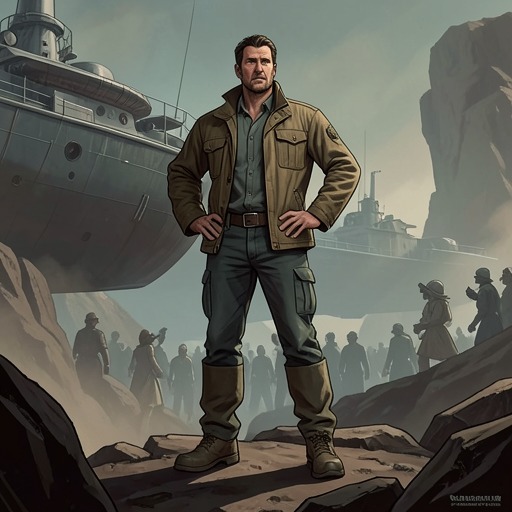
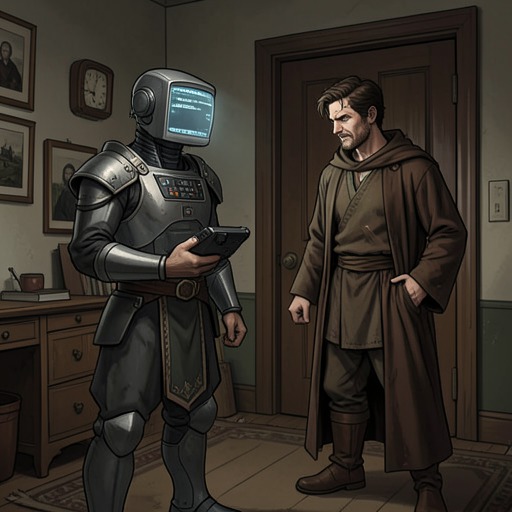
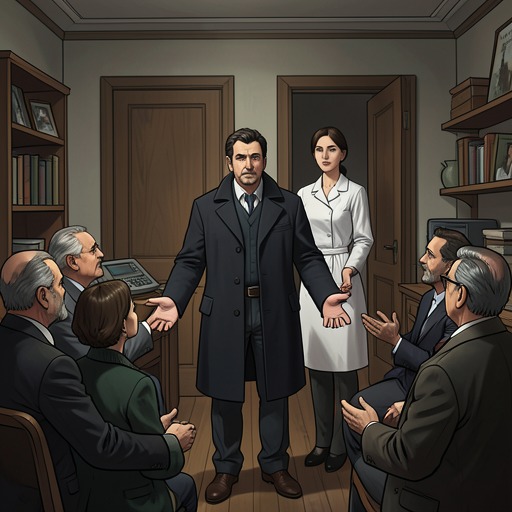
Lorian government
The Robot Who Looked Like MeThe Lorian government is less a hierarchy than a political expression of shared public judgment. On Loris, the collective mind is calm and thoughtful, and there is no discernible gap between what the public wants and what the government does. The system therefore appears to require little direct rule: its central figure, Veerhe, issues forecasts rather than orders. That low-intervention arrangement is tested when the government’s projections point toward conflict with Earth. Instead of waiting for the predicted struggle, the Lorians ask Johnny Bezique to rule them, turning their preference for avoiding needless hardship into an extraordinary transfer of authority.
Political Character and Social Setting
The government reflects a society in which resources and daily necessities are not organized around money. Loris has no need for currency, banks, or locks: food, clothing, housing, and entertainment are free, while people take what they want and give what they want. Work is creative and freely chosen, with self-regulating machines handling brute labor. The society is described as stable, technologically advanced, and ecologically balanced, with no wars, rebellions, or insurrections for five hundred years. These conditions provide the setting for a political order whose calm is not maintained through a prominent coercive state.
The government is said to mirror the near-unanimous collective mind of the Lorian people. Public desire and governmental action have no discernible distortion, gap, or lag between them. The description does not set out a conventional constitution, legislature, or chain of command; instead, it emphasizes alignment between the people and the institutions acting in their name. The government is therefore characterized less by a visible machinery of rule than by the apparent ease with which shared judgments become public action.
Veerhe and Forecast-Based Governance
Veerhe, Chief of the Office of Future Projections, is the closest figure Loris has to a ruler. The title gives him access to an influential planning role, but his stated practice is not to issue commands. He periodically produces economic, social, and scientific forecasts. His authority is associated with projection and interpretation rather than the routine exercise of personal command.
Johnny learns about Lorian society over several days with the help of Helmis, his specially assigned guide. When Johnny later meets Veerhe, the Chief Planner has completed a projection concerning Earth and Loris. He tells Johnny that the two peoples are likely to conflict over preeminence, not because the Lorians seek dominance, but because Earth’s people will not rest until one side rules the other. Veerhe presents this as an extrapolation from the peoples’ differing characteristics and levels of civilization, not as a desire of the Lorian government to expand its power.
The forecast is consequential because it turns a prediction into the basis for a political decision. Veerhe and the Lorians conclude that accepting the likely outcome in advance could spare them unnecessary pain and hardship. Their approach thus joins the government’s restrained methods to an unusually far-reaching act: the planners do not order a war or mobilize to conquer Earth, but they do propose changing who governs Loris in response to what they believe the future will bring.
Johnny Bezique’s Accession
Veerhe tells Johnny that the Lorian analysis predicts a conflict in which Earth’s people will pursue victory more fiercely than the Lorians. Johnny agrees with that assessment. He says that the Lorians are decent and rule-bound even in life-and-death contests, while humans are less restrained and will stop at nothing to win. His agreement confirms that the projected danger is not, in the government’s account, a Lorian ambition to dominate Earth; it is an anticipated imbalance in the two sides’ determination.
The Lorians then offer Johnny personal rule. Veerhe emphasizes that the offer is serious and that the Lorians do not lie. Johnny initially objects that he is not qualified, but accepts, saying that he likes the people and will do a good job for them. Veerhe adds a qualification: the Lorians will be easy to manage as long as Johnny’s orders remain within their psychological capabilities. Their invitation is therefore voluntary, but it does not imply unlimited power over the population. Lorian political character continues to matter after the transfer: the new ruler’s commands must remain within what the people can accept or carry out.
Johnny moves quickly from accepting the offer to planning its formal presentation. He wants to review information about the Ancient Dynasty spacefleet, but first proposes a referendum electing him Emperor, followed by a coronation. Veerhe says he will begin at once. The passage establishes that Johnny requests these steps and that Veerhe undertakes to arrange them; it does not describe the referendum or coronation taking place. The sequence nevertheless shows the planners converting their forecast into an immediate program for political transition, with a referendum proposed before the ceremonial title.
Consequences and Political Tension
The transfer changes the Lorian government’s position toward the outside world. The Lorians had previously been defenseless; under Johnny they have acquired an aggressive alien general, and a group of mercenaries is expected to operate their spacefleet. The narrator distinguishes the consequences for the two societies: the new arrangement is not good for Earth, but is not bad for Loris. The forecast intended to spare the Lorians hardship therefore prepares a reversal in which their restrained society gains the means to project force beyond its own world.
This outcome gives the government’s apparent pacifism a political limit. The Lorians do not seek conflict for its own sake, yet their attempt to avoid a disadvantage in a future conflict brings an ambitious human ruler and military capacity into their political order. Johnny frames his projected rule over Earth as beneficial to humans, imagining that they need civilization and will someday appreciate his intervention. His reasoning echoes the paternal justification offered by Mingus for taking power on a ruined future Earth: both rulers present domination as a remedy for disorder or incapacity. The Lorian government, however, reaches its decision through collective forecasting and a request that Johnny rule, rather than through Mingus’s seizure of power.
The episode makes the government’s central strength and vulnerability inseparable. Its forecasts allow it to anticipate a threat and act without waiting for violence to begin. But by treating the projected conflict as inevitable and selecting a more aggressive ruler as protection, it helps bring into being a political arrangement with consequences for Earth as well as Loris. Its preference for orderly prevention does not keep power out of politics; it changes who holds power and what that power may enable.