Lorian monitor and law-abiding conduct system
The Robot Who Looked Like MeThe Lorian monitor and law-abiding conduct system presents law as guidance rather than ordinary policing: monitors explain rules, citizens are expected to accept correction, and an inadvertent breach is normally settled by an apology. Johnny Bezique’s encounters with the system expose the assumption beneath that arrangement. In a society where refusal and repeated violence are treated as circumstances that should not arise, the response to his defiance shifts from explanation to restraint and, finally, an attempt to remove him from the community’s path.
Monitors and the Everyday Work of Law
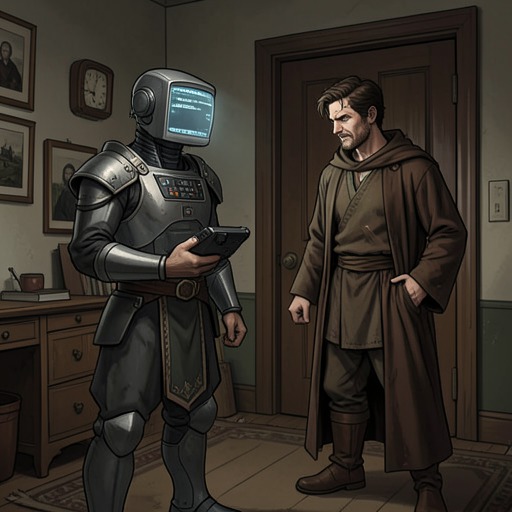
On Loris, the police are called monitors, and their manner is notably polite. Helmis explains that they are not a conventional law-enforcement branch but an educational one. A citizen may approach a monitor to ask for a ruling on a question of personal conduct; if the citizen has broken a law without realizing it, the monitor points this out. The system thus gives monitors a role in interpreting rules as well as communicating them, while making the individual citizen responsible for responding to that guidance.
This arrangement is not presented as a society without rules. Monitors exist because conduct is governed by laws, and the word police prompts Johnny to suspect that there must also be criminals. Helmis distinguishes occasional genetic deviants from a criminal class, which he says Loris does not have. The distinction matters to the system’s self-description: the monitor’s purpose is not to identify and punish a standing population of offenders but to help citizens understand the standards that apply to them.
Correction, Apology, and the Assumption of Compliance
The ordinary response to an inadvertent breach is deliberately limited. A monitor identifies the violation; the citizen apologizes; the incident is then forgotten. The account offers no further penalty for this kind of mistake. The arrangement depends on correction being accepted as sufficient, so that knowledge of the rule and acknowledgment of error restore ordinary relations without a continuing legal process.
The system’s account of repeated lawbreaking reveals a more difficult boundary. Asked what happens if someone breaks the law again and again, Helmis first says that such a circumstance never arises. When Johnny presses the hypothetical, Helmis adds that monitors are programmed to handle it if it does. The answer establishes that a response has been anticipated, but leaves its nature unspecified. The system’s confidence in the rarity of the case sits beside this provision for it: recurrence is declared absent from ordinary life, yet not wholly outside the system’s design.
Johnny Bezique as a Test of the Rule
Johnny’s conduct turns that hypothetical into a practical challenge. A counselor insists that he undergo social-adjustment therapy, judging his angry and aggressive moods a risk to other citizens. Johnny orders the counselor to leave; the counselor refuses while the matter remains unresolved, and Johnny punches him. The counselor then tells him that violence actually committed is more serious than violence merely offered and that he must accept restraint until the case is cleared. He explains that the restraint will not be unpleasant or long, and acknowledges the cultural difference between Johnny’s ways and Lorian expectations, while maintaining that unchecked, unmotivated violence cannot be permitted.
Johnny rejects restraint as well as the counselor’s account of what the rules require. A monitor arrives expecting him to cooperate voluntarily and is baffled when he refuses. Rather than immediately forcing compliance, the monitor goes away to obtain further orders. When he returns an hour later, he has authority to take Johnny by force if necessary. Johnny punches him too. His response makes plain the gap between the system’s usual sequence—explanation, acknowledgment, and voluntary cooperation—and the conduct it must confront when a citizen refuses every step.
Limits and Consequences
After assaulting the monitor, Johnny recognizes that he may have committed a particularly serious offense and concludes that leaving is his best option. He reaches his ship without incident, but about twenty workmen are already servicing it: its main drive has been removed for cleaning and modernization, presented as a gift from the Lorian people. The episode therefore ends not with a described arrest or a settled account of the restraint procedure, but with Johnny unable to take off at once. The monitor system’s response has moved beyond polite advice, while the immediate obstacle to escape is the ship’s disabled drive.
The contrast is between a rule-governed order built around correction and an exceptional case in which correction does not secure compliance. The monitors’ educational role and the practice of forgetting inadvertent errors give the system a distinctly nonpunitive routine; the counselor’s demand for restraint and the monitor’s later authorization to use force show that this routine has a boundary. Johnny does not prove that Lorian law has no answer to defiance: the stated authorization indicates otherwise. But his behavior makes the normally invisible premise of the system visible—that its rules work most smoothly when citizens accept them without coercion.