Loris
The Robot Who Looked Like MeLoris is the fifth planet examined by Johnny Bezique during a survey of the then-uncharted fringe of the Seergon Cluster. It appears to offer an answer to nearly every familiar social problem: abundance without money, technology without ecological ruin, and public life aligned with the wishes of its people. That apparent perfection is also its defining narrative pressure. To Bezique, Loris resembles the standard nightmare scenario—not because it is visibly hostile, but because its flawless order seems too good to be true.
Discovery and First Contact
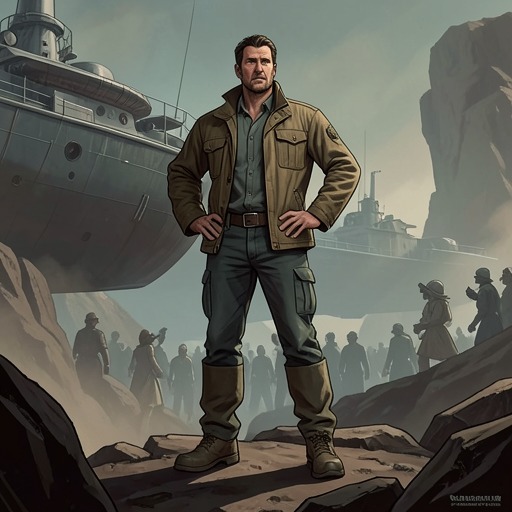
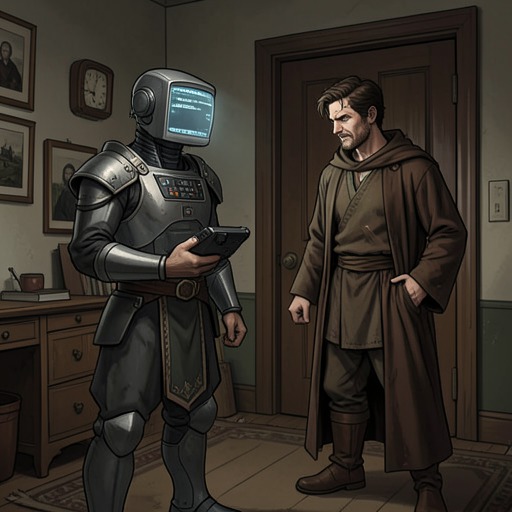
Bezique, a spaceship-driver for SBC Explorations, Inc., was surveying the Seergon Cluster’s fringe. The first four planets disclosed nothing of interest; the fifth brought him to Loris. As his ship approached, its loudspeaker activated by remote control. A deep voice announced that he was nearing the planet and presumed he intended to land. When Bezique asked how the speakers knew English, the reply was that a Lorian computer had deduced the language from inferential evidence gathered during his approach.
The encounter establishes Loris as technologically capable before Bezique reaches its surface. Its inhabitants have not merely detected an approaching ship: their computer has interpreted evidence about its occupant and prepared to communicate with him. The first impression of the planet is therefore one of attentive, highly developed systems rather than isolation or confusion. Loris is remote from the known world, but not technologically backward.
A City Built Around Abundance
The physical conditions of Loris are immediately hospitable to a human visitor: its air can be breathed and its water drunk, and its people are humanoid. The resemblance is striking enough to run against the expectation expressed by Nobel Prize winner Serge Von Blut, who had placed the likelihood at 1093 to one. For Bezique, however, biological familiarity is only the threshold to a more unsettling discovery. The Lorians give him hypnopaedic knowledge of their language and take him on a guided tour of Athisse, their major city; the more he sees, the gloomier he becomes.
Athisse is enormous, with castles, palaces, and other public buildings whose bold asymmetry makes the city visually varied and exciting. Its civic landscape includes bazaars, restaurants, parks, statues, houses, graveyards, funparks, hot-dog stands, playgrounds, and a clear river. These varied spaces do not belong to a narrow privileged class: the city’s food, clothing, housing, and entertainment are all free. People take what they need and give what they wish, with the balance maintained without money. Without money there is no need for banks, treasuries, vaults, or safe-deposit boxes; even locks are absent, because doors open and close by mental command.
The arrangement is more than material plenty. The Lorians are described as pleasant, comely, stable, inventive, and progressive. Their birth and death rates are stabilized, their population has room and opportunity, and their several races live without racial problems. Work is creative and freely chosen because self-regulating machines perform brute labor. Their advanced technology and their beautiful ecological balance coexist, rather than one being presented as the price of the other. The city’s abundance thus extends from private necessities to public architecture, recreation, labor, and the environment.
Social Order and Its Unsettling Edges
Lorian political life is said to mirror the people’s nearly unanimous collective mind, which is calm, thoughtful, and good. Between public desire and government action, the account identifies no discernible distortion, gap, or lag. This government appears neither to impose a visible separation between rulers and ruled nor to leave collective wishes waiting on administrative action. The description makes social harmony seem built into the planet’s institutions as thoroughly as its material abundance is built into Athisse.
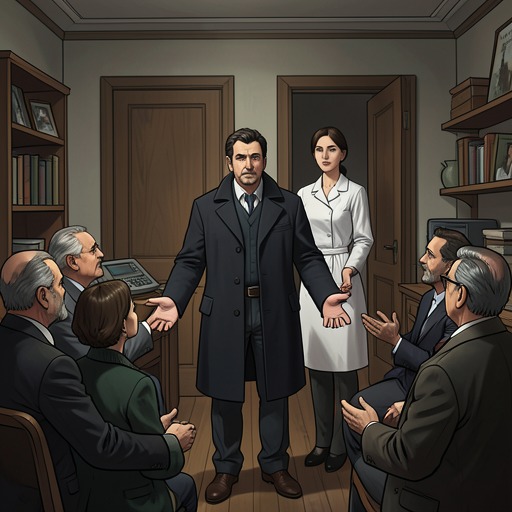
Yet Loris is not without police. Its officers are called monitors and are excruciatingly polite, but Bezique recognizes that they are still cops: their presence implies that criminals exist. That implication gives him a point of tension within a society otherwise represented as exceptionally stable. It does not, by itself, disclose the nature or scale of crime on Loris; rather, it interrupts the visitor’s impression that the planet has abolished every source of conflict. The monitors are a small but concrete sign that apparent harmony does not make the question of disorder disappear.
The Lorians also possess ships, which Helmis calls monuments to their past irrationality. He suggests that they might nevertheless help if anyone tried to invade. Bezique judges that one of these ships could handle anything Earth might put into space for roughly the next two hundred years. The vessels therefore embody a double reading of Lorian history: they preserve evidence of an earlier irrational age, yet remain a formidable defense. Even a society that has known no wars, rebellions, or insurrections for five hundred years has not discarded the capacity to protect itself.
The Standard Nightmare
Loris is presented as the standard nightmare scenario: too good to be true, and so perfect that Bezique finds the perfection dismaying and disgusting. His skepticism is not based on a demonstrated hidden tyranny or a revealed catastrophe. It comes from a prior conviction that every virtue must have a corresponding vice, usually expressed in his demand for a loophole. Even God’s heaven, he thinks, could not run so well. His suspicion is therefore a response to the gap between Lorian evidence and his expectation of how a society must work.
That contrast makes Loris more than a catalogue of ideal institutions. The guided tour steadily accumulates particulars—free food and housing, open doors, chosen work, ecological balance, calm government—while Bezique’s confidence in the possibility of uncomplicated virtue steadily diminishes. The planet’s strength and its narrative unease arise from the same feature: it appears to have resolved problems that Bezique assumes must persist. Loris remains, at this point, a seemingly successful society under a visitor’s skeptical gaze, with the polite monitors and the old defensive ships offering reminders that perfection does not mean the total absence of complications.