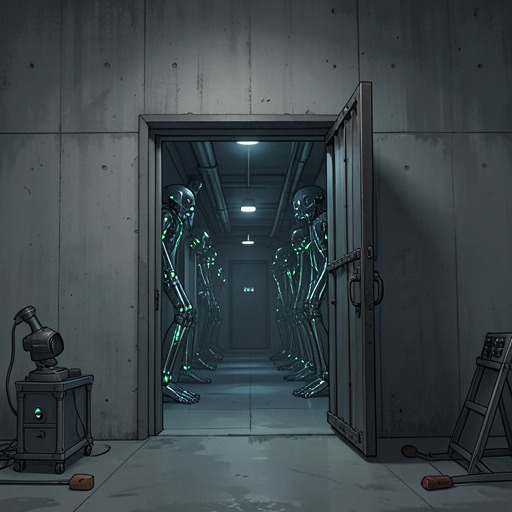
Love cannot be simulated by prediction systems
The Robot Who Looked Like MeLove cannot be simulated by prediction systems is the principle that intimate feeling escapes even a machine designed to project human behavior. In Peter Honorious’s story, the Political Factors Synthesizer and Simulator can render possible marriages as vivid, detailed futures, but its forecasts do not determine whom he loves. The decisive turn comes not from a more accurate projection, but from an unplanned encounter with Dinah Grebs.
Intimacy as a problem of prediction
The concept takes shape against a culture of deliberate calculation. Honorious has organized his life around a comprehensive schedule, devised with the Total Lifesplan people and entered into his personal computer. Marriage, too, has a place in this design: his schedule includes a subprogram for a wife, with a further adjustment for a wife and child. He has decided to marry at 32.5 and intends to obtain a wife through the Guarantee Trust Matrimonial Agency. These provisions treat intimacy as something that can be accommodated in advance, its effects on his time and productivity calculated before the relationship begins.
The proposed use of the Political Factors Synthesizer and Simulator extends that logic from scheduling to compatibility. The machine was designed to predict and simulate interactions among groups and subgroups; its operators adapt it to forecast how two individuals might interact. Rather than offering Honorious a single verdict, it lets him experience possible futures with different women. The system’s premise is that interpersonal outcomes can be made visible in advance, allowing him to inspect a marriage before choosing it.
Futures rendered by the Simulator
The projections are presented as sequences of visual scenes, not abstract scores. With Miss 1734-AV-2103C, Honorious sees an initially happy life give way to quarrels and divergent interests: a small apartment, then a more impressive home, followed by a move to Connecticut. The imagined future continues through her growing commitment to spiritual practice and their eventual separation. Other forecasts are similarly changeable. Miss 3543’s projected life with him includes travel and domestic scenes, as well as serious difficulties; another candidate begins as a quiet companion before a later scene shows Honorious angry at her silence. The futures vary in character and circumstance, but their accumulation leaves him alarmed and despondent rather than confident that the right choice has been identified.
By September 29, he has viewed fourteen possible marriages. For his final appointment, the terminal has been moved from its DeKalb Avenue location to a washroom near Euler’s office for security reasons. The setting is makeshift, but the machine again supplies a continuous future. With candidate 6903, Honorious sees a series of shared experiences, from a walk at Martha’s Vineyard and scenes abroad to a home with a colicky baby. The projection ends after five years. Unlike the preceding forecasts, this one persuades him that he may be in love with the woman it depicts.
The moment the forecast cannot supply
The difference is not simply that 6903 receives a happier projection. The earlier simulations had also shown attractive beginnings, domestic pleasures, and apparent happiness before moving on to disappointment or separation. What changes is Honorious’s response: the forecast leads him to believe that he has found someone he loves. Yet the system has shown him a possible life with an identified candidate; it has not produced the feeling that makes that future matter to him.
The distinction becomes concrete when Honorious and Dinah Grebs confront one another. He moves toward her after she recommends another candidate, and she swings at him; he catches her wrist. They pause, looking at each other, in a moment of contact and shared recognition. The scene does not proceed according to a scheduled appointment or an impersonal ranking. Their response arises between them, outside the sequence of projected vignettes. The narrative identifies love as the unofficial heart of pair-bonding behavior and stresses that it is a force the system cannot predict. The look gives them a preview of possible joys and sorrows, but it does not provide a complete forecast or settle what will follow.
Uncertainty after prediction
Honorious later asks Dinah whether the future shown by the Simulator was genuine or whether she altered its data. Her answer leaves the question open: he will have to wait and find out. That uncertainty is central to the concept. The projections may offer possible courses of life, but neither their apparent detail nor Honorious’s desire to trust the final one can establish what will actually happen between the two people. Love begins in an encounter that prediction did not supply, while its consequences remain ahead of them.
The episode therefore distinguishes forecasting from experience rather than claiming that machines can reveal nothing about human behavior. The Simulator can construct plausible developments in a relationship, and its scenarios make visible how lives might diverge over time. But a forecast cannot substitute for the unplanned response between two people, nor can it guarantee that the future it displays is the future they will live. Honorious’s carefully managed schedule and the machine’s successive projections both promise control; his encounter with Dinah exposes the limit of that promise. Intimacy remains consequential precisely because it is not secured in advance.