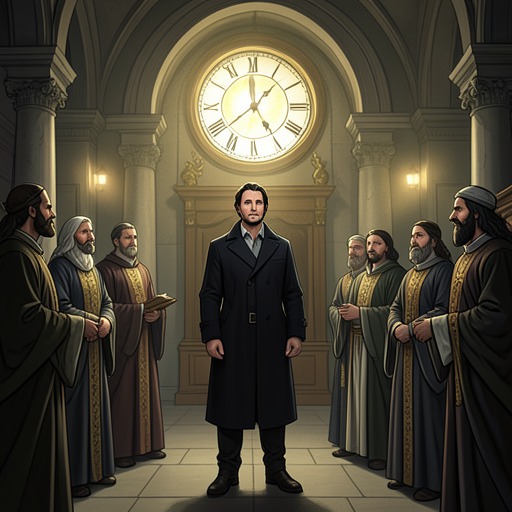
Mingus infiltrates the Gleister resistance
The Robot Who Looked Like MeThe infiltration of the Gleister resistance turns its gathering into a test of recognition and succession: Emperor Mingus enters under the identity of Mordecai Gleister, confronts the people organizing against him, and dies while attempting to kill Egon Gleister. The reversal does not end the imperial order. Instead, the meeting’s final exchange installs a new Emperor from among the very Gleisters Mingus had come to control.
A gathering built around a threat
The meeting brings together members of the Gleister Coequality Line of Potentialities, many of whom have reached the same place by different routes. Egon Gleister names it the Time-Space Center for Resistance to the Rule of the Emperor Mingus. The group’s existence is itself puzzling: Egon calls it a Gleister collection-point, though he cannot explain why so many of them have converged there. The Center’s immediate purpose, however, is clear. Its members see themselves as the only serious threat to Mingus’s reign and expect that the Emperor may already know of their plans.
Their fear has a concrete basis. Some Gleisters have experienced inexplicable near-fatal accidents before inventing the time machine, and Egon suspects that Mingus caused at least some of them. The resistance therefore assembles under the expectation of further attempts on its members’ lives. That danger makes the later discovery especially destabilizing: the supposed enemy is not merely watching the meeting from outside but has taken a place within it.
Before the meeting begins, the assembled Gleisters try to distinguish themselves by choosing unusual names. The Chairman calls himself Egon; Charlie Gleister, whose time-track the narrative has followed, chooses Hieronymous. This act of renaming helps make the crowded assembly legible, but it cannot guarantee that anyone is who he claims to be. The moment that makes names useful as individual markers also exposes their insufficiency as proof of identity.
Mordecai’s challenge
Mordecai Gleister enters the discussion as a confident, bearded man in his fifties and asks to address what he calls urgent matters. His argument is not an open declaration of loyalty to Mingus. Instead, he challenges the resistance’s judgment, saying that its members have assumed the Emperor and his aims to be evil without examining the matter impartially. The appeal to reconsider their settled view gives him the appearance of a dissenter within the group, rather than an intruder threatening it from beyond its ranks.
Hieronymous Gleister recognizes him. Having seen this man before, he suddenly connects the face to Emperor Mingus and runs toward the stage, shouting for the others to seize him. Egon Gleister hesitates, then moves with Hieronymous toward Mordecai; other members also start climbing onto the stage. The recognition turns debate into an immediate physical confrontation, but the resistance cannot carry its response through before Mordecai produces a weapon.
The gun is blue steel and resembles a Colt .45 automatic, but Mordecai explains that it is not a projectile weapon. He describes it as his invention—or theirs—and says it operates by laser diffusion: at fifteen feet it first causes paralysis, with death following seconds later if the beam is not switched off. By making the weapon’s effects explicit, he converts the group’s attempted seizure into a hostage crisis. Everyone except Egon and Hieronymous resumes a seat, while Mordecai keeps those two standing and makes their lives depend on the others’ behavior.
The Emperor reveals himself
Only after establishing control does Mordecai identify himself. He addresses the assembled Gleisters as his brothers and loyal subjects, then greets them as Emperor Mingus. The revelation recasts his appeal for impartial judgment: what seemed to be an internal objection to the resistance’s assumptions was spoken by the ruler it meant to oppose. His disguise has allowed him to stand inside the gathering and challenge its premise before the group could recognize the person making the challenge.
Mingus’s account of his rise gives the infiltration a larger time-travel context. He says that he invented a time machine and travelled to a distant future, where he encountered a depleted and brutal world divided into small, quarrelling kingdoms. He took power there, aided by the time machine’s unmatched advantage, but insists that his success also depended on the historical moment and his own suitability to organize it. The resistance’s present struggle is thus bound to a future empire that Mingus claims to have built after seeing the consequences of social collapse.
A death and a new Emperor
The confrontation shifts from Mingus’s control of the room to the question of who can inherit imperial authority. Egon claims a legitimate place in the royal line as a Gleister and asks for the gun, offering to let Mingus go in peace. Hieronymous urges Mingus to comply, reasoning that time travel requires events to be overdetermined and that there must be a second Emperor. His intervention treats succession not as an escape from the imperial cycle but as something the structure of time may require.
Mingus agrees to hand over the weapon, adding that a future Emperor should not care which end he receives first. He aims it at Egon and pulls the trigger. The outcome reverses the apparent threat: Mingus goes rigid, falls, and drops the gun, which clatters across the floor to Hieronymous’s feet. Hieronymous examines him and confirms that he is dead. The scene specifies the intended target and the unexpected death, but does not explain why the weapon’s effect falls on Mingus instead of Egon.
Egon responds that they appear to have a new Emperor. Hieronymous agrees and hands him the gun butt-first. The transfer is immediate, enacted through recognition and the physical passing of the weapon, rather than through any described election or deliberation. Mingus’s infiltration has failed to preserve his own rule, but his death does not dissolve the imperial office: the resistance meeting closes by naming Egon as its successor. The episode’s central reversal is therefore political as well as personal. The people who gathered to oppose the Emperor end by producing another one, while the time-travel logic Hieronymous invokes makes succession seem less like a break from history than its next compelled turn.