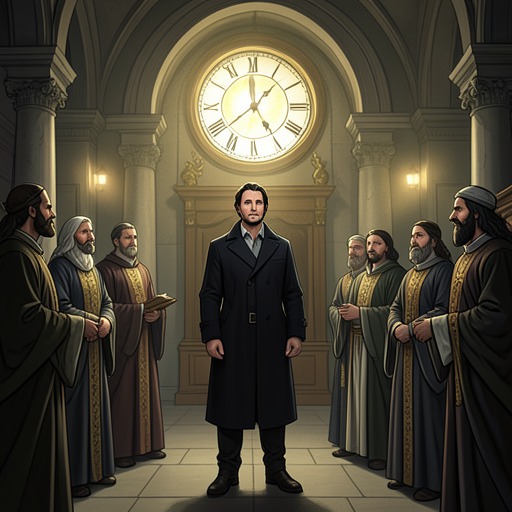
Mingus’s time-machine restriction requiring personal operation
The Robot Who Looked Like MeMingus’s time-machine restriction requiring personal operation is both a practical limit on the machine and a safeguard for the Emperor’s monopoly on power. Although the device lets Mingus intervene in the past to correct failures and attack opponents before they become threats, he must operate it himself: delegating would give another person the means to remove him and claim the throne.
Operation and Political Purpose
In Mingus’s police state, surveillance extends through cameras, recorders, monitoring teams, and supervisors who monitor the monitors, ending with the Emperor as the ultimate observer. The time machine gives this system a further reach across time. When something goes wrong, Mingus can travel back and correct it, subject to natural restrictions. He can also target an underground leader before that person goes underground, even as a child.
The machine’s central political limit is that Mingus cannot entrust it to anyone else. The reason is not merely administrative: whoever controlled the device could go back and kill Mingus, then become Emperor. Personal operation therefore protects the throne by keeping the means of temporal intervention in the ruler’s own hands. The same concentration of power that makes the machine useful also makes delegation intolerable.
Monopoly and the Reach of Resistance
This restriction does not make Mingus omnipotent. Some people cannot be located through time travel; those who are vulnerable to it have already been weeded out. The resistance persists among those Mingus cannot personally eliminate, and the rest of his extensive organization is devoted to finding and destroying those remaining enemies.
The distinction shapes the regime’s work. The machine allows Mingus to bypass ordinary searches by striking at a target’s earlier life, but it cannot perform that intervention independently or reach everyone. Since Mingus must act personally, his state must search for and deal with opponents outside the machine’s reach through its broader apparatus. Time travel reinforces surveillance without making surveillance—and the labor of repression—unnecessary.
Natural Limits and Repeated Displacement
The personal-operation requirement sits within a larger set of limits on time travel. Charlie Gleister considers traveling into the future and then returning to meet himself just before inventing the machine; another Gleister confirms his understanding, while reminding him that reality is positional and that events do not happen for the first time. The exchange presents time travel not as a simple route back to an unchanged past, but as an intervention into a reality whose positions and outcomes are already entangled.
The account of the machine’s invention develops that constraint through duplication. When the original inventor goes into the future, Nature fills the resulting absence in the space-time fabric by supplying an identical or near-identical Gleister. Each further use creates another displacement and another replacement. Likewise, the inventor cannot simply return to the past and occupy the place he left or persuade a single earlier self not to invent the machine: contact creates diverging Gleisters, and interference changes the conditions it seeks to undo. These temporal complications are not the same as Mingus’s requirement to operate the machine himself, but they clarify why the device’s power remains bounded by consequences it cannot straightforwardly erase.
Consequences for Imperial Rule
The danger of relying on time travel is also political. When Mingus returns to the past, Egon Gleister tells him that he has ceased to be Emperor: there is no uniquely real Emperor, only a Gleister who went to the future, seized power, and later returned in an attempt to take over the resistance organization. That attempt ends with the returning figure killed. The episode unsettles the apparent permanence of Mingus’s sovereignty: the machine can carry a ruler across time, but it cannot guarantee that the identity or authority he seeks to preserve will remain intact.
The restriction thus contains an irony. Mingus keeps the machine to himself because sharing it could cost him the throne, yet personal control does not free him from temporal consequences or ensure that his rule can be restored after a return. His monopoly is real, but it is not mastery over time.