Mr. West's Inner Voice
The Robot Who Looked Like MeMr. West's Inner Voice is the miniature decision-maker to whom Mr. West entrusts the problems he refuses to resolve through supernatural or chance-based guidance. It is at once an apparently reliable adviser and a divided image of Mr. West himself: a separate presence in his mind, but one that sees the world through his senses and acts on his behalf.
Identity and Function
Mr. West is described as a large, glum, secretive accountant who believes each person should make up his own mind rationally. He rejects the I Ching, Tarot cards, and horoscopes, even when a decision presses on him. Yet his method of independent judgment depends on referring his problems to an inner Voice. It tells him what to do, and, as the story establishes the arrangement, it is always right. His faith in rational self-direction thus rests on a peculiar division of labor: the outward Mr. West supplies the problems, while an inward counterpart supplies the decisions.
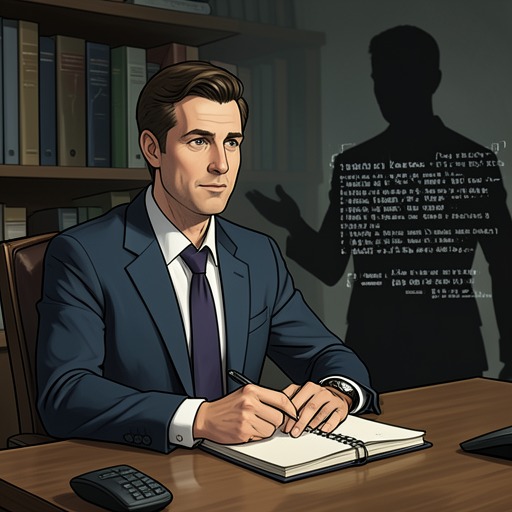
The Voice is not presented merely as a stream of Mr. West's conscious reasoning. Mr. West imagines it as a miniature version of himself, about the size of a pea, sitting in the part of his brain labeled Control Central. From there, it looks out through Mr. West's senses, sorts through what it perceives, and makes decisions. The image gives an internal process the shape of a tiny second person: Mr. West can ask it for direction, hear an answer, and treat that answer as coming from an adviser distinct from himself.
The arrangement initially seems to reconcile Mr. West's insistence on rationality with his reluctance to do the work of deliberation himself. When he faces a complicated investment choice involving leverage, margins, seasonal variation, investor confidence, stock averages, and alfalfa futures, he assumes that assessing these factors is precisely the Voice's task. After considering the problem overnight, the Voice responds at breakfast with a solution couched in technical language about tensile web structures, gradients, homeostasis, and product strength. The contrast between the ordinary setting and the answer's abstruse jargon makes the Voice's authority sound less like transparent reasoning than like a specialized intelligence speaking from inside him.
Disconnection and Return
The Voice’s authority depends on a connection that proves vulnerable to forces outside Mr. West’s conscious control. During the week engineers test generators in the newly built Conglomerate Building across the street from his apartment, the Voice stops reaching him. The disruption coincides with unusually high sunspot activity, a ten-year peak in cosmic-ray output, and a temporary four-degree shift in the Van Allen belts. The story links this cluster of environmental and technical disturbances to the breakdown of West’s private decision-making system without explaining the mechanism that joins them.
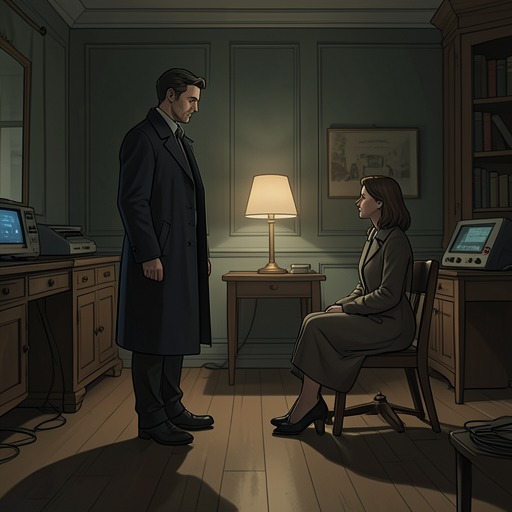
Left without its usual adviser, Mr. West tries to make decisions unaided. His investment choices go badly: he sells South African Sweatshops, Ltd., just before its shares rise five points, then buys International Thanatopsis Corporation shortly before it falls to a record low. The trouble exposes how thoroughly he has delegated judgment to the Voice. Even when he recognizes the danger in his contemplated response to Amelia, he sees himself as incapable of handling the problem and still expects the inner decision-maker to take over.
The silence is not complete. As the week wears on, Mr. West hears other Voices offering irrelevant instructions about fixing liquid helium at room temperature, building a substance-extractor from an old washing machine, and changing a collage technique. Their arrival does not restore the familiar adviser: they supply disconnected expertise rather than decisions fitted to his problems. In frustration, he shouts and pounds his forehead, but the Voice he needs remains absent. When the generator tests end, sunspot and cosmic-ray activity return to normal and the Van Allen belts shift back; the other Voices cease as well.
The original Voice returns only later, after Mr. West reads about a religious colony awaiting the end of the world on the northern slope of Mount Alluci in eastern Peru. Disoriented, he books a flight to Lima for the following day. As he puts down the telephone, his own Voice resumes contact and gives him a specific investment recommendation: although selling Sweatshops was a mistake, he can recover by doubling his investment in Thanatopsis, which it predicts will rise the next month. Mr. West’s miniature counterpart is again at Control Center, and his first response is to ask where it has been. The Voice says it had remained present but could not establish a connection, distinguishing its continued existence from its ability to communicate. Its return restores the arrangement’s familiar confidence, even as the preceding losses have shown the cost of relying on an adviser whose access to West can fail.
Narrative Role and Significance
The Inner Voice makes Mr. West’s claim to rational self-command depend on a form of dependence he refuses to recognize as such. He rejects divination, yet his own decisions are made by an unseen adviser whom he experiences as separate from himself. The miniature figure at Control Center sharpens that division: it is recognizably Mr. West in shape, but it looks through his senses and takes over the work of judgment. The story turns an ordinary metaphor for deliberation into a comic, literal partnership between the man who has problems and the man inside him who is supposed to solve them.
The interruption exposes how fragile that partnership is. The generator tests, solar activity, cosmic rays, and the shifting Van Allen belts coincide with the loss of the familiar Voice and the arrival of others whose elaborate expertise does not help Mr. West decide what to do. The text does not explain how these disturbances sever the connection, but its precise catalogue of external conditions makes the private mind seem unexpectedly vulnerable to the surrounding world. The Inner Voice’s later distinction between being present and being unable to connect preserves that uncertainty: disappearance from Mr. West’s awareness is not disappearance from the imagined Control Center.
The return also arrives at a moment when Mr. West has turned from investment decisions toward a reported religious colony awaiting the end of the world. He books a flight to Lima, and only then hears his familiar adviser again, immediately offering a confident forecast about Thanatopsis. The sequence places a mundane financial recommendation beside an apocalyptic prospect without resolving their relation. The Voice remains Mr. West’s trusted instrument of rational choice, but the episode has already shown that his access to it can fail, leaving the supposed master of his own judgment unable to act reliably on his own.
Moral Judgment and the Unanswered Question
The Voice’s role in Mr. West’s private life is shadowed by a problem that exposes the difference between making a decision and deciding what is right. During the week of its disconnection, West considers Amelia, his fourteen-year-old niece, who is staying with him while her parents are in Europe. He recognizes the legal danger of assaulting her and postpones the matter, but then imagines ways to evade responsibility rather than rejecting the intention. The episode therefore offers no evidence that the Voice has supplied moral guidance: West’s own reasoning turns on the threat of punishment, while his imagined miniature adviser is unavailable.
At the Voice’s return, West asks whether it has heard anything about the world ending the following year. The question follows the newspaper account of the colony awaiting the apocalypse, but the available scene supplies no answer. That silence leaves the Voice’s renewed connection—and its confident financial advice—beside a possibility it has not yet addressed, preserving a limit to what its return can resolve.