Natchez Parker
The Robot Who Looked Like MeNatchez Parker is a huge, mustachioed man paralyzed from the waist down by an old bullet crease in his spine, and one of the few people in the Territory with a claim on Tom Washburn deeper than the conventions of the Western role they inhabit. In Parker’s sitting room, over coffee, he tells Washburn that riding away would mean more than avoiding a showdown: it would mean abandoning a way of life and a bond built over years. His insistence that they do not merely act their parts gives the confrontation its central tension, while his final confidence in Washburn leaves their disagreement unresolved but their friendship intact.
Identity and Circumstances
Parker receives Washburn in his sitting room, seated in a straight-back wooden chair with an Indian blanket over his withered legs. The narration identifies the cause of his paralysis as an old bullet crease in his spine; it gives no further account of his medical history or of how his disability shapes his everyday life. The scene makes his physical circumstances concrete without presenting a recovery or cure as its endpoint. Parker remains an active presence in the exchange: he judges Washburn’s choice, argues with him, and, when words fail to hold him there, reaches for him.
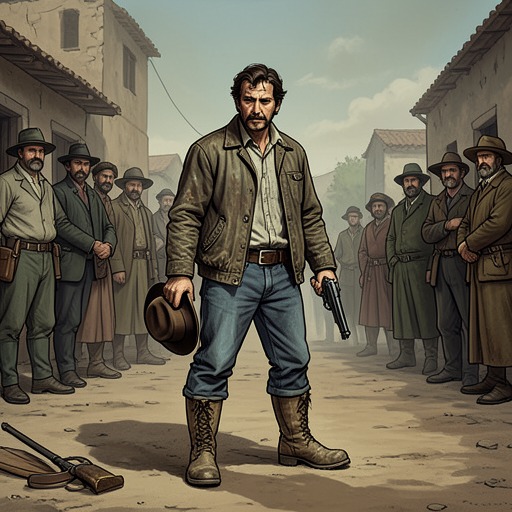
His position in the Territory is also defined through his relation to Washburn. Parker has heard about the expected meeting between Washburn and Little Joe Potter, and says that everyone else in the Territory has heard too. He wishes he could see it. The comment places him among those watching the approaching showdown, but the visit soon makes clear that he is not merely an audience for it. He has personal stakes in whether Washburn rides toward the encounter or leaves.
Friendship and the Dispute Over Leaving
When Washburn confirms he is running, Parker grimaces, hawks, and spits on the floor. He says he never expected Washburn to go against the values he had always lived by. Washburn rejects that account: “Natchez, those were never my values. They came ready-made with the role. Now I’m through with the role, and I’m turning in the values too.” Their disagreement is therefore not simply over whether one man should face a gunfight. Parker treats the code as something Washburn has lived into; Washburn calls it a set of ready-made obligations he can now discard.
Parker presses the practical and moral consequence of departure: “You’ve got to live with yourself, no matter where you go.” Washburn replies that he will manage. Parker answers with the history of their friendship, recalling that they had been “closer than kin” since Washburn arrived in the Territory as a frightened young man and made a place for himself through guts. He is the only man there who calls Washburn by his first name, and the narration stresses that he does not do so often. The name marks an intimacy that sits apart from the public reputation surrounding the coming meeting.
The Role and the Physical Confrontation
Parker’s argument reaches beyond Washburn’s immediate decision. He distinguishes dressing up and swaggering as a cowboy from carrying a gun and using it, and insists that the part has become a lived commitment: “We don’t just act these parts, Tom; we live them, we stake our lives on them, we are these parts.” The wording makes the Western role both theatrical and consequential. Parker acknowledges “the scene” and “The Movie,” then insists he is speaking directly to Washburn rather than to either of them. The scene thus holds two ideas together: the characters know the setting is a performance, yet Parker argues that its choices still demand real courage.
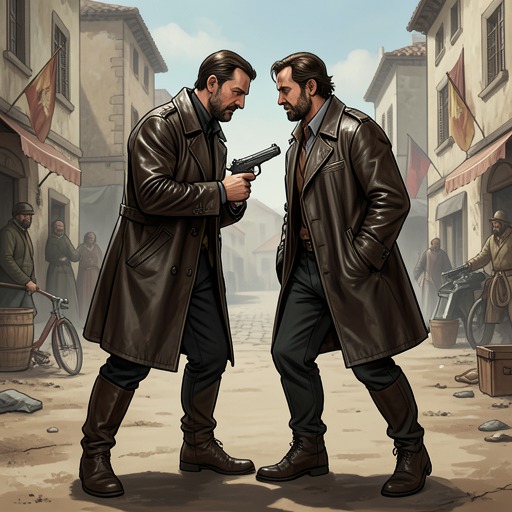
When Washburn says he will finish his coffee and ride on, Parker suddenly twists in his chair, grabs a handful of his shirt, and pulls him close. Washburn sees a knife in Parker’s other hand. Parker tells him to get out his own knife, saying he would rather kill Washburn himself than let him ride away a coward. The argument becomes physical, but Washburn does not draw his gun immediately. He braces one foot on the floor, plants the other on the edge of Parker’s chair, and pushes. The chair topples, and Parker falls. Washburn then draws his gun and aims between Parker’s eyes.
Reversal and Narrative Role
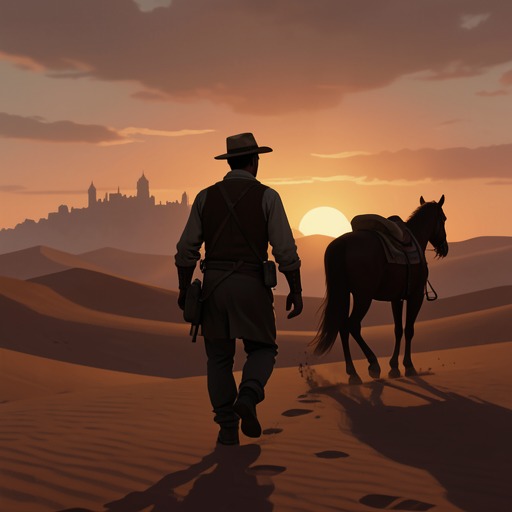
Washburn lowers the hammer, puts the gun away, lifts Parker, and slides the chair back beneath him. His parting explanation—that perhaps Parker can now wake up and remember how things really are—does not settle whether the encounter has changed Parker’s mind or merely interrupted his attempt to stop Washburn. At the door, Washburn looks back and finds Parker grinning. Parker says he is glad Washburn is feeling better, that he should have remembered Washburn has nerves, and that he will be fine at the showdown.
That confidence meets Washburn’s final insistence that there will be no showdown and that he is riding out. Parker nevertheless wishes him luck and tells him to give them hell. He does not obtain the promise he wanted, and the scene does not confirm that Washburn will return to face Little Joe Potter. Instead, Parker’s last words preserve the friendship while refusing to withdraw his belief in Washburn’s courage. His role in the episode is to make departure answerable to more than fear: he turns a public Western reputation into an intimate question about the person who must live with the choice.