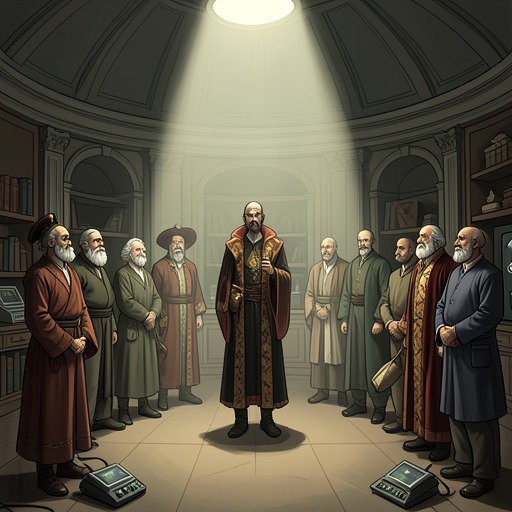
Nature tolerates paradoxes but abhors vacuums
The Robot Who Looked Like MeNature’s tolerance of paradox but aversion to vacancies is the story’s governing explanation for Gleister duplication. Time travel can disrupt the ordinary placement of a person in space-time, but the resulting absence does not remain empty: Nature supplies another Gleister, and each further journey can renew the process. The principle turns an apparent escape from history into a mechanism for multiplying its consequences.
The Rule of Displacement
When the original Gleister builds a time machine and travels into the future, he leaves a hole in the space-time fabric by departing his normal position. Nature fills that vacancy with an identical or near-identical Gleister, as though drawing on spare parts. The rule therefore does not erase the displacement or restore a single, undisturbed timeline. It allows the paradox to stand while answering the absence with a replacement.
The replacement is not an isolated correction. Each time a Gleister uses a time machine, another displacement creates another vacancy, which Nature fills by producing yet another Gleister. Time travel thus carries a self-renewing consequence: every journey adds to the population of versions whose later actions can generate further journeys and further replacements.
Why the Past Cannot Be Undone
After recognizing that he has multiplied Gleisters and badly affected the human race, Gleister considers going back to the moment before he invented the time machine and preventing its invention. The experience of another Gleister has already shown him that this solution cannot simply be carried out. There is no vacant niche in the past waiting for him to return to and occupy; everything modifies everything, including the traveler who would attempt to intervene.
Nor is there just one other Gleister who could be persuaded to make a different choice. There are multiple potential Gleisters, identical up to the moment of contact and different thereafter. The principle consequently places a limit on corrective action: Gleister can remain himself only if he does not interfere with himself. Nature’s filling of a vacancy explains why an absence cannot be used as a clean opening through which to restore the past.
Consequences for the Gleister Sequences
Mingus explains that the accumulating Gleisters travel on separate missions and form different sequences. One becomes the Emperor; another forms an organization against the Emperor; other sequences also arise. Because each new Gleister can travel through time and help create still more Gleisters, the replacement rule develops into a recursive history rather than a one-time anomaly.
The principle therefore connects a local event—the departure of one person from his normal position—to a widening political and temporal disorder. It makes the proliferation intelligible without making it reversible: Nature fills the vacancy, but the replacement itself becomes part of the chain that produces further vacancies. The paradox is tolerated; the multiplying consequences are not thereby resolved.