Never-Ending Live Western Film
The Robot Who Looked Like MeThe Never-Ending Live Western Film turns the Western from a story viewed at a distance into an ongoing world inhabited by performers. Its landscape is not merely a backdrop: actors enter it through a boundary between modern America and a vast monitored territory, then improvise within a genre whose violence is real enough to make a no-kill contract significant. The film’s central formal paradox is that its performers are both inside the action and aware of themselves as its audience.
Definition and Setting
The Movie occupies a million-acre expanse of prairie, mountains, and desert, watched by thousands of concealed cameras and microphones. Its scale makes the fictional West a place actors can move through rather than a succession of constructed scenes. At one entrance, a low, unpainted pinewood station marks the division between the monitored frontier and twenty-first-century America, described as recycled and reprocessed. Crossing the station takes performers from one material environment into another, while the cameras make the passage part of the film’s unseen production system.
The setting includes recognizable Western landmarks and routines. A Wells Fargo station provides an entrance; elsewhere, a settlement called Comanche has a single Main Street lined with a saloon, boarding house, livery stable, blacksmith’s, and general store. The scale shifts from the immense territory to the compact, familiar town. This combination gives the production room for extended travel while retaining the conventional social stage of a Western settlement.
Production and Performance
Unlike the staged films Consuela knows from South America, The Movie is performed for real, with its guns not limited to firing blanks. Her difficulty accepting that arrangement exposes the production’s basic distinction between simulated effects and actual consequences. The Movie has no script: performers improvise around whatever situations arise. Its form therefore depends on a continuing possibility of action, not on actors following a fixed sequence of written scenes.
The production’s contracts show that participation can nevertheless be bounded. Washburn returns from retirement for a cameo under a no-kill contract, appearing as a famous gunfighter in a comedy bit with Old Jeff Mangles and Natchez Parker. The contract is striking precisely because a contract to kill is more familiar to Consuela. It does not turn the broader production into a simulated one; instead, it defines the terms of this particular return within a world whose dangers the performers take seriously.
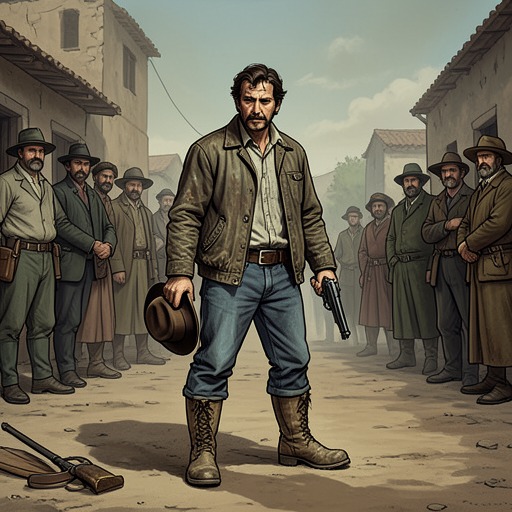
Preparation preserves the separation between the modern production and its historical fiction. Before Washburn enters, an assistant director checks his costume for anachronisms, including a wristwatch. Washburn wears blue jeans, a checked shirt, a rawhide jacket, and his derby, with a revolver and other equipment ready on a horse beyond the station. The checks make ordinary objects consequential: anything that belongs to the modern world could expose the machinery behind the Western image.
The Performer as Character and Audience
Washburn’s return makes visible the difference between the celebrated image and the person who performs it. Viewers have seen him repeatedly on neighborhood theater screens and pay-TV, riding through the Western landscape in his familiar derby with a Colt .44 at his side. Now he is entering the territory after retirement, while the production’s cameras present the rider as a figure moving through a cinematic panorama. The familiar screen image is thus renewed through a performer’s actual journey into the set.
The narration makes that division more complicated: Washburn describes himself as both the audience watching the actor and the actor watching the audience. The film’s perspective consequently doubles back on itself. The camera follows a solitary rider across canyon walls, shows him camped beside a small fire, and returns to him at dawn preparing for another day’s ride; at the same time, Washburn recognizes those images as performances that he can observe. The dream of playing a role while also watching oneself play it becomes an explicit account of how the film is experienced from within.
This self-observation extends beyond the Western production. Washburn reflects that people never stop acting or watching themselves act, while the heroic images he sees coincide with those shown to viewers. The passage does not erase the distinction between actor and audience; it makes that distinction part of the subject. The Movie’s cameras organize an image for distant viewers, while its performer watches that image form from inside the role.
Continuity, Risk, and Significance
The production’s continuity is measured against the familiar conventions of the Western. Washburn and Gordon Simms had imagined ending their years at the top of their form, in a definitive final confrontation on a dusty Main Street. Instead, the opposition became cautious, and Washburn spent a final year riding around without finding anyone willing to challenge him. His later cameo is therefore both a return to The Movie and a diminished version of the climactic ending they had wanted. The ongoing form can sustain a character beyond the point at which a conventional story might provide a decisive finale.
The Never-Ending Live Western Film also places theatrical play beside practical limits. It offers no script and leaves events open to improvisation, yet it depends on cameras, costume checks, contracts, and an entrance between two worlds. Its performers can inhabit legendary roles, but their awareness of the production never entirely disappears. That tension gives the film its distinctive structure: the Western is at once an unfolding performance, a monitored physical environment, and an image watched by people who know they are watching a performer.