Office of Future Projections
The Robot Who Looked Like MeThe Office of Future Projections is Loris’s forecasting institution and the nearest thing its nearly leaderless society has to a governing center. It does not ordinarily issue commands: it produces economic, social, and scientific projections. Its encounter with Johnny Bezique reveals both the office’s restrained place in Lorian public life and the danger that its knowledge may be drawn into a conflict with Earth.
Identity and Place in Lorian Government
The Office of Future Projections operates in a society where food, clothing, housing, and entertainment are free, money and banks are unnecessary, and even doors respond to mental commands. Lorian government reflects the collective mind of the population so closely that there is little apparent distance between public wishes and official action. In this setting, the office is not described as a conventional ministry exercising broad administrative power. It is instead the closest institutional equivalent to a governing center in a place that seems to have almost no government at all.
Veerhe, its chief, is identified as the nearest thing Loris has to a ruler, but he does not give orders. His stated function is to issue forecasts from time to time, covering economic, social, and scientific matters. The distinction is central to the office’s character: it makes the future legible to its society without routinely dictating what that society must do. Its prominence comes less from command than from the authority attached to projection and expertise.
Forecasting and Political Judgment
The office’s work is not limited to abstract trends. When Johnny reaches Veerhe, the Chief Planner has completed a projection concerning Earth in relation to Loris. The forecast compares the racial characteristics of the two peoples and predicts a struggle for preeminence. It attributes the coming conflict not to Lorian ambition but to the human drive to rule or resist being ruled, which it presents as an outcome of Earth’s level of civilization.
This projection gives the office a role in interpreting danger before it becomes open conflict. Yet the scene also distinguishes prediction from prevention. The office can identify a likely collision between societies, but its forecast does not itself resolve the political problem. Johnny already believes that the peoples cannot coexist as equals; he dismisses the forecast as something he could have understood without an official title. The office’s analytical authority therefore does not guarantee that its conclusions will restrain someone determined to act on the threat.
Johnny Bezique’s Approach to the Office
Johnny first tries to exploit what he assumes must be a conventional political hierarchy. Intending to force people to listen by threatening a ruler, he looks for the person who occupies that role. Loris has no ruler in the familiar sense, so he turns to the office and Veerhe as the closest available equivalent. A local resident supplies the address, and Johnny gets within four blocks before a group of twenty monitors stops him.
The monitors’ uncertainty reflects Loris’s unfamiliar relationship to enforcement: arresting people is their task, but the scene suggests that they have little experience carrying it out. Johnny takes advantage of that hesitation by claiming that he is a Lorian Planner who received special aggression training for a mission. He says that the mission is complete, that he has returned to test Loris, and that he must report grave news to the Chief Planner at the office. This is a fabricated identity and explanation, not an official account of the office’s own operations. The monitors ask him to confirm his claims, but he insists that the matter is too urgent to wait.
After a monitor asks for orders, Johnny directs the group to keep the peace and calm worried citizens. His passage is then challenged by ten armed monitors in black at the Planning Office door. He refuses to stop; they do not fire, and he continues through the office corridors. The sequence shows how a confident invocation of institutional rank can unsettle officials who are accustomed to a comparatively peaceful public order, even when the claimed authority is false.
Veerhe and the Consequences of the Forecast
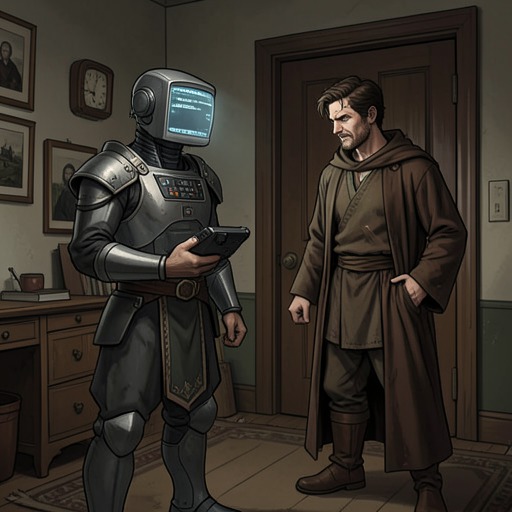
Inside the office, Johnny meets Veerhe, described as a calm, small man with an aging pixie face. Veerhe offers the completed projection on Earth and Loris, while Johnny attempts to subordinate the meeting to his own demands. The two men embody contrasting uses of the office’s authority: Veerhe presents an assessment of the interplanetary situation; Johnny has come prepared to convert the political crisis into personal rule.
Johnny’s ambitions soon exceed the role he had first claimed. He wants to review information about the Ancient Dynasty Spacefleet and proposes first a referendum electing him Emperor, followed by a coronation. Veerhe agrees to begin arranging this. The office, initially defined by forecasts rather than commands, is now shown participating in the practical preparations for a transformation of power. The narrative does not describe the office’s wider procedures or establish that this response represents ordinary practice; it shows Veerhe’s agreement in this particular crisis.
Narrative Significance
The Office of Future Projections stands at the hinge between Loris’s quiet political arrangements and the impending projection of power beyond the planet. Its forecasts articulate a danger created by the mismatch between Lorian restraint and human appetite for supremacy, but the institution’s non-commanding character leaves room for Johnny to turn its prestige toward his own program. A society in which officials generally predict rather than order is vulnerable, in this episode, to a forceful newcomer who claims emergency authority and then seeks formal authorization for his ambitions.
The office’s response has sharply different implications for the two worlds. Earth faces the prospect of an advanced alien civilization imposing its culture; Loris, previously described as defenseless, gains an aggressive general and the prospect of mercenaries to operate its fleet. Veerhe’s office does not originate Johnny’s expansionist purpose, but it becomes the institutional setting in which that purpose acquires a route toward legitimacy. Its importance lies in this reversal: forecasting is not the same as governing, yet in a crisis the boundary between describing a future and helping to arrange one can narrow.