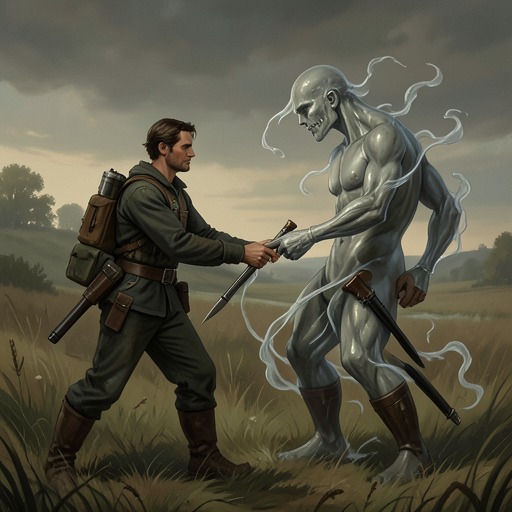
One’s shape is one’s career
The Robot Who Looked Like Me“One’s shape is one’s career” gives the Goo’s transformation a language of vocation rather than mere physical change. The phrase links the form an organism has to the life it is trying to make, and becomes especially pointed when the Goo asks what form it should take next.
The Phrase in Context
The Goo uses the maxim while explaining that, before meeting Joe Pareti, it had tried to become what it wanted to be without knowing what that was. It describes the experience as frustrating: it had its whole life ahead of it, yet no clear direction. The sentence therefore makes shape more than appearance. For the Goo, finding a form is bound up with discovering what its life can be.
The Goo presents this uncertainty as part of a personal history. It says that it had tried with five other men and had not become what it wanted, then contrasts that past with its relationship with Joe Pareti. The line about shape and career sits inside this account of experimentation, desire, and eventual attachment; it is not offered as a detached proverb.
Relationship and Recognition
The Goo recalls Joe Pareti’s pet names and describes their earlier encounters as a courtship in which it was lifted from the water and gradually grew up. It also acknowledges that both had sexual histories before they met, asking that neither hold the other’s past against them. These details give the maxim an intimate setting: its idea of a future form has developed within a relationship, but it does not erase the Goo’s life before that relationship.
Joe Pareti initially rejects the Goo’s account as a misreading, while the scene overwhelms his senses and makes the world seem to change around him. The passage then reframes what he has underestimated. The Goo had been young and mute, but not unintelligent; like other living creatures, it was shaped by powerful desires, including the desire to have form. Its present speech makes that earlier development newly legible as an ongoing process of becoming.
Form as an Unfinished Future
The maxim’s meaning sharpens when the Goo asks Joe Pareti what he would like it to become. Its question turns the abstract connection between shape and vocation into an immediate choice about its future form. The Goo’s evolution is not presented as finished: it is still changing, and it seeks an answer from the person with whom it understands itself to have formed a bond.
That ending leaves a tension inside the phrase. The Goo’s desire to have form is its own, yet it invites Joe Pareti to help specify what that form might be. “One’s shape is one’s career” thus names both self-making and the uncertainty that precedes it: a life takes shape through desire, but its eventual direction remains open.