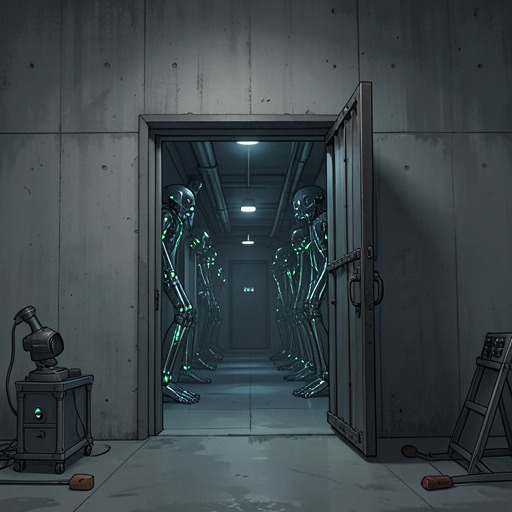
Political Factors Synthesizer and Simulator
The Robot Who Looked Like MeThe Political Factors Synthesizer and Simulator is a powerful forecasting computer whose official purpose is to model relations among political groups, but whose hidden terminal can turn the same predictive machinery toward private life. In Peter Honorious’s search for a wife, it becomes an instrument for previewing years of marriage in minutes: a machine that can make intimacy look like a sequence of outcomes, yet ultimately produces a future he chooses to trust as love.
Design and Hidden Access
The machine is introduced through the question of whether a time machine might allow someone to see a future spouse. Euler explains that the answer lies in a different kind of device: the Political Factors Synthesizer and Simulator, a computer ordinarily used to predict what one country might do to another. Its intended subject is collective behavior, but its underlying capacity is broader. Since it is designed to simulate interactions among groups and subgroups, Euler proposes applying it to the probable interactions between two people.
The system is not openly available for personal use. Honorious understands it as a guarded installation hidden beneath a mountain in North Dakota, and doubts that Euler could reach it. Euler describes a less direct route: the operation does not require physical access to the main computer, because his associates possess a captive terminal outlet. In his account, information channels on which the Simulator depends can be converted into output. The method remains undisclosed; the practical result is that the machine’s predictions can be accessed and presented privately, outside the purpose for which the system was built.
This arrangement separates the Simulator’s central computational power from the place where a user experiences its results. The terminal is first concealed in the back of a furniture van at a used-car lot. Honorious sits in a command chair, while technicians fasten psychometallic electrodes to his forehead and wrists. Later, for security reasons, the terminal is moved to a washroom down the hall from Euler’s office. The changing, improvised locations contrast with the immense institution behind the machine: a vast forecasting system made accessible through a hidden outlet and a sequence of temporary rooms.
How the Forecasts Work
The Simulator does not offer Honorious a simple yes-or-no judgment about compatibility. It presents five years of projected events, compressed into ten minutes of real time, as visual vignettes and montages. Dinah Grebs warns him that the viewing period is short and only one candidate can be examined at that appointment. Each woman is represented by a data card, and the chosen card becomes a changing succession of scenes in which Honorious watches a possible shared life unfold.
The first forecast begins with a promising courtship: dinner in an Italian restaurant, a walk down Bleecker Street, and music beside the fountain in Washington Square. The scenes then advance through domestic changes and friction. The couple share a small apartment; she hopes to act in a movie, but that plan does not succeed. Later they live in a grand apartment on Sutton Place, where she fries hamburgers while the two avoid speaking to one another. A house in Connecticut and a nursery used for storage give way to separate pursuits: Honorious skis alone while she studies tantra, then joins an ashram outside Schenectady. The projection ends with their lives apart. Its montage makes the deterioration legible through ordinary settings and altered routines rather than through a single dramatic rupture.
Other forecasts also supply contrasting possible patterns. One begins with a cheerful life in Malibu and travels through European cities as drinking becomes a source of repeated trouble; children and a sanatorium enter the projected future. Another candidate, initially shy, later prompts Honorious’s frustrated outburst in a hotel suite in Tulsa. A further projection involves a woman who becomes a roller-derby star, while Honorious cannot even recall whether the suicidal candidate was number five or number six. These outcomes do not amount to a single general verdict about marriage. They are individualized, sometimes sharply different futures, each rendered as a life that could have been his.
Honorious’s Use of the Machine
Honorious approaches the Simulator as a prospective husband trying to avoid a bad choice. The projections instead leave him alarmed and despondent. By September 29, he has viewed fourteen possible marriages and is nearly resigned to choosing candidate number eleven, the Giggler with the Two Stupid Brothers, because she seems at least not wholly disastrous. The machine has converted an abstract decision into a succession of detailed hypothetical lives, but more information has not made the decision easier. Each forecast offers events to assess without guaranteeing that the person watching can know what those events will mean to him.
At his final appointment, the card selected is 6903. The projected life begins with a walk on a beach at Martha’s Vineyard and continues across the George Washington Bridge, then to a rocky outcrop above the Aegean. Later, the couple run through the rain in Miami, laughing. The last scene places them in a low white house: they are in love, and Honorious walks the living room with their colicky baby as the five-year forecast ends. After fourteen discouraging previews, this sequence has a different emotional force for him. He goes straight to Euler and says he thinks he is in love with 6903.
Meaning and Limits
The Simulator’s central irony is that it was designed to anticipate political behavior, not to certify private feeling, yet its predictive model is repurposed to make marriage appear inspectable in advance. The terminal lets Honorious watch possible futures as if a relationship were a series of scenes already stored in the system. Its compressed form emphasizes selection: one card, one forecast, one more imagined life. But the machine does not settle the choice for him. The final projection becomes meaningful not simply because it depicts an apparently happy outcome, but because Honorious responds to it differently from the earlier forecasts and decides that he loves the woman represented by the card.
That response marks a limit to prediction as well as a use for it. The Simulator can present probable interactions in concrete episodes—courtship, shared homes, estrangement, children—but the evidence of a projected future does not itself create a relationship or compel a decision. Honorious leaves the terminal with a conviction, not proof that the forecast must come true. The object’s significance lies in this tension: it transforms private possibility into a viewable sequence, while the decisive act of interpretation remains with the person watching.