Postwar ecological collapse and global food crisis
The Robot Who Looked Like MePostwar ecological collapse and global food crisis are the interlocking consequences of the Third World War: contamination destroys much of the natural food chain, while the resulting Goo becomes the raw material for a new global food industry. The crisis does not end with the fighting. Radiation travels across continents, ecosystems fail in ways that cannot be repaired by treating human survivors, and hunger forces governments to make industrial food production a matter of collective survival.
From Cold War preparation to ecological ruin
The disaster follows decades of preparation and demographic pressure. Cold War Phase I had ended in the 1970s, when war seemed inevitable; Cold War Phase II lasted another thirty years and centered on measures intended to limit the effects of an overwhelming attack. Among those measures were underground canister cities, including Lower Hong Kong, Labyrinth beneath Boston, and New Cuernavaca. Their enclosed conditions offered few pleasures, and population growth filled them, driving the expansion of tunnels and subterranean settlements. Aboveground, military and scientific elites were the principal groups living by choice.
The Third World War then brought bacteriological, atomic, laser, and radiation attacks. The North American continent suffered extensive destruction: Los Angeles was destroyed, Oak Ridge disappeared in a flash, Louisville was reduced to rubble, and Detroit and Birmingham were replaced by smooth reflective surfaces. Ironwall, the antimissile complex buried beneath the Smokies, was lost along with half the surrounding mountains. New York and Chicago fared better: their suburbs were lost, but their canister sub-cities and central metropolitan cores survived, battered but still functioning. The war’s ecological effects, however, extended far beyond the cities and military targets.
Contamination reaches the sea
Human beings could be saved in large numbers because the Cold War years had allowed the development of serums, remedies, antidotes, and other treatments. That medical response could not restore crops or protect all the animals and fish exposed to the altered environment. Species disappeared, while others survived; the ecology itself became unstable. The distinction is central to the crisis: medical protection for people did not mean that the systems supplying their food were also protected.
The pollution followed a long atmospheric route. Westerly winds carried radiation and biological residue across North America, picking up further contamination around the Smokies, Louisville, Detroit, and New York. The winds then bore that material over the Eastern Seaboard and the Atlantic, finally dispersing it in the jet stream over Asia. Before dispersal, fallout off the Carolinas combined with sunlight and rain over the plankton-rich waters of Diamond Shoals. Ten years after the war ended, the plankton had changed into a substance Outer Banks fishermen called Goo. Diamond Shoals became a site of continuing biological transformation rather than a landscape simply left behind by the war.
The new organism spread and adapted. Deformed exoskeletal fish appeared in shallow waters; four new dog-shark species were found, including one successful adaptation, and a centipedal squid with a hundred arms flourished for several years before vanishing. These changes made the sea appear to be producing a new ecological threat. Goo itself persisted even as some of the other mutations did not, giving the crisis its decisive reversal: the substance born of pollution would become a resource for people left without a functioning natural food supply.
Hunger and the political response
The loss of crops and animals made the food crisis global. The account emphasizes that an ear of corn could not be inoculated against the damage, and that domestic, wild, and marine life could not all be protected. As the ecological losses accumulated, hunger strikes and food riots began. They ended quickly, not because the shortage had been resolved, but because people weakened by hunger could no longer sustain collective resistance. Severe deprivation was followed by social breakdown, and governments, alarmed by the consequences of the war and of their own actions, finally acted together.
The United Nations was rebuilt and commissioned The Companies to develop artificial foodstuffs. This response joined public coordination to corporate processing, but it was slow to emerge. Its dependence on industrial transformation reflected the scale of the problem: the old supply of meat, vegetables, and other foods had been drastically reduced, while the surviving population still needed nourishment on a vast scale. The food crisis therefore did not merely prompt a new product; it reorganized the relationship between ecological damage, industrial production, and everyday survival.
Goo becomes a food supply
Experiments established that Goo could be converted into nourishment when it was killed and processed. Its composition included proteins, vitamins, amino acids, carbohydrates, and minimum amounts of trace elements. Dehydrated and packaged, it could be stored and sold; combined with water, it could be prepared in many ways. Its flavor changed according to the patented processing system used, rather than having one defining taste. This flexibility allowed a single postwar resource to become an adaptable substitute for foods that the damaged ecology could no longer reliably provide.
The production chain also multiplied the available supply. Goo sent to cracking and radiation plants was subjected to patented processing methods that caused it to fragment, expand, and yield roughly forty times its original weight before it was killed and reprocessed as basic artificial food. It was purified, supplemented, colored, scented, and packaged under multiple brands for twenty-seven billion consumers. The scale of that market makes the industrial solution inseparable from the emergency that produced it: the same material that emerged from polluted waters became a standardized staple for a population long estranged from familiar foods.
Harvesting and the cost of survival
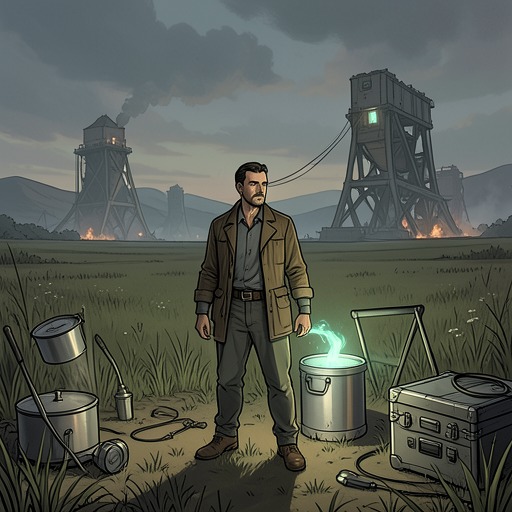
The Companies erected harvesting factories called TexasTowers and trained workers to collect Goo offshore. A TexasTower could be moved or fixed to the ocean bottom, making it difficult to classify as either ship or island; its feeder pipes drew the harvest into a factory that also functioned as a vessel. At Diamond Shoals, harvesters skimmed the water for material that could resemble different objects and forms. Its abundance and economic usefulness did not make collection safe. The work was legally classified as high-hazard labor, and harvesters received unusually high wages as compensation for the risk.
Joe Pareti illustrates the human place in this system. Although he had graduated from the Multiversity, he chose harvesting over industry or the think-factories, drawn to work for which he had an instinctive aptitude. He earned $530 per shift, yet the high-hazard designation concealed a danger he did not understand when he took the job. When a doctor later reminded him that the risks had been disclosed and compensated, the exchange exposed the distance between formal consent and a worker’s grasp of what the work might cost. Harvester labor kept the world alive, but the food system placed the danger of securing its raw material on workers at sea.
The crisis thus resolves neither into a return to the prewar world nor into a simple triumph of technology. Human survival depends on an organism created by accumulated contamination, transformed by corporate processes, and gathered through hazardous labor. Goo saves lives precisely because ecological collapse has made other sources of food scarce; its promise and its danger remain joined at every stage, from polluted sea to processing plant to the meal prepared with water.