Snaithe
The Robot Who Looked Like MeSnaithe is a resourceful, disreputable robot-maker whose custom-built humanoids allow people to delegate intimate social encounters to mechanical doubles. In Charles’s case, Snaithe makes a robot identical to its client and able to reproduce his behavior, enabling a courtship conducted in Charles’s place; Elaine’s account suggests that his services have also helped other women navigate comparable romantic predicaments.
Identity and Workshop
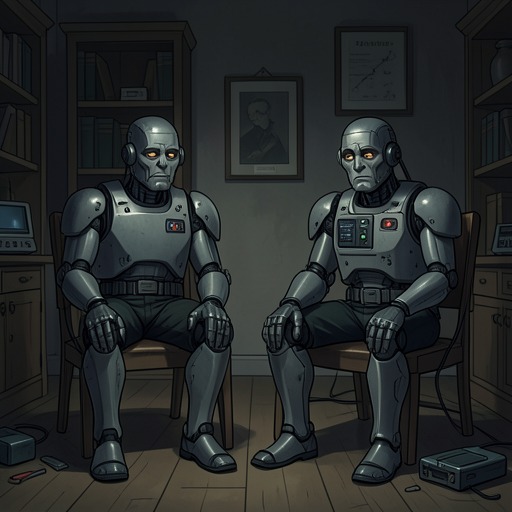
Snaithe runs Snaithe’s Robotorama, an inconspicuous shop on Boulevard KB22 near the Uhuru Cutoff in Greater New Newark. Wedged between an oxygenator factory and a protein store, it advertises full-size humanoid robots dressed as a French chef, a British nanny, and an Italian gardener. The polished promise of domestic service gives way inside to a dusty showroom and a workshop crowded with humanlike heads, limbs, torsos, and dangling wires, stacked on shelves or propped in corners.
Charles’s description of Snaithe is as unflattering as the shop is unsettling: a small, gray, wormlike man with a lantern jaw and conspicuously large red hands. Charles also calls him normally larcenous and frames his foreignness as part of a stereotype about bootleg robot-makers. That judgment belongs to Charles’s narration, not to any independently established account of Snaithe’s background; what the transaction does establish is that he is willing to work outside official controls.
Custom Work for Charles
When Charles asks Gordon Simms who makes the best individualized one-shot robots, Gordon immediately names Snaithe. Charles approaches him with a precise commission: a robot without government markings, physically identical to himself and capable of duplicating his behavioral patterns. Snaithe agrees, and Charles pays heavily. The arrangement suits a client with money but little time to spend, making the machine a purchased substitute for Charles’s own presence rather than merely a household appliance.
The completed robot is sent to Charles’s apartment by pneumo-express. Charles animates it, transmits relevant data from his computer to its memory tapes, and enters a courtship plan before running tests. At the workshop, Snaithe presents the finished double by removing a sheet from its head. The resemblance is exact down to the textures of skin and hair; Charles recognizes his own firmly cut features and impatient-looking eyes in the machine. He postpones testing its voice and behavior, pays Snaithe, and asks him to deliver it to the apartment. The subsequent programming and testing show that Snaithe’s role extends beyond fabricating a likeness: he supplies the physical instrument for a behavioral imitation that Charles intends to use in courtship.
Courtship Service and Significance
Elaine later recalls knowing several girls who had found themselves in a similar romantic predicament and had gone to Snaithe, describing him as a clever robot-maker. Her account places Charles’s purchase within a recognizable, if discreet, pattern of using custom robots to manage courtship. It does not establish that Elaine herself commissioned a robot, but it shows that Snaithe’s work is known beyond Charles’s own transaction.
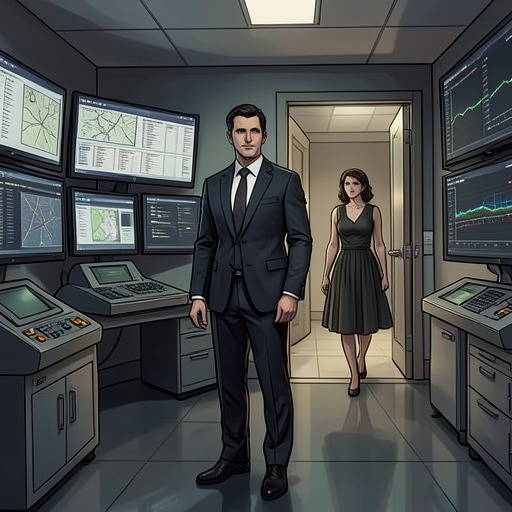
When Charles confesses that he, too, used Snaithe, Elaine realizes that he sent a robot to court her and objects to the possibility that she might have been the person it encountered. The revelation makes the machine’s exact likeness more than a technical achievement: the robot can reproduce a person’s appearance and behavior while leaving the person absent from the encounter. Snaithe remains a compact, sharply drawn figure rather than a character whose private motives or later fate are explored; his narrative importance lies in making that substitution possible, and in turning the pressures of courtship into a marketable, personalized service.