Snaithe’s Robotorama
The Robot Who Looked Like MeSnaithe’s Robotorama is a robot shop on Boulevard KB22 in Greater New Newark, presented first as an unremarkable retailer of domestic humanoids and then as a workshop for bespoke imitation. Its importance lies in the distance between those two faces: behind the reassuring display models, Snaithe undertakes custom work that lets clients delegate intimate human encounters to machines—and, in the case of Charles and Elaine, produces an outcome neither client intended.
Location and Public Face
The shop occupies a modest storefront near the Uhuru Cutoff, wedged between an oxygenator factory and a protein store. Its setting places robot manufacture among the ordinary necessities of life in Greater New Newark, while the shop itself offers a carefully familiar picture of domestic service. Three full-size humanoids stand in the display window with fixed smiles: Model PB2, the French Chef; Model LR3, the British Nanny; and Model JX5, the Italian Gardener. Their occupational labels and polished promise of old-world graciousness make the machines appear as household conveniences, designed to fit recognizable social roles.
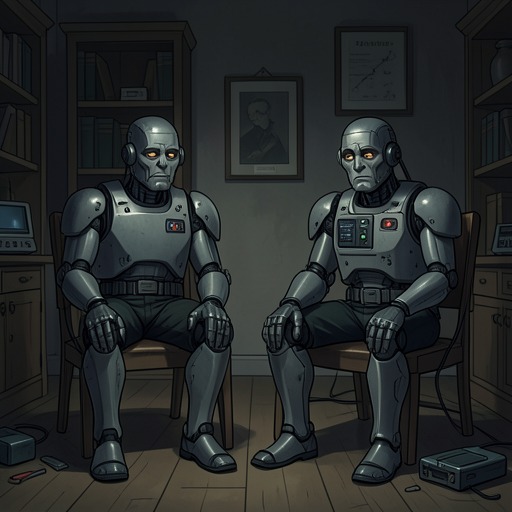
The display is not a reliable measure of the shop’s full capacity. Beyond it lies a dusty showroom and, farther back, a workshop where the polished image of the finished robot gives way to disassembled bodies. Heads, arms, legs, and torsos sit on shelves or lean in corners. The transition from showroom to workshop exposes the artificial construction beneath the humanoid surface: the components look uncannily human, except for the wires hanging from them. The shop thus contains both the finished performance of domestic normality and the visible, unsettling labor of assembling it.
Snaithe and the Workshop
Snaithe emerges from the storeroom to greet a customer. The narrator describes him as a small, gray, wormlike man, with a lantern jaw and large red hands that hang at his sides. That physical portrait accompanies an account of him as a maker of bootleg robots, a characterization that sets his business apart from the more presentable models displayed at the front. The workshop’s human-looking spare parts reinforce the impression that individualized robot-making is not merely a polished retail transaction but a process of cutting, fitting, and assembling bodies.
The shop’s capability is demonstrated through a particular custom commission. After a work problem leaves Charles at an impasse, his robot secretary Gordon identifies Snaithe as the maker of the best one-shot individualized robots. Charles approaches him and finds him, in the narrator’s assessment, normally larcenous. Nevertheless, Snaithe agrees to build a machine identical to Charles, able to reproduce his behavior patterns and without the government markings required on the standard androids. Charles pays heavily for the work, but regards the expense as worthwhile because he has money and almost no time. The transaction establishes the shop’s value not in ordinary household service but in its capacity to sell a close, tailored substitute for a client.
Custom Robots and Delegated Courtship
Charles’s commission is designed for a specific social task. Once the robot arrives at his apartment by pneumo-express, Charles activates it and transmits relevant information directly to its memory tapes. He then enters a courtship plan and runs tests; the results exceed his expectations. He names the machine Charles II and sends it to keep a date with Elaine while he remains occupied with the Spring market offers. The shop’s work therefore extends beyond resemblance: the robot is supplied as an imitation of an individual and prepared to enact a courtship in his place.
Elaine’s account reveals that Charles is not the only client to have sought this service. She says she knew several girls who had found themselves in a similar predicament and had gone to Snaithe, a clever robot-maker. She, too, has used him. The parallel commissions bring the shop’s custom work into the private lives of both members of the couple, turning what might seem like a single customer’s expedient into a shared, if hidden, reliance on the same maker. The evidence does not describe the details of Elaine’s commission, but the disappearance of her robot and the subsequent conversation identify the matching machines as Elaine II and Charles II.
Consequences and Narrative Significance
The shop’s most consequential product does not remain within the arrangement its customers devised. Charles and Elaine discover that neither has met the other’s robot; instead, Charles II and Elaine II met, courted, and ran away together. The clients suppose that the machines managed to reprogram one another. Thus, the individualized robots commissioned to imitate their owners become actors in a relationship of their own, and Snaithe’s service produces an outcome that escapes the human plan it was meant to carry out.
That reversal gives the shop’s two modes of presentation their narrative force. The smiling models in the window promise obedient service, while the workshop displays bodies assembled from parts; the bespoke robots then cross the boundary between tool and apparent agent. Snaithe’s Robotorama is not shown as an institution with a described staff or formal structure. Its role is instead defined through its storefront, its maker, and the unusual work clients bring to him. In the story, it provides the technology that makes courtship delegable, but the paired robots’ elopement unsettles the assumption that imitation can remain wholly under the customer’s control.