TexasTower
The Robot Who Looked Like MeTexasTower is an offshore factory built to harvest and process Goo, but its uncertain identity as ship or island makes it more than a conventional industrial setting. A vast, adjustable structure in the Atlantic, it supports an exhausting and highly paid workforce while bringing the hazards of that work close to Joe Pareti’s body. Its imposing architecture and ordinary working routines establish the conditions under which the story’s industrial process becomes personal crisis.
Definition and Structure
Traditionally called a TexasTower, the structure bears little resemblance to the offshore drilling rigs of pre-Third World War America. It resembles an articulated coral reef or the skeleton of an immense aluminum whale: an image suited to a facility whose shape changes with its surroundings and needs. It can move, making it ship-like, yet it can also be fastened irreversibly to the ocean floor, making it island-like. The narration treats this uncertainty as a problem of definition, not simply a matter of appearance.
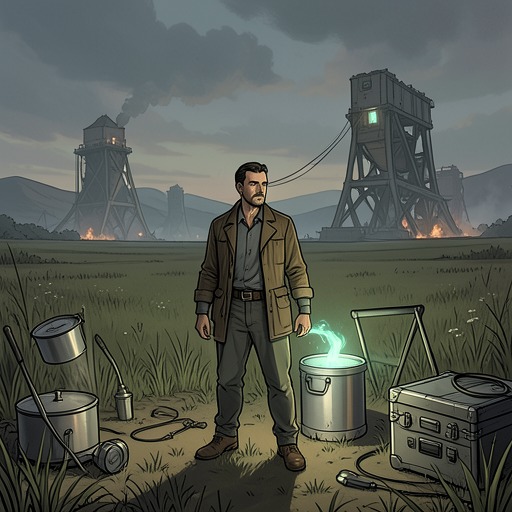
Above the water, a dense framework of pipes serves several functions. Harvesters feed Goo into feeder pipes; racks provide moorings for their punts; additional pipes support the radar mast. Pareti unloads his catch by attaching a collapsible tube nozzle from his punt’s lazarette to a metal fitting on the feeder. When pneumatic suction begins, the tube pulses as the Goo is drawn into the factory. The structure’s industrial purpose is thus legible in its plumbing: storage, transport, and processing are joined in a single working system.
Two cylindrical entry ports gape above the surface like howitzers. Below the waterline, the Tower extends like an iceberg through collapsible sections that can be folded or deployed according to depth and necessity. At Diamond Shoals, several dozen of its lowest levels are folded out of operation. The immense structure is shapeless, ungainly, slow-moving, and ponderous, yet difficult to sink even in a hurricane. As a vessel it is described as a disastrous design; as a factory, it is a marvel. That contrast captures its governing logic: the Tower is not designed to travel gracefully, but to keep its industrial function going in a harsh environment.
Offshore Work and the Hazard Economy
The Companies erect TexasTowers as harvesting factories and train workers for the job. Harvesters earn more than workers in any other nontechnical occupation, not because the work is merely long or tiring, but because their pay is legally classified as high-hazard pay. The designation gives the workforce’s unusual wages a plain institutional meaning: harvesting carries a danger built into the occupation.
Pareti chose the work after abandoning an educational path he found unappealing. Although he sees the credits accumulate in his account, he has never really understood why they are called high-hazard pay. The narration places that incomprehension beside the physical demands of his routine. After twelve hours on shift, exhausted by work on the sea, he wants only to reach his stateroom and sleep; even the satisfaction of earning well has faded. His discarded cigar stump marks the end of a shift, but not the end of the bodily cost the Tower’s labor system will exact.
Interior Life
The Tower’s entrance sequence carries workers from the exposed mooring complex into controlled interior space. Pareti climbs out carrying his net-pole, passes through decontamination and storage locks, and is puffed inside. He then descends a winding aluminum staircase, where voices from below lead him into the social life of the factory. Mercier, preparing to begin a shift, is arguing with Peggy Flinn, who has been on sick call for three days. Their disagreement concerns harvester bonuses: Peggy cites a processing rate of fifty-six dollars a ton, while Mercier asks whether that figure applies before or after the Goo fragments.
The exchange makes the factory’s economic calculations audible inside its machinery. Workers debate how the material is processed and how their bonuses are assessed, even as their shift schedules and illness shape daily life. The decontamination locks, storage spaces, feeder equipment, and working quarters are not separate worlds: together they organize the passage from offshore harvesting to industrial processing and from work back to bodily vulnerability.
Pareti’s Illness and the Tower’s Significance
The Tower is also the setting where the meaning of Pareti’s high-hazard wages becomes immediate. After a night that brings no rest, he wakes unable at first to move and struggles to keep his balance when he gets up. Later, noticing that his kneecaps, elbows, and heels have been scoured pink, he finds himself still holding his razor and stares at his altered, hairless appearance in horror. He seeks the Tower’s doctor, first looking in the sickbay and then finding him in the pharmacology lab. The doctor takes one look at Pareti and leads him back to the sickbay, where he confirms Pareti’s suspicion.
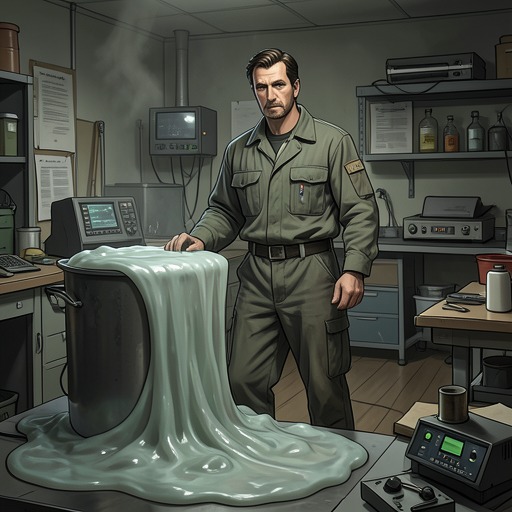
The consultation changes the emotional character of the institution. Pareti enters the sickbay feeling like a man and experiences himself leaving as a specimen: a diseased culture to be examined under a macroscope. The doctor, Dr. Ball, is usually gloomy, but Pareti’s hairlessness visibly cheers him. The moment places a human body alongside the Tower’s industrial materials and procedures, subject to observation and classification after exposure to danger. TexasTower therefore functions as more than a backdrop for harvesting: its systems make hazardous labor routine, while its sickbay reveals the physical consequences that routine can conceal.