The Companies
The Robot Who Looked Like MeThe Companies are the industrial firms charged with converting Goo into artificial food after the Third World War. Their processing system turns a strange growth in the waters of Diamond Shoals into nourishment for a population dependent on manufactured food. The same system links offshore harvesting, high-hazard labor, patented processing, and mass distribution: The Companies help keep the world alive, while their factories and the risks surrounding them become part of ordinary economic life.
Origins and Commission
The Companies enter the postwar food system after hunger strikes and food riots reveal how precarious the population’s food supply has become. The crisis abates, but scarcity has already exposed the consequences of a society with too many people and too little dependable food. The United Nations is rebuilt and commissions The Companies to solve the problem of artificial foodstuffs. The work proceeds slowly, and the commission marks the beginning of an industrial response rather than an immediate return to abundance.
The need for that response grows out of an ecological transformation. Radiation and other residues carried across the continent and over the Atlantic combine with sunlight and rain in the plankton-rich waters of Diamond Shoals. A decade after the war, the plankton has become Goo. It spreads and changes form, at first appearing to be a threat to marine life. Experiments eventually disclose an unexpected use: when processed, Goo supplies a broad range of nutrients and can be made into food. The Companies are therefore asked to manage a substance whose emergence is tied to the same wartime devastation that made artificial nourishment necessary.
Processing and Distribution
The Companies’ central contribution is a conversion process. Raw Goo is sent from the harvesting grounds to cracking and radiation plants. There it is treated through patented methods, multiplied molecule for molecule, fragmented, and expanded until its weight is about forty times its original amount. The expanded material is then killed and reprocessed as the basic artificial foodstuff of a population whose diet has long since lost its former staples. Industrial treatment thus changes Goo twice over: it increases the available quantity and makes the living, unstable substance usable as food.
The processed material is ground, purified, supplemented with vitamins, colored, scented, given different flavor accents, and individually packaged. Products reach consumers under names including VitaGram, Savor, Deelish, Gratifood, Sweetmeat, Quench-Caffe, and Family Treatall. The variety of labels and flavors presents a range of recognizable products, although their common origin is the same processed Goo. In dehydrated form the substance is economically rewarding; combined with water, it can be prepared in many ways. Its flavor depends on the patented processing system used, and it has many possible tastes but no characteristic taste of its own.
This production chain operates at extraordinary scale. The packaged food is marketed to twenty-seven billion people, with water added before serving. The Companies’ work therefore extends beyond the factory: it supplies a standardized basic food across a population too large to depend on familiar natural foods. The range of brand names differentiates the final products, while the underlying material and the industrial processes that make it edible remain shared features of the system.
Factories and Labor
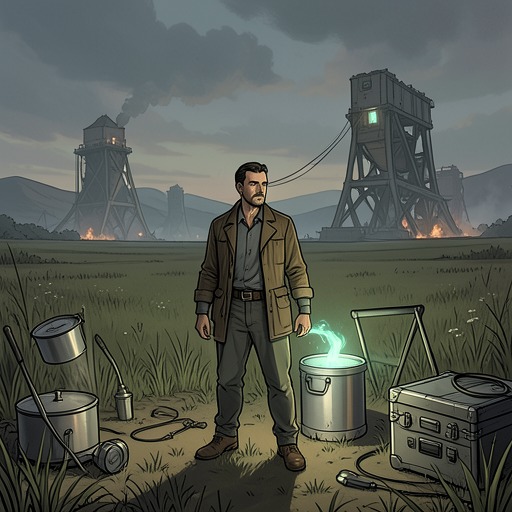
To secure the raw material, each of The Companies erects harvesting factories called TexasTowers and trains harvesters to gather Goo offshore. The towers serve as industrial infrastructure as well as places where collected material enters the processing chain. Harvesters bring their loads to the tower and feed them into a tube connected to its feeder system; from there, the Goo can be sent onward to the processing plants. The immense apparatus makes visible the dependence of food production on a continuous supply from the sea.
Harvesting is the best-paid nontechnical occupation in the world, not because the work is easy but because its wages are legally classified as high-hazard pay. The compensation is substantial: a shift can pay five hundred and thirty dollars. Yet the money does not remove the danger attached to the work. Joe Pareti, a university graduate who chooses harvesting instead of industry or a think-factory, has spent three years in the Goo fields without understanding why his deposits are designated hazard pay. When he later challenges the doctor treating him, the doctor points to his signed awareness of the risks and the bonus he has received. Pareti counters that the likelihood of contracting Goo disease had been presented as small and buried in the contract’s fine print. Their exchange shows how the employment system formally acknowledges danger while leaving the worker and the company in conflict over what that warning meant.
Social Function and Limits
The harvesters are described as literally keeping the world alive. That dependence gives The Companies’ industrial process a life-preserving function: without the conversion of Goo into food, the population’s already fragile diet would have no comparable source in the evidence presented. The Companies are not simply manufacturers of branded goods; they operate at the point where ecological mutation is made to answer a global food emergency.
That success does not erase the system’s costs or contradictions. The substance that initially inspires panic becomes a resource only after extensive industrial intervention, and its abundance depends on risky offshore labor. The Companies’ processing multiplies the raw material, but the harvester’s exposure remains attached to the act of collecting it. High wages and hazard bonuses acknowledge that risk without resolving Pareti’s dispute over how clearly it was disclosed. The Companies consequently stand at the center of a survival system that is both remarkable in its capacity to feed billions and inseparable from the dangers and economic terms imposed along its supply chain.