The Megenth assault on the Jenghik Palace
The Robot Who Looked Like MeThe Megenth assault on the Jenghik Palace is presented as the decisive public image of a larger military collapse: Earth’s farthest reach of power is destroyed, its defenders are overcome, and a witness concludes that the fate of Terra is sealed. The account links the attack not to a single battlefield reversal but to an expanding Megenth threat, a breach in the defenses around Zirn, and the loss of Jon Westerley. Its central irony is that the Palace’s fall becomes visible only after the conditions for defeat have already spread beyond it.
Causes and Strategic Collapse
The Megenth forces had long been quiescent, but their expansion began after Charles Engstrom, described as a power-crazed telepath, gave them a serum. The sudden change transformed a contained or dormant threat into an advancing force. The account does not describe the serum’s operation, but it establishes a direct causal link between Engstrom’s intervention and the Megenth resurgence.
The crisis also reaches Earth through the loss of Zirn. A guard, found in a stupor in a smoldering control chair, is freed by the first-person narrator and urged to explain what has happened. His effort yields only the repeated warning that Zirn is lost; he then dies. The narrator understands the strategic consequence: with Zirn gone, High Star Pass is open, the negative accumulators no longer function, and the drone soldiers have been overwhelmed. Zirn is therefore not merely another defeat. Its loss opens a route through which Earth’s defenses can be penetrated.
A separate account traces the death of Jon Westerley to the same widening emergency. Hastily recalled from a secret mission to Angos II, Westerley materializes within a ring of Black Force. The account attributes this to the inadvertent treachery of Ocpetis Mam, his faithful Mnerian companion, who had been trapped in the Hall of Floating Mirrors and mentally taken over by Santhis, the renegade leader of the Entropy Guild. Westerley’s death is thus not described as a deliberate betrayal by his companion: the chain of events depends on Ocpetis Mam’s capture and loss of control. The narrative calls Westerley’s death the beginning of the end for the rest of the defenders.
The Fall of the Palace
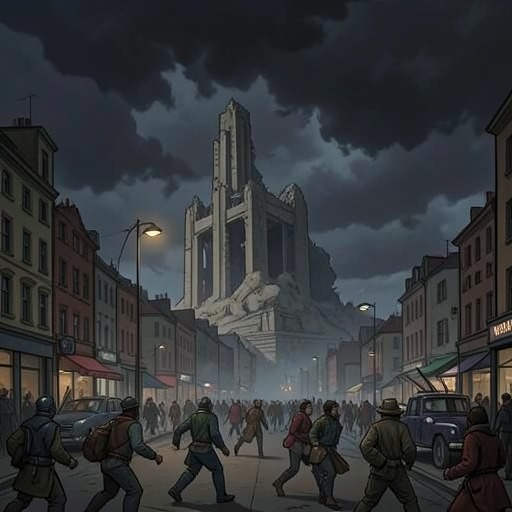
The fullest view of the assault comes from testimony attributed to a robot who might have been Dr. Zach. The witness acknowledges that its true identity may never be resolved, then gives an eyewitness account of the Megenth warriors entering the Jenghik Palace. The Palace’s crimson balustrades and ceremonial bronze cauldrons locate the assault within a ceremonial seat of power, now subjected to the destruction of its symbols and institutions.
The governor dies defending the Palace with a sword. The Terran Guard makes its last stand in Dolorus Keep and perishes after fighting there. The ladies of the court defend themselves with small daggers before being granted quick passage. The testimony gives each group a distinct place in the defeat: the governor’s individual resistance, the Guard’s final collective stand, and the court’s limited means of defense. It offers no rescue or reversal. The last actions of the defenders are acts within a defeat already closing around them.
The witness then sees fire consume Earth’s silver eagles, followed by the Jenghik Palace toppling into dust. The destruction is both material and emblematic. The Palace had marked the furthest extent of Earth’s suzerainty; its fall therefore registers more than the loss of a building. A physical monument to the reach of Earth’s power disappears at the moment that power fails to hold its territory.
Testimony and Aftermath
The report that Zirn has been left unguarded, the Palace is in flames, and Jon Westerley is dead compresses the wider crisis into three linked losses. A subsequent bulletin arrives blurred with fear. Charleroi interprets the news as evidence that someone is dancing on the survivors’ graves and imagines Earth itself as a mausoleum. The language conveys the scale of the perceived defeat, while the earlier strategic explanation supplies its concrete military meaning: Zirn’s fall has opened High Star Pass, the defense systems are no longer operating, and the drone soldiers have been overwhelmed.
The robot witness’s conclusion extends beyond the immediate destruction. It fears that Terra will be annihilated so completely that even its memory will vanish. That forecast is the witness’s judgment, not a separately confirmed account of Earth’s eventual fate. Its force comes from the contrast between the witness’s uncertain origin and its declared loyalty: it considers itself a son of Terra despite being, as it understands it, crafted rather than born. The testimony makes its recognition of defeat a statement of allegiance as well as a report of events.
Narrative Significance
The assault is constructed through accounts of different kinds: a terse crisis bulletin, a survivor’s failing attempt to report Zirn’s loss, a causal reconstruction of Westerley’s death, and the robot’s retrospective testimony from the Palace. Together, they replace the image of an isolated attack with a chain of failures. The fall of Zirn compromises the route and defenses; Westerley’s death signals that the crisis has reached the people and missions expected to resist it; the Palace’s destruction makes the loss of Earth’s authority unmistakable.
The Palace scene turns the value of security into its opposite. A seat of imperial reach, defended by a governor and the Terran Guard, becomes a ruin; the silver eagles that represent Earth’s presence are consumed in the same fire. Yet the account preserves the defenders’ resistance rather than reducing them to a single image of collapse. The governor dies armed, the Guard makes its final stand, and the robot remains a witness who claims loyalty even while judging the cause lost. The assault’s lasting significance lies in that double record: the defeat of Earth’s power and the persistence, among those who recognize the defeat, of testimony to what was defended.