The Never-Ending Western Movie
The Robot Who Looked Like MeThe Never-Ending Western Movie is an immersive Western in which the conventional boundary between a filmed performance and the world outside it is deliberately crossed. Its sprawling setting, improvised action, and spectatorship that folds back on the actor turn the familiar gunfighter story into an ongoing experience of both performing and observing a role.
The Movie and Its Setting
The Movie is staged on The Set, a million-acre expanse of prairie, mountains, and desert equipped with concealed cameras and microphones. A low pinewood station marks the threshold: one side belongs to twenty-first-century America, while the other opens onto the Western landscape. The arrangement makes entry into the story a physical transition, not simply a change of scenery on a conventional film set.
The scale of The Set supports the film’s continuous, unscripted form. Washburn returns from retirement for a cameo under a contract stipulating that he will not kill; there is no script, and performers improvise around whatever situations arise. Rather than constructing every effect at a remove, The Movie treats its Western world as a place in which the performance is carried out for real. Consuela, unfamiliar with this filmmaking practice, contrasts it with the staged films she knows from South America, where effects are contrived and guns fire blanks. Her incomprehension brings the premise into focus: the film’s defining distinction is not merely its Western subject but the reality of its production.
The Gunfighter as Performance
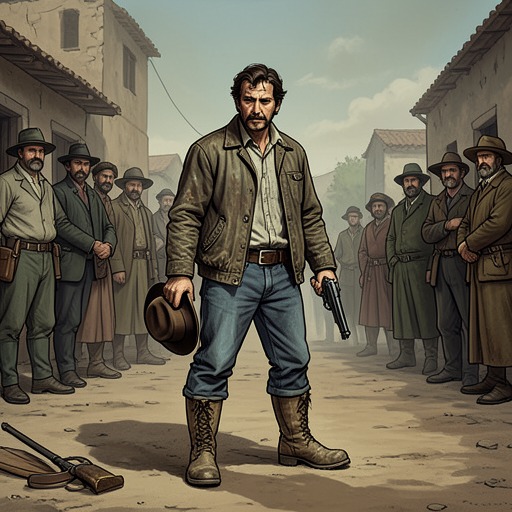
The Western image of Washburn is already familiar to its audience. He is presented as a recognizable screen gunfighter, riding through cactus and grass with his derby and Colt .44. His return to The Set revisits that public persona, but the scene also exposes the private circumstances behind it: he arrives in an air-conditioned Cadillac with his agent-manager, Gordon Simms, and Consuela, his wife of less than two months.
The contrast between the manufactured celebrity and the lived role extends to Simms. He is Washburn’s friend and business manager, but he also experiences the gunfighter identity vicariously, having spent years associating with Washburn and imagining himself alongside him. The danger and prestige belong to the role Washburn performs; Simms participates by proxy. The Movie’s heroic image therefore shapes not only what spectators see but how the people around its star understand their own relationship to him.
A Story Watched from Within
The film follows Washburn across the landscape in a sequence of distant views: riding between canyon walls, camping beneath the evening sky, sleeping beside a dying fire, and setting out again at dawn. From a high pass, he looks down toward Comanche Town, then rides into its single dusty street, lined with a saloon, boarding house, livery stable, blacksmith’s shop, and general store. The expansive journey gives the Western setting room to unfold as a continuous environment rather than a succession of visibly staged scenes.
Yet the camera’s view is not confined to an external audience. Washburn is both the actor being watched and a spectator watching himself as an actor. The heroic image he sees coincides with the image shown to viewers on their screens. This doubled perspective makes self-observation part of the performance: the gunfighter is at once a character in the Western and a person conscious of inhabiting that character.
Performance as an Ongoing Condition
The Never-Ending Western Movie gives literal form to the idea that acting and watching oneself act need not end when a scene ends. Its landscape, hidden recording apparatus, improvised situations, and returning performers keep the role in motion, while Washburn’s awareness of his own screen image exposes the mechanism beneath the adventure. The result is not simply a Western that continues indefinitely, but a story about how a public persona can be lived from within and viewed from outside at the same time.