The inner voice as decision-maker
The Robot Who Looked Like MeThe inner voice as decision-maker is the mental arrangement through which Mr. West delegates judgment to an imagined authority inside his own mind. For years, The Voice has supplied answers he considers rational and dependable, making private decision-making feel less like uncertainty than consultation with a trusted expert. Its temporary disappearance reveals the fragility of that arrangement: Mr. West can hear many voices, but cannot tell which one is his, and the Voice’s eventual return restores its influence without making its advice reliably sound.
Identity and Function
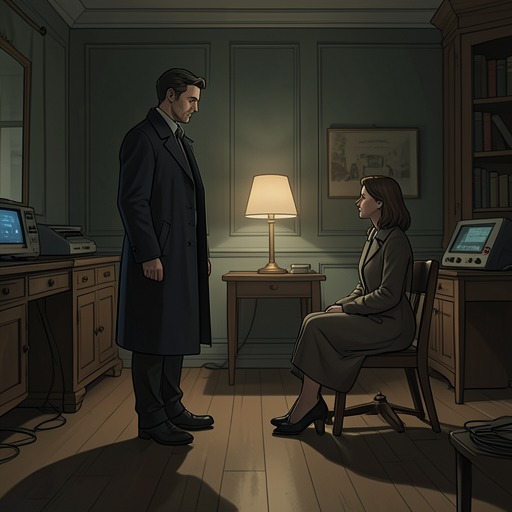
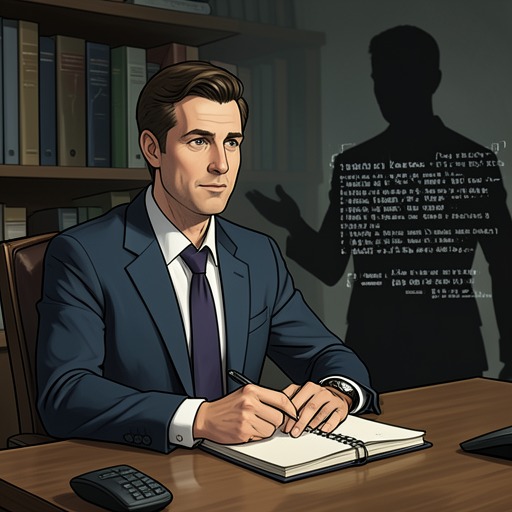
Mr. West is a large, glum, secretive man employed by a New York accounting firm. He distrusts divination and other irrational methods of deciding what to do. Rather than consult the I Ching, Tarot cards, or a horoscope, he refers problems to The Voice in his head. The distinction matters to him: he considers following this private authority a rational way to make up his own mind, even though the practical work of judgment has been transferred elsewhere.
The Voice’s defining credential is its record. It has guided Mr. West for many years, and he believes it is always right. When he faces a complicated investment choice involving South African Sweatshops, Ltd. and International Thanatopsis Corporation, he turns to The Voice to assess market considerations he regards as too numerous for one person to evaluate alone. Its apparent expertise lets him treat the decisions as technical problems with a correct answer, rather than choices for which he must accept personal responsibility.
The Voice’s Model of Judgment
Mr. West imagines The Voice as a miniature version of himself, about the size of a pea, sitting in a brain region he calls Control Central. This small double looks out through Mr. West’s senses, sorts information, and makes decisions. The image divides the person into an embodied observer and an internal executive: Mr. West supplies the perceptions, while his miniature counterpart is supposed to process them and determine what follows.
That division also gives Mr. West a ready explanation for his dependence. He thinks of the system as the normal, rational arrangement, not as a habit that might leave him unable to act when the familiar adviser is unavailable. The miniature figure makes an abstract division of labor seem concrete, but it does not give Mr. West any independent way to test the answers he receives. His confidence rests on the Voice’s history of being right, not on a process of checking its reasoning.
Breakdown and Substitution
The system falters during a week when engineers are testing generators in a newly built building across the street from Mr. West’s apartment. The same week brings unusually high sunspot activity, a ten-year maximum in cosmic-ray output, and a temporary shift in the Van Allen belts. These conditions coincide with the trouble, although the account does not establish that any one of them caused it.
At breakfast, The Voice begins answering the investment question in elaborate technical language about tensile web structures and material strength. Mr. West cannot make sense of the explanation and challenges it. The Voice then falls silent. Over the rest of the day, numerous other voices speak in his head, offering disconnected remarks and information rather than a coherent answer to the problems he has brought to the system. Their variety does not help him decide; it makes clear that hearing a voice is not the same as having access to the particular adviser he trusts.
Mr. West attempts to manage without that adviser, but his decisions go badly. He sells his shares in South African Sweatshops, Ltd., after which they rise five points. He buys International Thanatopsis Corporation, which falls to a record low following news that an immortality serum is imminent. These reversals sharpen the contrast between the Voice’s former authority and the disorder that follows its loss. Yet the setback does not lead Mr. West to develop confidence in his own judgment. He continues to regard decision-making as work for The Voice, and the surrounding crowd of voices cannot take its place.
Return and Limits
Near the end of the week, a newspaper story about a religious colony on Mount Alluci awaiting the end of the world prompts Mr. West to book a flight to Lima. As he puts down the telephone, his own Voice returns. It says that he should not have sold South African Sweatshops, Ltd., but that he can still recover by increasing his investment in International Thanatopsis Corporation, which it expects to rise the next month. The return is presented as a recovered connection: the miniature Mr. West says it had been present all along but unable to get through.
The Voice’s reappearance restores the arrangement Mr. West depends on, but the advice it gives exposes its limits. Asked about the anticipated end of the world, it dismisses the subject as irrational rather than considering the report. It then turns to Mr. West’s serious personal problem involving his fourteen-year-old niece, Amelia, who is staying with him, and supplies a dangerous, unlawful recommendation. The narrative therefore does not equate the Voice’s confidence or familiarity with sound judgment. Its advice can be clear and decisive while still directing Mr. West toward harm.
Wider Significance
Mr. West’s private decision system belongs to a broader pattern in which mechanisms meant to manage uncertainty or correct error acquire consequences of their own. Emperor Mingus’s surveillance state monitors the population through layers of watchers, while his time machine lets him intervene personally when events go wrong. The power of that system remains constrained by the fact that he must operate the machine himself. In another time-travel mechanism, each displacement produces another Gleister, and the resulting geometric growth eventually threatens to overwhelm the resources of the Empire and Earth. These are not versions of Mr. West’s mental arrangement, but they echo its central tension: control depends on a system whose limits cannot be removed simply by trusting it more.
For Mr. West, the limit is intimate and immediate. He believes that his own mind should operate through a rational inner authority, yet he cannot call that authority back by force or reliably distinguish it from the many voices that crowd in during its absence. When it returns, he accepts its direction despite the danger in its counsel. The Voice thus functions both as a decision-maker and as an alibi for not deciding: it relieves Mr. West of uncertainty, but cannot relieve him of the consequences of what it tells him to do.