Third World War
The Robot Who Looked Like MeThe Third World War is the turning point that transforms a long-prepared global catastrophe into an ecological and food crisis, and then into a new system of industrial survival. Its destruction does not end when the fighting stops: fallout carried across continents changes the waters at Diamond Shoals, where goo becomes both a potential threat and the raw material that keeps a hungry world alive. The war’s consequences thus reach from ruined cities and failed ecosystems to the hazardous labor of harvesting and processing a new food supply.
Background and outbreak
The war followed a prolonged period of preparation. Cold War Phase I ended in the 1970s, when war appeared inevitable, and Cold War Phase II continued for another thirty years. Governments and planners prepared for an overkill scenario by building subterranean cities, publicly given optimistic names such as Jade City, Golden Grotto, and East Pyrites. In the Smokies, the Ironwall antimissile complex was buried two miles underground. These defensive projects coexisted with a population boom that had begun even earlier: fear and the restricted pleasures of enclosed city life helped drive people to have children, until the canister cities expanded through tunnels and connecting passages. Aboveground, life was largely reserved for the military and scientific elite.
The war finally broke out roughly fifty years before the events surrounding Joe Pareti. It was fought with bacteriological weapons, atomic weapons, lasers, and radiation. The North American continent suffered especially extensive damage. Los Angeles was destroyed; Ironwall and half the Smokies disappeared; Oak Ridge was lost in a single explosion; and Louisville was reduced to rubble. Detroit and Birmingham were erased, leaving smooth, reflective ground where the cities had stood. New York and Chicago fared better because their central cores and underground cities were protected, although their suburbs were lost. Other continents suffered comparable or worse devastation. Preparations made during the Cold War did allow the development of serums, remedies, and other treatments that saved millions of people.
Ecological aftermath and hunger
Medical defenses could not protect crops or wildlife. Corn could not be inoculated, nor could every domestic and wild animal be saved; the oceans could not be seeded to preserve their fish. The resulting ecological breakdown varied by species: some survived, while others disappeared. Hunger strikes and food riots began, then quickly subsided as hunger weakened the people who might have sustained them. The crisis continued into a period of extreme social breakdown before governments, frightened by the consequences of the war and the hunger that followed, finally joined forces.
The United Nations was rebuilt and commissioned The Companies to develop artificial foodstuffs. That remedy took time. Meanwhile, winds carried radioactive and biological residue across North America, picking up further contamination around the Smokies, Louisville, Detroit, and New York. The polluted air crossed the Eastern Seaboard and the Atlantic before dispersing over Asia. Fallout over the Carolinas combined with sunlight and rain, producing a mutation in the plankton-rich waters of Diamond Shoals. Ten years after the war ended, Outer Banks fishermen were calling the transformed material goo. The water had become a site of continuing biological change: goo adapted and assumed rudimentary forms, while unusual fish and other marine species appeared. Some vanished; goo remained.
From mutation to food supply
Experiments eventually reversed the meaning of goo. What had seemed an unstoppable danger to marine life—and perhaps life more broadly—proved useful when the organism was killed and processed into food. It contained proteins, vitamins, amino acids, carbohydrates, and trace elements. Dehydrated and packaged, it could be prepared in numerous ways, and its flavor varied according to the patented processing method rather than having one defining taste. Living goo was described as apparently unintelligent, yet persistently inclined to form itself into rudimentary plant- and animal-like shapes. Its capacity to take on forms made it strange and uncertain; its usefulness after processing made it indispensable.
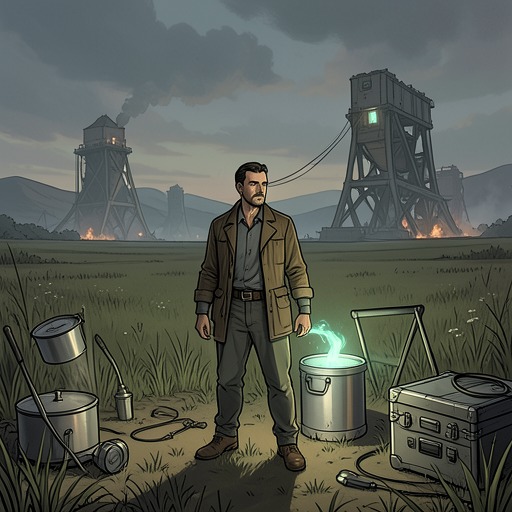
The Companies built harvesting factories called TexasTowers and trained workers to collect the goo. At the Towers, harvesters sent their catch through feeder pipes to cracking and radiation plants. Processing multiplied the material molecule by molecule, then fragmented and expanded it, yielding roughly forty times the harvested weight after radiation treatment. The result was killed and reprocessed as the basic artificial food of a population whose diet had lost foods such as meat, eggs, vegetables, and coffee. The product was purified, supplemented with vitamins, colored, scented, and sold under brand names including VitaGram, Savor, and Quench-Caffe. It was then distributed to twenty-seven billion consumers. In this chain, a contaminated marine mutation became a mass-produced food supply, and harvesters became essential to keeping the world alive.
Labor and lasting significance
The work carried a price for those who performed it. Harvesters received some of the highest wages available in a nontechnical occupation, formally classified as high-hazard pay rather than as compensation for long hours or exhausting labor. During one shift, Pareti works twelve hours harvesting goo in the sea and brings his catch back to a TexasTower, where a collapsible tube draws it from his punt into the factory’s feeder system. The Tower itself embodies the industrial adaptation: it can be moved like a ship or fastened to the seabed like an island, and its underwater sections can be folded or extended. It is an awkward vessel but an effective factory.
Pareti chose harvesting rather than an industrial career after graduating from the Multiversity, drawn to the work by an aptitude for recognizing and collecting goo. He has received hazard-bonus payments for three years without fully understanding their significance. When he later challenges Dr. Ball over the risk of the disease associated with the work, Ball points to the warnings and the compensation Pareti received. The war’s legacy is therefore not limited to ruined landscapes or a changed food system: it persists in the danger borne by the people who gather the material on which that system depends. The story presents recovery as real but uneven. Goo prevents starvation on a planetary scale, while the cost of extracting it remains concentrated in the bodies and working lives of harvesters.