Time tracks
The Robot Who Looked Like MeTime tracks are the novel’s way of holding together two apparently incompatible experiences of time: the traveler’s sense of moving through a line of events and the cosmic view of repetition as an orbit. They make time travel possible, but not as a simple journey into a past that can be freely rewritten. Each departure alters the conditions around it, while recurring patterns and alternate Gleisters keep the consequences from settling into one uncomplicated history.
Linear Experience and Cosmic Recurrence
At the scale of an individual traveler, a time track feels like a straight line extending between past and future, with branches appearing as chance or circumstance intervenes. The story sets this lived perspective against a larger one: from a higher magnitude, the track is a fixed orbit around an unimaginable center. What feels like a deviation at close range can therefore be only a perturbation within a wider recurrence. The distinction does not erase the traveler’s experience; it shows that the meaning of a temporal path depends on the scale from which it is seen.
Coincidence is the interface between these different temporal realities. The narrative associates its rate with speed: travel far and fast enough, and the traveler begins to perceive the cosmic scenery of recurring events. This makes coincidence more than an accidental meeting. It is a sign that apparently separate points of experience belong to a larger temporal pattern, even when the people inside that pattern cannot see its full orbit.
The sequence headings reinforce this layered structure. The story labels passages as different time tracks and as conjunctions of multiple tracks, rather than presenting every event as one seamless chronology. These labels invite the reader to distinguish a character’s immediate path from the broader arrangement in which that path recurs or intersects with others. The result is not a conventional branching tree in which every alternative remains cleanly separate: the tracks can converge, and the distinction between deviation and repetition changes with the observer’s scale.
The Machine and the Traveler’s Path
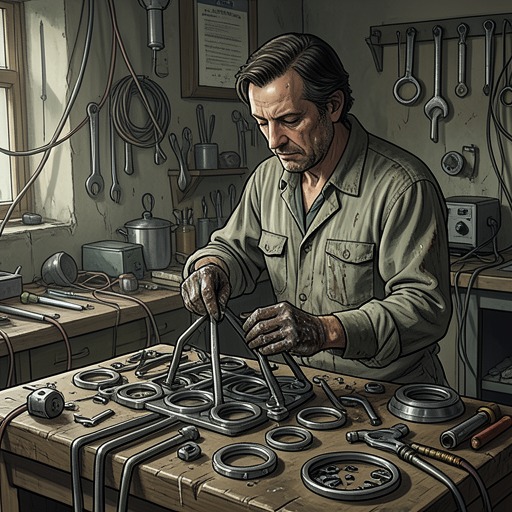
The time-track model first takes shape around Charlie Gleister’s invention. His white plastic, shoe-box-sized machine initially flashes purple and green, makes noises, and tingles his skin, but does not travel through time. It becomes functional only after Charlie has gained insight from the future, creating the paradox that knowledge from a later point helps make possible the journey that will produce that knowledge. The story presents such paradox as a condition of time travel, not as evidence that the temporal system has failed.
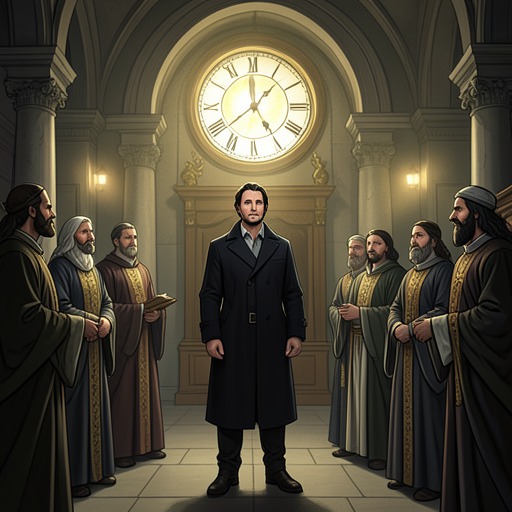
When a future version of Charlie visits him, he offers the principles that reality is positional and nothing happens for the first time. Charlie understands that he is meant to get the machine working, travel into the future, and return to meet himself before the invention. Yet the encounter does not lock him into obeying the visitor’s wishes. Once the visitor disappears, Charlie rejects the instruction not to invent the machine and gets it working in two hours. This decision demonstrates how the same encounter can occupy different positions in the lives of the two Charlies: the advice is part of one traveler’s past, but it does not compel the younger Charlie to repeat his visitor’s intention.
Charlie sets the machine to the limit of its forward range, described as millions of years of human time, and becomes the world’s first time traveler. After a brief vertigo, he arrives in the distant future and notices policemen. The journey gives him the evidence and insight that the machine’s earlier, unsuccessful form could not provide. It also places his personal movement along a line inside a much larger temporal scale, where the apparent novelty of invention is already entangled with recurrence.
Displacement, Doubles, and the Past
Time travel does not leave an empty place behind. After Charlie’s departure, the story explains, Nature supplies an identical or near-identical Gleister to fill the resulting gap in space-time. Every later use of a time machine creates another displacement and calls forth another Gleister. The replacement is not simply a copy standing outside history: it occupies a position that would otherwise be vacant, allowing events to continue while multiplying the number of people who may resemble the traveler.
This mechanism makes returning to prevent the invention an inadequate solution. At Mingus Memorial Park, Gleister reasons that the past contains no waiting niche for him to re-enter; everything modifies everything. Nor is there a single untouched younger Gleister to persuade. There are multiple potential Gleisters, identical up to the moment of contact and different thereafter. A new encounter changes the conditions from which each mind proceeds. Gleister can remain himself only by not interfering with himself, even as he recognizes that the world affected by his invention is intolerable and that he must act.
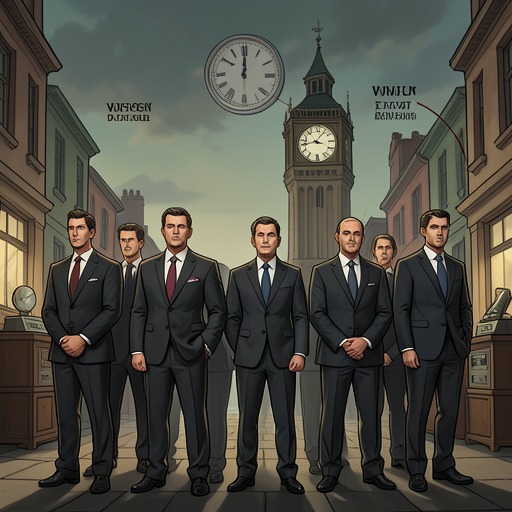
The scene’s repeated question about how many Gleisters have sat on the same bench turns the temporal problem into an image of recurrence. Gleister’s reflection is itself shadowed by the likelihood that another version has already considered the alternatives. The past is therefore neither a stable location to which one person can return unchanged nor a blank surface on which to make a first mark. It is a field of consequences in which each intervention creates a different relation among versions of the same person.
Tracks, Power, and Consequence
The political history of Mingus further shows why a temporal path cannot be treated as a single, secure line of identity. Mingus describes inventing a time machine, reaching a distant future of depleted resources and quarrelling kingdoms, and taking power there. He attributes his success both to the machine’s advantage and to the historical moment. But when he returns to the past to take over the resistance organization, Egon argues that the return has changed his position: the Emperor is no longer the Emperor. The Gleister who became ruler in the future and the returned Gleister facing opposition belong to linked events, but the title and its authority do not travel back intact.
The story thus connects temporal mechanics to the instability of political power. Mingus’s account presents empire as the outcome of a particular future and a particular set of circumstances; Egon’s account exposes the limit of treating that outcome as a permanent identity. A traveler can be the same person in bodily continuity and yet occupy a different historical position, with different claims on power. Time tracks make that difference consequential rather than merely philosophical.
Taken together, recurrence, branching experience, and displacement explain why the narrative’s timeline resists a simple beginning-to-end account. From Charlie’s perspective, invention and travel are actions with causes and consequences; from the larger perspective, those actions belong to patterns that recur, intersect, and produce replacements. The tracks preserve both views at once: novelty remains real to the person experiencing it, while the wider universe makes even apparent exceptionality part of a repeating orbit.