Washburn
The Robot Who Looked Like MeWashburn is a famous gunfighter whose identity has been shaped by years of playing himself in The Never-Ending Western Movie, a Western staged for real across The Set. In this episode he returns from retirement for a cameo, but the boundary between the performer, the heroic figure on screen, and the man watching himself perform is already difficult to hold. His passage back into The Set is at once a return to a familiar role and a reckoning with the end of his greatest years there.
Identity and Public Persona
Washburn introduces himself as a man whose name changes with the relationship: friends call him Washburn, while enemies and strangers use Mr. Washburn. Audiences recognize him from screens, riding through the Old West with his familiar derby and Colt .44. His reputation rests not only on his appearance but on a career in which he and Gordon Simms imagined themselves clearing opposition until they became the West’s preeminent gunslingers. The story’s account of him as both a recognizable screen image and a working actor makes his celebrity part of his character, rather than simply a fact about his past.
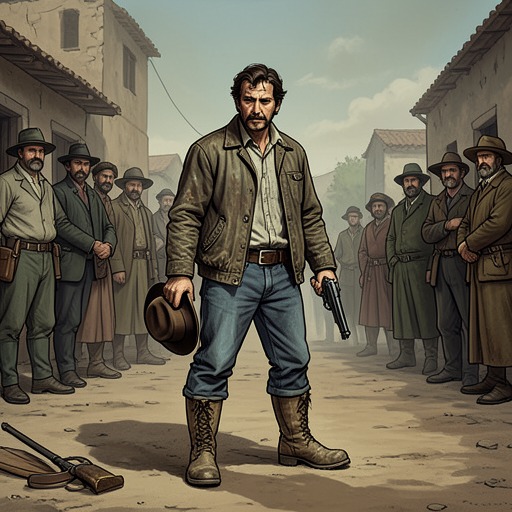
When he arrives in Comanche, that public image is immediately legible to the town. Washburn dismounts stiffly, travel-stained, with his gun belt worn low and his revolver easy to reach. The account describes his scarred, long face and steady gray eyes as conveying danger and unpredictability alongside sympathy. The recognition he receives is not an incidental welcome: the townspeople know the image he has carried through his career, and he is aware of himself as that image being watched.
Career and Return to The Set
At the episode’s opening, Washburn is traveling in an air-conditioned Cadillac with Simms and Consuela. They have left State Highway 101 for a dirt road leading to the Wells Fargo Station, an entrance to The Set. The contrast is built into the location: the station stands amid twenty-first-century America, while beyond it lies a million-acre expanse of prairie, mountains, and desert, monitored by concealed cameras and microphones for The Never-Ending Western Movie.
Washburn is coming out of retirement for a cameo with Old Jeff Mangles and Natchez Parker. His contract is explicitly a no-kill contract, and the part is a comedy appearance rather than a return to the deadly work associated with his fame. The Movie has no script; its players improvise around whatever situations arise. That arrangement helps explain why a seemingly limited cameo can be unsettled by events on arrival: the production’s story is not fixed in advance, and the participants must respond to what happens in The Set.
The return also revisits a career ending that Washburn and Simms had hoped would be more triumphant. Simms had wanted one final, definitive showdown on a dusty Main Street, a blaze-of-gunfire retirement at the height of their fame. Washburn wanted that ending too. Instead, as opposition grew cautious, he spent a last, unsatisfying year riding around ready to draw but finding no one willing to face him. The cameo therefore feels to Simms like a mockery of what they had represented, and Washburn shares that unease. He cannot easily separate his own wishes from Simms’s: their partnership has made the imagined gunslinger’s life a shared ambition.
Relationships and Private Life
Simms is Washburn’s agent-manager, friend, and longtime partner in the construction of his Western persona. He has earned a thirty-percent share of Washburn’s income during the actor’s ten most successful years and is already wealthy, yet he remains emotionally invested in their old ambitions. As Washburn prepares to cross into The Set, Simms rubs his neck like a fighter about to enter a match and bounces with excitement, envying the chance to ride into the desert. He cannot plausibly occupy the heroic gunman’s role himself, so he lives it vicariously through Washburn. Their closeness is expressed through both business and performance, to the point that Washburn finds it difficult to know where one man’s desires end and the other’s begin.
Consuela, Washburn’s wife of less than two months, accompanies him to the station. A former Miss Chile and actress in Gaucho dramas filmed in Buenos Aires and Montevideo, she comes from a filmmaking tradition in which scenes are staged and gunfire is simulated. She does not understand why the American Movie must be performed for real when effects could be contrived and no one would be killed; the no-kill contract is unfamiliar to her as well. Her unease exposes the strangeness of Washburn’s working world from outside it. Before he enters The Set, she hugs and kisses him, with tears in her eyes, and asks him to return soon. Washburn notes that she is his fourth wife, placing the tenderness of their new marriage beside the weary repetition he associates with his past relationships.
Events in Comanche
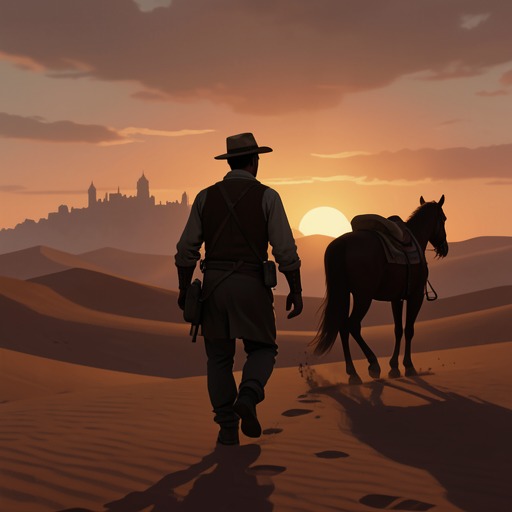
After passing through the Wells Fargo Office, Washburn rides into The Set and is shown traveling across the desert before reaching Comanche. There he encounters Sheriff Ben Watson, an old friend. Watson tells him that Jeff Mangles has died after being thrown and dragged, and that Mangles was already dead when Jimmy Conners found him. Washburn recognizes the immediate consequence for his work: Mangles’s death has spoiled the scene for which he was hired. He pushes his derby back and waits for Watson to say what else has happened, sensing the sheriff’s unease before Watson changes the subject by suggesting a beer.
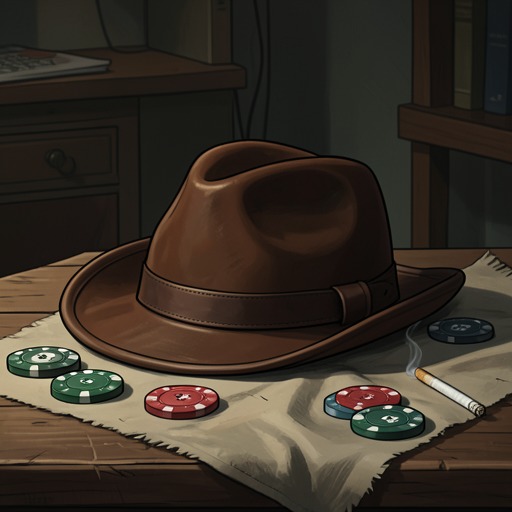
In the saloon, Washburn asks Charlie Gibbs about Little Joe Potter’s poker game. Gibbs, a comic character and the local Screen Actors’ Guild representative, recounts what he heard from Texas Jim Claire. At a game near Gila Bend, Little Joe had no money left to support his hand when Doc Dailey offered to accept collateral. Little Joe proposed Washburn’s derby, a piece of property with special weight because taking it would mean confronting the gunman underneath it. Doc accepted it as a thousand-dollar stake and proposed paying another thousand for a ringside seat when Little Joe went to claim it.
The hand makes that boast consequential: Little Joe’s four eights lose to Doc’s four jacks. Little Joe rises and announces that Doc will get his ringside seat after all. Gibbs finishes his drink and watches Washburn with bright, malicious eyes; Washburn nods, finishes his own drink, and goes out back. The account establishes the wager and the threat it implies, but does not show Little Joe confronting Washburn or establish what happens to the derby. Washburn’s return thus ends this portion of the story not in a completed showdown, but at the edge of one.
Performance and Self-Observation
The episode repeatedly makes Washburn both performer and spectator. As he rides through the landscape, the narration presents the distant rider in successive images: traveling between canyon walls, silhouetted at evening, sleeping beside a dying campfire, and preparing to ride again before dawn. Washburn understands that these are the images audiences see, but he also experiences himself as watching the actor who plays him. His childhood dream of performing a part and observing that performance has come true; the irony, as he sees it, is that the audience shares the same heroic images.
This divided viewpoint gives the familiar Western role an unsettled dimension. Washburn’s legend is not simply something others project onto him: he participates in viewing and sustaining it, while also noticing the gap between its heroic shape and the uncertain circumstances of his return. The no-kill cameo, the failed hope for a climactic retirement, and the derby wager all place the celebrated gunman inside a story that cannot be fully controlled or scripted. His defining conflict is therefore not only whether he will face another opponent, but how far the man and the watched performance can still be distinguished.