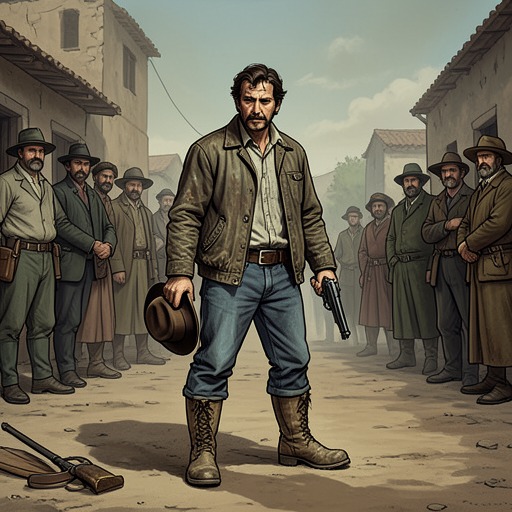
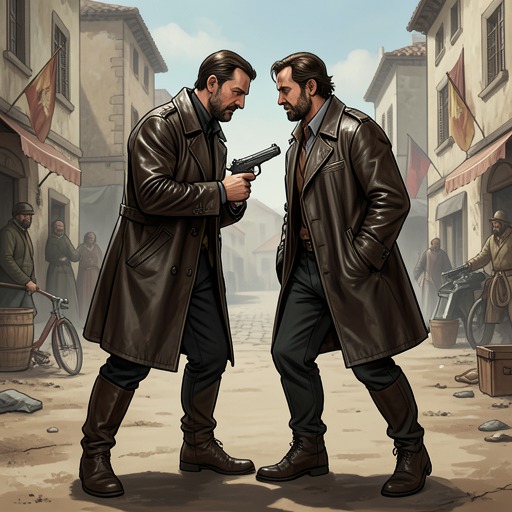
Washburn confronts Natchez Parker
The Robot Who Looked Like MeWashburn confronts Natchez Parker at the moment Parker tries to keep him from riding away, turning a plea between old companions into an armed struggle over who has the right to define courage. Parker insists that life in The Territory demands more than playing at being a cowboy; Washburn answers that claim by refusing both Parker’s authority and the script Parker believes they share. The confrontation ends without a shot, but not with agreement: Washburn says he is still leaving, while Parker takes the encounter as evidence that he will be ready for the showdown.
The Dispute Over Leaving
Parker begins by addressing Washburn as Tom, a rare intimacy in The Territory: he is the only man there who uses Washburn’s first name, and he does so infrequently. That choice makes the appeal personal before Parker explains it. Washburn, he says, cannot run away on account of himself, because he will have to live with himself wherever he goes. Washburn answers that he will manage. Their disagreement is not simply over whether he should leave; it is over whether leaving would be an act of self-preservation or a failure to meet an obligation to himself.
Parker gives that obligation a particular shape. The men are paid to dress in fine clothes and perform as if they own the world, but, in his account, the performance carries a price: they must continue being men when it is no longer easy. They do not merely act their parts, he argues; they live them and stake their lives on them. His contrast between swaggering down Main Street in a cowboy outfit and actually wearing and using a gun makes the distinction concrete. Parker’s argument is both a challenge to Washburn’s retreat and a defense of the life their roles demand.
The Knife and the Gun
When Washburn says he will finish his coffee and ride on, Parker rejects the limits of persuasion. He twists in his chair, grabs Washburn’s shirt, pulls him close, and reveals a knife in his other hand. He tells Washburn to get out his own knife, declaring that he would rather kill him himself than let him ride away a coward. The gesture brings Parker’s abstract language about being a man to the level of immediate bodily danger: he is prepared to turn the argument into a fight.
Washburn does not take the weapon Parker offers as the terms of the encounter. He braces one foot on the floor, plants the other on Parker’s chair, and pushes, toppling the chair and sending Parker to the floor. He draws his gun and aims between Parker’s eyes. The reversal is abrupt: Parker has seized Washburn and tried to dictate how he must answer; Washburn now controls the distance and the weapon. The exchange makes the question of courage inseparable from the question of control.
Washburn cocks the hammer and rejects Parker’s assumptions about special rules. He tells Parker that neither man gets to dictate what the other must do, and that if Parker picks a fight, Washburn will fight in his own way. He explicitly threatens to put Parker down by whatever means he can. The threat is not a claim that the danger is merely theatrical: with the gun trained on Parker, Washburn takes up the slack on the trigger. Parker’s eyes bulge and his mouth trembles; he tries to control himself but cannot, and his scream is high-pitched rather than loud. The scene gives Washburn’s argument force through the immediate possibility of a killing.
A Change in the Balance
Washburn then lowers the hammer and puts the gun away. The change comes after Parker’s fear becomes visible, but the excerpt does not state that Washburn intended the threat as a test or that Parker’s attack was staged. What it does show is a precise shift in action: Washburn has demonstrated that he will not submit to Parker’s chosen terms, yet he stops short of shooting him. His instruction that Parker wake up and remember how things really are casts the threat as a correction to Parker’s assumptions, not as permission for a continued fight.
The next gesture is practical and markedly different from the violence just before it. Washburn lifts Parker and slides the chair back beneath him, apologizes that it has to be this way, and repeats that he is going. The help does not cancel the threat, and the apology does not withdraw the decision to leave. Their relationship remains present in both actions: Washburn is willing to use force against Parker when challenged, but he also restores the older man to his chair rather than abandoning him on the floor.
Friendship and the Unresolved Showdown
Parker’s earlier appeal makes clear how he understands their history. He says they have been closer than kin since Washburn entered The Territory as a frightened, awkward young man and made a place for himself through sheer guts. Parker frames his intervention as refusal to let that man run away now. His language binds affection to confrontation: he calls Washburn by his first name, invokes their closeness, and then puts a knife into the dispute. The scene does not make those acts easy to reconcile; their force lies in occurring together.
At the door, Washburn looks back and finds Parker grinning. Parker says he is glad Washburn is feeling better, recalls that he has nerves like the good ones, and predicts that he will be fine at the showdown. This response recasts the encounter in terms of readiness, though it does not erase the fear he has just displayed. Washburn rejects the implication that the showdown will happen, insisting that he has already said he is riding out. The scene therefore closes on competing readings rather than a settled outcome: Parker treats Washburn’s armed resistance as reassurance, while Washburn maintains that his decision is to leave. The confrontation tests the cowboy role Parker defends, but it cannot make the two men agree on what that role now requires.