Washburn’s distinctive derby
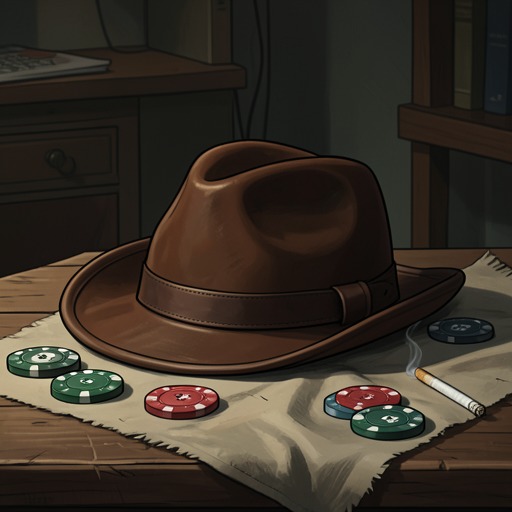
The Robot Who Looked Like MeWashburn’s distinctive derby is the most recognizable item in Washburn’s Western-film identity: a familiar part of his silhouette, costume, and public reputation. It travels with him from the off-camera world of his return to The Set into the improvised life of The Movie, where its importance becomes more than visual. When Little Joe Potter offers it as collateral in a poker game, the hat becomes the object through which Washburn’s reputation is tested, though the account does not establish that Potter actually takes possession of it.
Appearance and Performance
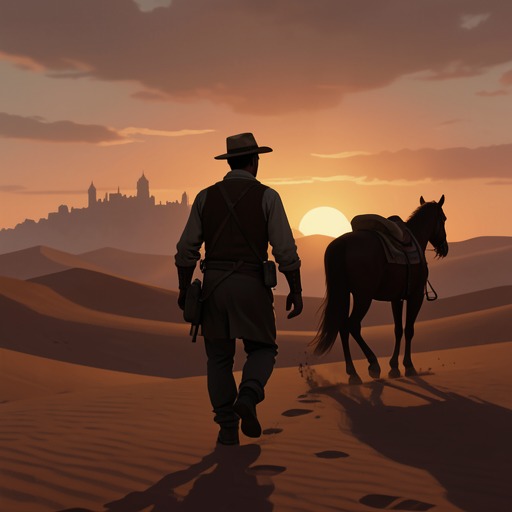
The hat is introduced as part of Washburn’s established image. Audiences have seen him riding across the screen with the derby pulled down over his eyes, alongside the famous Colt .44 strapped to his leg. The image is so familiar that Washburn treats the hat as one of the features by which viewers recognize him; it belongs to the public figure they have seen repeatedly, not merely to an anonymous costume.
On his return to The Set, the derby is also one element of a carefully checked outfit. Washburn is dressed in blue jeans, a blue-and-white checked shirt, a rawhide jacket, and the hat, with his equipment arranged for the journey into the Western landscape. An assistant director checks him for modern anachronisms before he crosses through the Wells Fargo Station. In this passage, the derby helps mark the boundary between the contemporary world outside the station and the performed Old West beyond it: Washburn puts on the recognizable image and then enters the setting in which that image is lived out.
The hat’s position changes with the camera’s view. In the opening description it is pulled low over Washburn’s eyes; in the distant images of his ride, it sits jauntily at the back of his head. Later, as he approaches Comanche, the account describes him as the derby-wearing rider. These appearances keep the hat legible across shifts in distance and perspective, from the close preparation of a returning performer to the remote figure watched on screen. Its function is not simply to complete the costume; it helps preserve the continuity of Washburn’s familiar screen persona.
A Signature Shared With the Audience
The narrative links the derby to the unusual double perspective of The Movie. Washburn describes himself as both the actor and the audience watching the actor, while the people watching on their own screens see the same heroic image. The hat belongs to that image: it is an outward sign through which the character remains recognizable to viewers even as the narration draws attention to the person performing him. Its familiarity makes the gap between performer and role visible without dissolving the role’s force.
The object also sits within Washburn’s entanglement with Gordon Simms, his agent-manager and longtime friend. Simms has built his own sense of identity around Washburn’s career and shares, in imagination, the gunfighter’s triumphs. As Washburn prepares to leave the station, the derby is part of the heroic appearance Simms admires and envies. The hat thus participates in a persona that is not experienced by Washburn alone: it is bound to the audience’s recognition, Simms’s investment in the star, and the performance both men have inhabited for years.
The Poker Wager
The derby acquires a different kind of importance in Charlie Gibbs’s account of Little Joe Potter’s poker game. Potter has run out of money while facing a large final bet. Asked what collateral he can offer, he proposes Washburn’s hat. The suggestion draws its force from the belief that no one can simply take the famous derby without first facing the man who wears it. The wager therefore converts Washburn’s reputation into the condition that gives the object its apparent value: the hat is desirable as collateral precisely because it is inseparable, in the listeners’ minds, from the danger of approaching its owner.
Potter’s confidence is part of the story Charlie tells. After Doc Dailey accepts the derby as collateral, the players reveal their hands: Potter’s four eights lose to Dailey’s four jacks. Potter then rises and indicates that Dailey will get the promised ringside view after all. The distinction matters: the account reports the wager and Potter’s response to losing, but does not narrate a completed transfer or the physical removal of the derby. The hat’s immediate narrative role is to turn the poker loss into an anticipated confrontation with Washburn.
Narrative Significance
Washburn hears the story from Charlie Gibbs in the saloon, where he has gone to ask about Potter’s game. After the account, Charlie finishes his drink, looks at Washburn, and Washburn leaves for the outhouse, a designated off-camera area used for conversations outside the Western setting. The sequence places the hat’s threatened loss immediately before a shift away from the public performance. The derby has been discussed as a wager inside the story, while the characters’ next conversation takes place beyond the visible Western context.
Across these scenes, the derby moves between costume, recognition, and stake. It first makes Washburn’s screen identity instantly legible; then it becomes collateral whose proposed loss tests the limits of that identity. The object does not need to leave Washburn’s possession for the wager to matter: the possibility of its removal is enough to bring his public reputation into the poker story. Its significance rests on that tension between a familiar accessory and the formidable persona that makes it difficult to claim.