Astrological portents and divination
The Romance of the Three KingdomsAstrological portents and divination give visible form to the story’s unsettled relation between human action and Heaven’s will. A star dimming, a sudden storm, a fallen tree, or a diviner’s reading may announce what is coming; yet signs do not speak by themselves. Characters interpret them, and those interpretations can guide decisions, claim political legitimacy, or expose how readily rulers accept reassurance that serves their interests.
Signs, Mandate, and Political Legitimacy
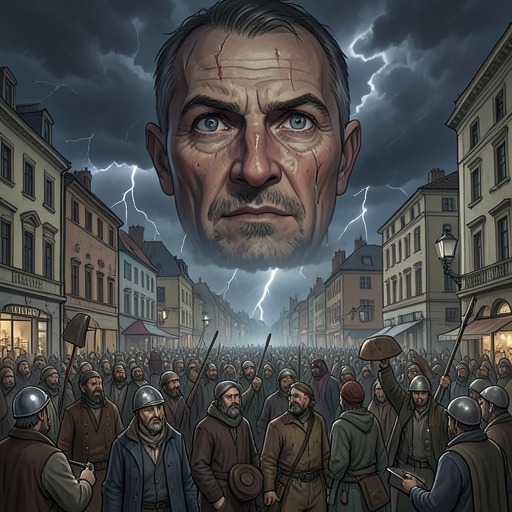
The narrative establishes portent-reading against the history of a state repeatedly broken and reunited. Its account of dynastic change links political collapse to failures of rule: under Emperor Huan and Emperor Ling, the court’s preference for eunuchs and inability to restrain them contribute to the empire’s division. Signs appear in the same account as symptoms of disorder. During Emperor Ling’s reign, a green snake coils around the throne during a ceremony; later come destructive storms, an earthquake at Luoyang, floods, reports of hens turning into cocks, strange clouds in the Hall of Gentle Virtue, and a rainbow in the Jade Chamber. The number and variety of these disturbances make them difficult to dismiss within the story’s moral and political framework.
The discovery of the Jade Seal gives this language of signs a more concentrated political object. In the ruined capital, a soldier notices five lights coming from a well. The search finds a body carrying an embroidered pouch; inside it lies a small box containing the seal, marked with five intertwined dragons and an ancient inscription invoking Heaven’s mandate and the emperor’s long life. Cheng Pu recounts the seal’s history, including its passage through dynastic upheavals and its loss amid the eunuch crisis. He treats its recovery by Sun Jian as evidence that Sun Jian is destined to rule, turning an uncanny discovery into a claim about political succession. The episode shows how a material object, its history, and its interpretation can reinforce one another without making the resulting political conclusion self-evident.
A later portent offers a striking contrast. When Dong Zhuo’s followers attempt to bury his remains at Meiwu, repeated storms and floods drive the coffin back out of the ground, and lightning destroys what remains. The narration interprets the failed burial not as an ambiguous coincidence but as Heaven making its anger plain. Here the sign passes from event to judgment: nature’s disruption gives visible form to the condemnation of a ruler whose conduct has already made him hated.
Divination as Counsel and Forecast
In military and political decisions, divination can function as counsel, but it rarely replaces practical judgment. At a mountain hut, Liu Gui persuades his companions to consult a sage despite Zhang Ren’s contempt for visiting hermits. The Master initially ignores them, then writes a short prophecy. The scene makes the act of reading a sign part of the decision-making process: a cryptic message arrives only after a request for guidance, and its meaning must be considered rather than simply acted out as an explicit order.
The narrative also puts prediction beside military knowledge. At Jieting, Ma Su relies on passages from Sun Zi’s Art of War while rejecting Wang Ping’s practical advice to defend the road. His choice to occupy the hill leaves his force without water once the enemy closes in, and his army begins to break apart. The episode does not make this a case of astrology, but it sharpens the broader distinction the book draws between claims to know what will happen and the discipline of reading present conditions. A doctrine or forecast cannot compensate for a failure to attend to terrain and circumstance.
When Kong Ming receives news that the Wu army has been defeated and retreated, he collapses and says that his old affliction may mean his end is near. Later that night he studies the stars and tells Jiang Wei that they indicate only a few days remain. Jiang Wei urges him to attempt a ritual to prolong his life, and Kong Ming agrees. During the ceremony, Wei Yan rushes in to report an approaching attack and knocks over the ritual lamp. Kong Ming then says that fate cannot be avoided. The sequence brings star-reading, ritual, military interruption, and personal decline into one scene, while distinguishing a prediction from the effort to resist it.
After Kong Ming’s death, a reddish star dips, rises, and dips again. Sima Yi hopes that this indicates his rival’s death, but fear of another stratagem keeps him from pursuing the retreating army. The omen matters not merely for what it may predict, but for what it does to Sima Yi’s conduct: uncertainty is itself consequential. The star does not provide him with certainty, and his interpretation is shaped by his enduring fear of Kong Ming.
Portents Around Succession and Rule
The transfer of power from the Han to Wei makes celestial interpretation an explicit instrument of political argument. When the Han emperor resists surrendering authority, Hua Xin brings forward astrologers who cite auspicious signs as proof that Heaven has transferred its mandate from Han to Wei. The emperor dismisses their reading, while Wang Lang presses the case for the dynasty’s natural end. The competing positions reveal that a portent is not politically neutral: its meaning becomes part of a dispute over who may rule and whether abdication is a voluntary act or an outcome demanded by the times.
The new emperor’s ceremony then supplies a contrary sign. As Cao Pi kneels to worship Heaven and Earth, a violent storm scatters dust and stones, darkens the sky, and overturns the ritual lanterns. He is so alarmed that he collapses and is carried away; for days he is unable to act, and he later orders a new palace at Luoyang because he believes his existing palace is haunted. The storm does not undo Wei’s establishment, but it unsettles the ceremony that was meant to affirm it. The contrast with the astrologers’ auspicious interpretation keeps political possession and heavenly approval from appearing identical.
Later, a yellow dragon appears twice in a well at Ningling. When others congratulate the ruler on what they consider a favorable sight, the Son of Heaven interprets it in the opposite way: a dragon belonging underground rather than in Heaven or in the fields signifies imprisonment. He composes a poem about the trapped dragon, directed at Sima Zhao. The episode gives the sign an unusually pointed political reading, but the interpretation comes from a ruler already confronting Sima Zhao’s power, and the portent functions as warning rather than effective protection.
Ritual, Belief, and Deception
Divination can also be staged to quiet fear and suppress inconvenient information. When Jiang Wei sends a memorial requesting reinforcements to defend Shu, Huang Hao intercepts it and persuades the second ruler to consult a shaman instead. She performs an elaborate trance ritual before declaring that Shu’s lands are secure and that Wei will soon belong to Shu. The second ruler believes her, and Huang Hao uses that reassurance to ensure Jiang Wei’s letters are ignored. The military warning is therefore displaced not by evidence that the danger has passed, but by a divinatory performance that tells the court what it wants to hear. The narrative directly connects this decision to the beginning of Shu’s path toward destruction.
Across these episodes, portents can expose the moral meaning assigned to political disorder, lend a claim to dynastic authority, forecast a death, or distort a ruler’s assessment of danger. Their effects depend on who reads them and what that reader is prepared to believe. The stars and storms supply recurring images of a world in which fate may be legible, but the consequences arise through human interpretation: the same culture of signs can warn, persuade, intimidate, or deceive.