Baidi
The Romance of the Three KingdomsBaidi is the refuge where defeat, succession, and the unfinished cause of the Han converge. After the disaster at Yiling, Xuande withdraws there rather than return to Chengdu; as his strength fails, Baidi becomes the setting for his final admission of error, his charge to Kong Ming to guide Liu Shan, and his death. Xuande’s body is then carried from Baidi to Chengdu for the rites that continue the Han lineage, while the news of his death prompts a five-army plan against Shu and Kong Ming’s first work on behalf of the new ruler.
Strategic and political setting
Baidi enters the late narrative as the place to which Xuande escapes after the defeat of his army. In the summer of AD 222, Lu Xun defeats the Shu forces. Xuande takes refuge at Baidi, and when Ma Liang arrives he laments that the disaster was his fault. Xuande answers that if he had listened to Kong Ming, the calamity would not have happened, and asks how he can return to Chengdu after such a failure. Rather than return, he raises the standing of his quarters and formally names them the Palace of Eternal Peace.
Baidi is thus not simply a safe destination after battle. It becomes a place where military failure is interpreted as a consequence of political and strategic judgment. The defeated ruler’s decision to remain there marks the break between his earlier campaign and the final period of his reign; his words connect that defeat directly to disregarding Kong Ming’s advice.
A refuge after defeat
The retreat to Baidi is also bound up with the survival of Xuande himself. During the flight from the battlefield, Wu troops pursue him toward the city. His escort throws away armour to ride faster, but Zhu Ran’s men block their way and arrows inflict heavy losses. Zhao Zilong then arrives, cuts through the encircling force, kills Zhu Ran, and escorts Xuande to safety at Baidi. By then only about a hundred men remain with the ruler.
The city therefore represents a narrow escape rather than a victory. Xuande reaches it after the destruction of his army and the loss of many followers; the protection afforded by Baidi gives him shelter, but cannot undo the defeat that has brought him there. That contrast carries into the name Palace of Eternal Peace: the formal dignity of the refuge stands beside the military disaster and the ruler’s admission that his own choice helped bring it about.
The last days of Xuande
By late spring AD 223, Xuande’s strength is declining rapidly inside the Palace of Eternal Peace. The shock of what has happened to his sworn brothers, Guan Yu and Zhang Fei, has left him unable to withstand illness. One night, alone after dismissing his attendants, he dreams that the two men appear to him as ghosts and tell him they have become gods and that the three of them will soon be reunited. He wakes, summons his servants, and says that he has little time left; he orders them to bring Kong Ming from Chengdu.
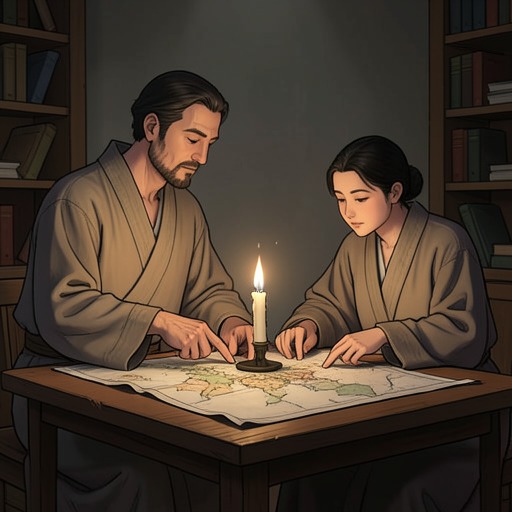
When Kong Ming arrives, Xuande speaks privately and accepts responsibility for the defeat. He says that Kong Ming brought him success, yet he foolishly ignored his advice and thereby brought disaster upon the state. He entrusts the kingdom and his heir to Kong Ming, explaining that Liu Shan is too weak to govern without guidance. The scene makes Baidi the setting for a transfer of responsibility as well as a deathbed reckoning: the ruler cannot complete the work he began, so he places its continuation in his prime minister’s hands.
Xuande also warns Kong Ming against promoting Ma Su, whom he judges to be all talk despite Kong Ming’s high opinion of him. He then dictates his last will and testament, formally charging Kong Ming with carrying it out as prime minister. The warning is a specific final piece of political counsel, distinct from the larger charge to protect the heir and continue the struggle for the Han.
Succession and continuing significance
Xuande says that he and his followers tried to rid the world of Cao Cao and support the House of Han, but that the task remains unfinished. He asks Kong Ming to teach his heir well and entrusts him with the kingdom. His death at Baidi thus leaves both a succession and an uncompleted political purpose: Liu Shan is to inherit the throne, while Kong Ming is expected to preserve the cause that Xuande could not finish.
Xuande’s body is carried from Baidi to Chengdu, where mourning rites and the enthronement of Liu Shan take place so that the Han lineage can continue without interruption. Xuande is posthumously named August Emperor Zhao Lie and buried at Huiling. Baidi marks the end of his personal rule, but the transfer of his body and the formal enthronement elsewhere show that the political succession extends beyond the place of his death.
News of Xuande’s death immediately shapes the next crisis. Cao Pi sees an opportunity to attack Shu while it is unsettled and accepts Sima Yi’s proposal for a five-army invasion, with forces intended to approach from several directions. Liu Shan, alarmed by reports of the mobilization, summons Kong Ming, who has already begun arranging defenses against the threats. Baidi therefore stands at the hinge between Xuande’s failed campaign and the next generation’s struggle: it is where the old ruler’s unfinished charge is entrusted to Kong Ming, and where his death creates the opening his enemies hope to exploit.