Battle of Bowang Slope
The Romance of the Three KingdomsThe Battle of Bowang Slope establishes Kong Ming’s authority in the field: faced with an advancing army from Cao Cao’s forces, he turns a skeptical command into a coordinated ambush and secures a victory at Bowang. The battle is at once a practical success against a superior force and a turning point in Xuande’s camp, where Guan Yu and Zhang Fei move from open doubt to acknowledging the new adviser’s skill.
Context and Command
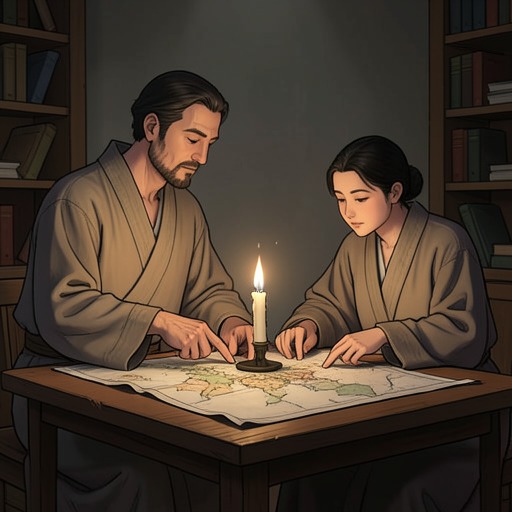
Cao Cao’s army, more than one hundred thousand strong, is advancing on Xinye. Kong Ming’s appointment as adviser has unsettled Guan Yu and Zhang Fei, who resent Xuande’s choice and doubt whether the newcomer can command them. Concerned that his authority will not be recognized, Kong Ming asks Xuande for a sword and seal as insignia of command. The brothers agree to cooperate, though they hope his plans will fail.
Kong Ming’s orders assign each force a specific task and make fire the signal for a coordinated attack. Guan Yu is to conceal his troops in the hills around Bowang, let the enemy pass, then strike its rearguard and supply train when the flames appear. Zhang Fei is to hide in valleys behind the forest and attack the army’s stores at Bowang. Two commanders are to prepare firewood on either side of the ravine, while Zhao Zilong leads the advance party and is instructed to feign retreat when he meets Cao Cao’s men. Kong Ming himself will stay away from the fighting, a decision that especially irritates the two brothers.
Even Xuande is uneasy when Kong Ming orders him to leave camp as the enemy approaches and return only at the sign of fire. Kong Ming nevertheless directs Sun Qian and Jian Yong to prepare victory celebrations. The contrast between Xuande’s misgivings and Kong Ming’s confidence frames the battle as a test not just of tactics but of whether the new adviser can make his orders work through a doubtful command.
The Feigned Retreat and Ambush
Cao Cao’s advance is led by Xiahou Dun, supported by Yu Jin. Near Bowang, the Wei force divides: one part moves forward, while another remains behind to guard the supply wagons. When Zhao Zilong appears with a small force, Xiahou Dun laughs and charges, expecting an easy victory. Zhao Zilong follows Kong Ming’s instructions, briefly skirmishes, and retreats, drawing Xiahou Dun after him.
Another commander recognizes the danger and warns Xiahou Dun that the retreat may be a lure. Xiahou Dun dismisses the warning. Xuande then joins the retreat, drawing the pursuers farther into a narrowing ravine. Yu Jin eventually realizes the troops risk being caught between fires and rushes to alert Xiahou Dun, but by then the trap is closing.
Fires erupt on both sides of the ravine, throwing the advancing force into confusion. Zhao Zilong attacks the trapped troops, while Xiahou Dun narrowly escapes. The deception has depended on the enemy’s confidence in its apparent advantage: a small force gives way, the pursuers press on, and the narrowing route becomes a liability once fire blocks their escape.
Supply Lines and Victory
While the ambush breaks the advance, Guan Yu and Zhang Fei attack the troops guarding the supplies. Their assault succeeds in destroying the supply wagons, turning the loss of position into a broader defeat for Cao Cao’s force. The battle’s outcome therefore rests on more than the fires in the ravine: the concealed troops, the staged retreat, Xuande’s participation, and the attack on the wagons combine to disrupt both the advancing force and its support.
The account presents the result as a decisive victory, with many of Cao Cao’s men killed and the army’s supplies destroyed. A poem accompanying the episode praises Kong Ming’s use of fire and the effect of his example, describing how even Cao Cao is made to tremble at the strategy of a novice who has never fought. The poem gives the victory a performative, celebratory finish, turning a successful operation into a public demonstration of the adviser’s reputation.
Aftermath and Significance
After the fighting, Guan Yu and Zhang Fei come upon Kong Ming’s humble carriage. They dismount and bow, acknowledging the skill they had doubted. Their change of attitude is among the battle’s most immediate consequences: Kong Ming’s authority, initially secured by Xuande’s insignia, is now reinforced by results witnessed by the commanders themselves.
The forces return triumphantly to Xinye, but the victory does not end the conflict. The camp expects Cao Cao to seek revenge soon with a much larger army. When Xuande asks what they should do next, Kong Ming replies that he has a plan, leaving the battle as both a completed success and the beginning of a continuing strategic contest. Its narrative function is to show how command, deception, terrain, and coordination allow Xuande’s smaller force to win—and how Kong Ming’s first victory converts skepticism into trust.