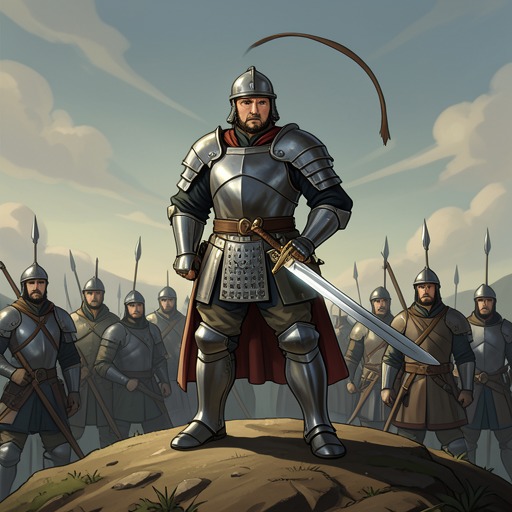
Battle of Tiger Cage Pass
The Romance of the Three KingdomsThe Battle of Tiger Cage Pass is the dramatic confrontation in which Lü Bu’s extraordinary fighting ability stops the coalition’s advance—until Zhang Fei and Guan Yu join forces against him. The encounter gives the Peach Orchard Brotherhood its first defining battlefield test: neither brother defeats Lü Bu alone, but their intervention turns a threatened retreat into a rebel counterattack and carries them toward Dong Zhuo himself.
Causes and Stakes
In revenge for Hua Xiong’s death, Dong Zhuo orders the killing of Yuan Shao’s family members in the capital. He then sends a force of two hundred thousand men against the rebels, both to confront Yuan Shao’s army and to guard Tiger Cage Pass, about fifty miles from Luoyang. The battle is therefore not an isolated contest of champions: it takes place within Dong Zhuo’s effort to crush the opposition and secure the route protecting his position.
The political landscape behind the clash is the disintegration of the Han. The book describes the Three Kingdoms period as the era in which China breaks apart among warlords and three leaders—Liu Bei, Cao Cao, and Sun Quan—eventually found kingdoms from the declining Han realm. At Tiger Cage Pass, that later division has not yet taken shape. The immediate struggle is between Dong Zhuo’s forces and a coalition whose members must first survive the regime’s military strength.
Lü Bu and the Challenge
Lü Bu rides onto the front line to challenge any warrior willing to face him. His elaborate equipment makes him a conspicuous figure: flower-embroidered robes, a triple-layered gold headdress, beast-shaped armor, a lion-headed belt, and a choice of arrows, halberd, and two-edged sword. Beneath him is Red Hare, presented as the foremost of horses; the account ranks rider and mount together as the greatest in their respective fields.
Warriors from Yuan Shao’s forces successively go forward and are quickly overcome. Gongsun Zan is the sole champion to escape with his life, and even he is pursued by Lü Bu on Red Hare. The sequence establishes the imbalance at the center of the encounter: the coalition has many challengers, but none can halt Lü Bu’s advance by himself.
The Three Brothers Turn the Fight
Zhang Fei intervenes when Gongsun Zan is in danger. He calls Lü Bu an upstart claiming titles he has not earned, identifies himself, and charges in, drawing Lü Bu away from the pursuit. They fight for fifty rounds without either gaining the upper hand. Guan Yu then comes to support Zhang Fei, his sworn brother. Even with the two brothers fighting together for many more rounds, Lü Bu remains undefeated.
The decisive change is not a clean victory over Lü Bu but the pressure of the prolonged fight. As he tires, he feints an attack, turns, and rides away, with Zhang Fei and Guan Yu pursuing him. The rebel troops surge forward as Lü Bu’s men retreat toward the pass. Xuande and his brothers join the pursuit with their army, transforming Lü Bu’s withdrawal into an opportunity for the coalition to advance.
From Battlefield to Political Target
As the brothers gallop toward the pass, they see Dong Zhuo’s blue canopy. Zhang Fei argues that pursuing Lü Bu is less important than reaching the principal culprit and removing the source of the evil. The brothers then head directly toward Dong Zhuo. The battle thus closes not with Lü Bu captured or defeated, but with the brothers’ attention shifting from the formidable warrior to the ruler whose forces he serves.
That movement gives the encounter its narrative and political force. Lü Bu’s prowess embodies the immediate obstacle; the blue canopy makes the larger target visible. The brothers’ cooperation enables them to press forward, while their decision to pursue Dong Zhuo connects battlefield action to the broader conflict over who will command the collapsing Han order.