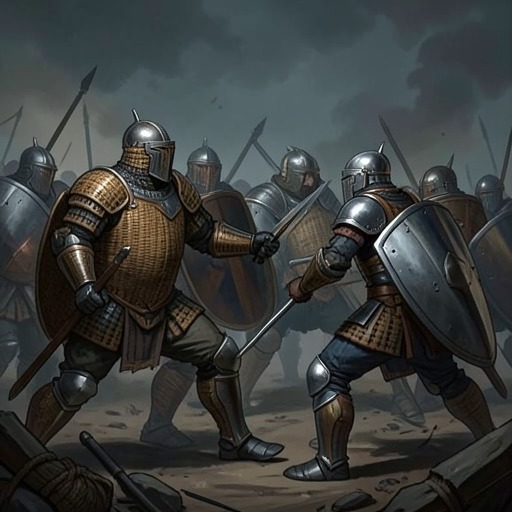
Burning of Wutugu’s rattan-armored army
The Romance of the Three KingdomsThe Burning of Wutugu’s rattan-armored army is the final great military reversal in Kong Ming’s campaign against Meng Huo: armor that had made its warriors seemingly invulnerable becomes the means of their destruction. Kong Ming exploits the terrain of the Serpent Winding valley to trap Wutugu’s force and set it alight, killing thirty thousand men. The victory is tactically decisive, but the narrative refuses to treat it as a clean triumph: Kong Ming acknowledges the terrible cost and says the extermination of the tribes will remain a burden to him.
Background and the rattan army
After another defeat, Meng Huo has only about a thousand men and turns to the Wugu tribe for help. Its chieftain, Wutugu, agrees to support him, and some thirty thousand warriors join the campaign. The tribe’s distinctive rattan armor has been repeatedly soaked in oil, making it resistant to arrows and swords; it also floats, allowing the soldiers to cross rivers. Its protection proves effective in battle: when the Shu army confronts Wutugu’s force beside Peach Blossom river, it can neither penetrate the armor nor stop the Wugu soldiers from returning to camp unharmed.
The apparent invulnerability of the armor presents Kong Ming with a practical problem as well as a military one. Some advise withdrawing from the desolate land, arguing that it contains nothing worth the struggle. Kong Ming rejects retreat, saying that it would undo what has already been gained. He then scouts the surrounding terrain himself and finds a winding valley shaped like a great serpent. The valley gives him the feature his plan requires: a confined route where a large force can be drawn forward and prevented from escaping.
The trap in Serpent Winding valley
Kong Ming organizes the operation around deception, barriers, and coordinated positions. He assigns Ma Dai ten black carriages and a thousand bamboo poles, giving him two weeks to prepare. Zhao Zilong is sent to control the end of the valley leading to Sanjiang. Wei Yan receives the role of apparent loser: he is to abandon camps repeatedly, following white flags that lead the pursuing army toward the valley, and is specifically ordered not to seek Kong Ming until after the fifteenth staged defeat.
The deception works through repetition. Day after day, Meng Huo and Wutugu attack Wei Yan’s camps and appear to drive him back. Each abandoned position draws the Wugu force farther along the route Kong Ming has chosen. Although Meng Huo warns Wutugu to avoid valleys thick with trees and brush, the approaches they encounter seem to contain no ambush. On the sixteenth day, Wutugu follows Wei Yan into Serpent Winding valley. He rides a white elephant, wearing a wolf-fur helmet decorated with the sun and moon and a cloak covered with gold and pearls. The valley’s bare sides reassure him that he is not riding into a concealed attack, and he continues in pursuit of Wei Yan.
The army first passes wagons that seem to have been abandoned by a retreating enemy. At the far end, however, tree trunks block the route, while rocks fall from above and obstruct the road. As Wutugu’s men try to clear the obstruction, blazing wagons appear and cut off the passage. The carts they had already passed are set alight too, sealing the way back. The apparent signs of a hurried retreat have become part of the trap: the pursuing force is enclosed between barriers and fire.
Destruction and its consequences
The valley’s slopes initially appear to offer another escape route because they lack brush that might catch fire. Wutugu leads his men toward them, but flaming brands are thrown from above and ignite fuses connected to landmines buried in the ground. The explosions set the valley ablaze. The oil-soaked rattan armor, which had turned aside arrows and swords, now catches fire and prevents the warriors from escaping its flames. Thirty thousand men, including Wutugu, die in the valley.
Kong Ming watches from the heights and weeps at the destruction. The scene makes the reversal exceptionally stark: the armor’s strength has not simply failed; the material and treatment that made it protective have made it fatal once the force is trapped and fire reaches it. The route, the staged retreats, the obstructed exits, and the prepared fuses all depend on one another. The battle is won through advance planning and terrain rather than through an attempt to defeat the armor directly.
The destruction also breaks the military support on which Meng Huo has relied. Misled by men who claim to have escaped Shu captivity, Meng Huo and his entourage enter the valley believing Wutugu needs their help. They realize too late that they have been drawn into another trap. Zhang Ni, Ma Zhong, and the thousand men capture Meng Huo, his wife, and the rest of the party; when Meng Huo briefly breaks free, Kong Ming blocks his path in his carriage, and Ma Dai seizes him.
Victory and moral burden
Once the captives are brought before him, Kong Ming explains the plan: Wei Yan served as the lure, Ma Dai prepared the black wagons, and the bamboo poles were used in the arrangement of the buried landmines and fuses. Burning wagons closed the far exit, while fire provided the means of destroying armor that ordinary weapons could not penetrate. The explanation turns the outcome into more than a surprise battlefield reversal: it reveals how carefully the apparent retreats and obstacles were coordinated to make the final destruction possible.
Kong Ming does not present the result as uncomplicated ingenuity. He says that he had no choice but to use these methods, despises himself for doing so, and expects the consequences to weigh on him in this life and the next. He singles out the complete extermination of the people of the tribes as a lasting burden. That response places a moral limit inside the victory itself: the tactic succeeds, and Meng Huo is captured, but the deaths of thirty thousand men remain consequential rather than disappearing beneath the success of the campaign. The army’s destruction therefore marks both the high point of Kong Ming’s stratagem and the cost at which that success is achieved.