Cao Cao
The Romance of the Three KingdomsCao Cao is one of the three leaders who emerge as the Han empire breaks apart and establish kingdoms from its collapsing territory. A practiced schemer, he combines military strength with political calculation: he warns against an ill-conceived attempt to eliminate the eunuchs, later seeks to kill Dong Zhuo, and ultimately gains control of the emperor. His rise makes him the northern power Xuande cannot simply confront, while his death and Cao Pi’s succession mark the transition from Han rule to the Wei dynasty.
Identity and Political Position
The Three Kingdoms take their name from the three leaders who carve kingdoms out of the dying Han empire: Xuande, Cao Cao, and Sun Quan. Cao Cao’s particular source of power is not only his army but his ability to turn proximity to the imperial court into practical authority. By the time Kong Ming assesses the political landscape for Xuande, Cao Cao has overcome the stronger Yuan Shao through cunning, commands an army said to exceed a million, and controls the emperor. Kong Ming consequently warns that Xuande cannot oppose him directly.
Cao Cao’s political intelligence appears early in a personal anecdote about his youth. After an uncle complains about his behavior and prompts his father to punish him, Cao pretends to suffer a fit. When his father arrives, Cao claims the uncle has fabricated the accusation to turn father against son. The deception succeeds: his father’s trust in the uncle is damaged, and Cao is thereafter freer to act as he pleases. The episode presents manipulation not as a later tool acquired with power, but as an ability already established in his youth.
Judgment and the Struggle Against Dong Zhuo
When He Jin proposes summoning troops from across the land to eliminate the eunuchs, Cao Cao objects. He argues that the leaders should instead be struck stealthily by a small, dedicated force, since a conspicuous military mobilization would alert the others and allow them to obstruct the plan. He Jin rejects this advice and insists on his own approach. Cao Cao leaves, warning that He Jin will bring disaster upon the realm if he does not take care. The episode distinguishes Cao’s preference for focused, covert action from the larger, less controlled intervention that follows.
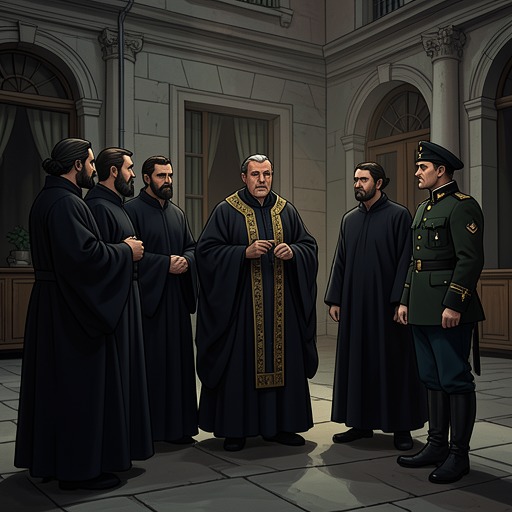
After Dong Zhuo’s brutal rule has become a cause for opposition, Cao Cao offers to assassinate him. At a meeting convened under cover of a birthday celebration, he asks for Wang Yun’s Seven-jewelled Dagger as both weapon and inducement; the assembled men hand it over and drink to the plan. Cao enters Dong Zhuo’s palace carrying the dagger, but his attempt fails when Dong Zhuo sees him reflected in a mirror. Cao averts immediate suspicion by presenting the weapon as a gift. The failure does not erase the audacity of the attempt, but it shows how his survival depends on improvisation when a covert plan is exposed.
Imperial Authority and Strategic Power
Later, with the Han emperor back in the ruined former capital and facing famine and renewed danger, Yang Biao proposes summoning Cao Cao because he has the strongest army. The emperor consents, and a messenger is sent; Cao promptly puts his affairs in order and prepares for the long march to the capital. His military strength thus makes him a resource the court turns to for protection even as reliance on him opens the way to his greater political influence.
Kong Ming’s account of the balance of power makes the consequences explicit. Cao Cao has defeated Yuan Shao despite Yuan Shao’s greater strength, commands an enormous army, and holds the emperor, whose position brings the allegiance of many nobles. That combination leaves Xuande without a direct path to victory over him. Later, after Xuande’s successes in the Hanzhong region, Kong Ming urges him to accept the imperial title, arguing that Cao Cao has seized so much power that the rightful ruler has been usurped. Cao’s political ascent therefore frames the central question of legitimacy: military success and control of the court have given him power, while his opponents invoke loyalty to the Han to contest the authority he exercises.
Guan Yu’s Death and Its Political Use
After Guan Yu dies, Sun Quan sends his head to Cao Cao in a special box, hoping to redirect Xuande’s anger northward. Cao initially welcomes the news, saying that Guan Yu’s death will let him sleep easily. Sima Yi warns that Sun Quan is trying to shift the danger from the south onto Cao Cao by making Xuande believe Cao ordered the death. Cao accepts the warning and asks what course to take.
Sima Yi proposes that Cao have a wooden body made, place Guan Yu’s head upon it, and give him a full military burial. The ceremony would transfer blame back to Sun Quan, leaving Xuande more likely to attack Wu; Cao could then exploit whichever side prevailed. Cao approves the plan. When the box is opened, however, Guan Yu’s face appears lifelike. Cao addresses the head familiarly, but its mouth moves and its eyes roll. He faints, then declares that Guan Yu is no ordinary mortal. On hearing what has happened to Lü Meng, he orders an even grander burial, attended by the officials of the city, outside the walls of Luoyang. The episode brings together Cao’s instinct for turning an enemy’s death to political advantage and a supernatural disturbance that unsettles his confidence.
Haunting, Death, and Succession
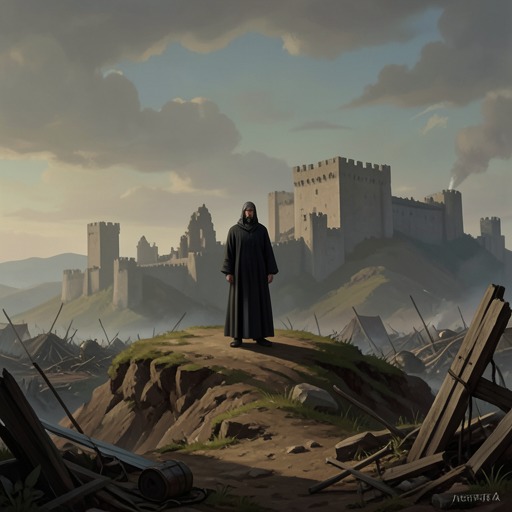
Cao remains troubled by Guan Yu’s spirit. When he plans a new palace hall, he seeks a large tree near Leaping Dragon Pool, but the men sent to cut it cannot damage its trunk. Local leaders plead that the tree, said to be many centuries old, is sacred and inhabited by a deity. Cao refuses to be deterred. That night he sees a black-clad figure who identifies himself as the tree’s deity and accuses Cao of attacking a sacred tree in order to build a hall connected with overthrowing the dynasty. Cao wakes in terror with severe pain in his head.
Hua Xin recommends summoning the physician Hua Tuo, known for having cured Zhou Tai. Hua Tuo explains that treatment would require opening Cao’s skull. When he mentions having treated Guan Yu, Cao suspects that he has come to avenge Guan Yu and has him imprisoned. Although the prison warden tries to help him, Hua Tuo dies soon afterward. The physician’s medical book, the Black Bag Book, is given to the warden, but the warden’s wife uses the manuscript to light a fire, and almost none of its cures survive. Cao’s suspicion thus leads not only to the loss of a physician who might have treated him, but also to the destruction of the book associated with his medical knowledge.
In a later night vision, Cao sees the ghosts of Empress Fu, Lady Dong, two imperial sons, and many others he has killed. As they demand his life, he reaches for his sword; at that moment, a corner of the hall collapses, and Cao collapses as well. The following morning he tells his advisers that he has spent thirty years at war without attending to supernatural beings, but asks what the apparitions mean. When a Daoist exorcism is suggested, he refuses it, saying that one who has offended Heaven has no one left to pray for him. He believes that his mandate from Heaven is exhausted and that nothing can be done.
As death approaches, Cao gives practical instructions for the women of his household, telling them to perfect their needlework so they can make goods to sell and support themselves after he is gone. He also orders some of them to pray for him every day at the Bronze Bird Tower. To deter grave robbers, he commands that seventy-two false tombs be built outside Jiangwu in Zhangde County. He dies at sixty-six in AD 220, with tears on his face. His death closes the life of the ruler whose power had centered on control of the emperor, but it does not settle the succession: Cao Pi’s advisers press him to secure power, and an imperial decree confirms him as King of Wei.
Legacy and Contested Legitimacy
The transfer of power after Cao Cao’s death makes the political consequence of his career visible. The Han emperor’s abdication announcement credits the Cao family with the mandate and invokes the example of Yao, presenting the transfer as an orderly, virtuous surrender of rule. Cao Pi then accepts the throne and begins his reign as emperor of Wei. In Chengdu, the news prompts Kong Ming to propose that Xuande become emperor in order to continue the Han lineage. Xuande initially recoils at the idea as disloyal, but Kong Ming argues that Cao Pi has usurped the Han and that Xuande, as a descendant of its founder, has a duty to restore it.
Cao Cao’s narrative role therefore rests on a deliberate tension. He is an effective strategist whose judgments repeatedly reveal the value of secrecy, timing, and political leverage; he is also the ruler whose concentration of power is treated by Xuande’s camp as the usurpation that makes restoration necessary. His final encounters with visions of those killed under his rule turn that political conflict into a moral one: the empire he helped shape passes to his son, while the narrative surrounds his dying authority with the question of whether worldly victories can outlast the consequences of the means by which they were won.