Cao Cao's Relocation of Emperor Xian to Xuchang
The Romance of the Three KingdomsCao Cao's Relocation of Emperor Xian to Xuchang marks the change from an imperial court seeking protection in ruined Luoyang to one increasingly controlled by Cao Cao. Called to the capital because he commanded the strongest army, Cao Cao first helped secure the emperor against Li Jue and Guo Si, then moved the court to Xuchang. The transfer was presented as a practical answer to danger and scarcity, but its consequence was to place the emperor within Cao Cao’s reach and narrow the influence of rival commanders.
The court in ruined Luoyang
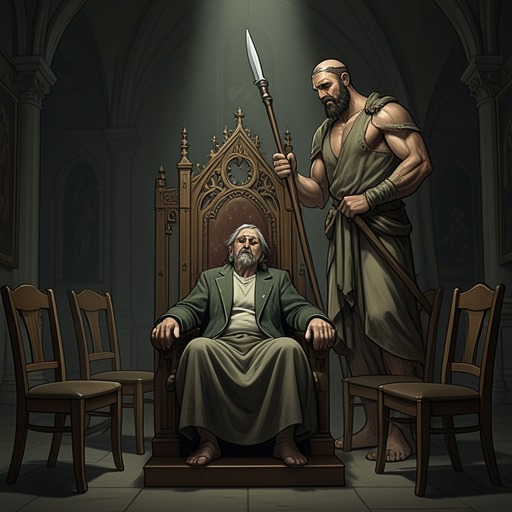
When Emperor Xian returned to Luoyang, he found a capital devastated by Dong Zhuo’s earlier orders. The palaces and halls had been burned, streets were overgrown, and the court met among the ruins around the one building still partly intact. Famine compounded the destruction: the few hundred families remaining survived on bark and roots, while people died beside their homes. The city’s ruin was not merely a backdrop. It made the court’s need for an armed protector immediate and rendered a return to the old capital an unstable restoration.
The violence that had emptied the city had also stripped its inhabitants of safety and resources. Earlier, five thousand troops had been sent into Luoyang to kill people associated with Yuan Shao and seize their property; thousands were murdered, including their families, and many residents were driven out toward Chang’an. Dong Zhuo then ordered the city, its palaces, and ancestral shrines burned, and imperial tombs opened. The court’s later presence among the ruins therefore belongs to a longer history of political violence: the emperor had returned to a capital whose destruction had been deliberate.
Cao Cao is summoned
To protect the emperor, Yang Biao proposed summoning Cao Cao, whose army was the strongest available. With the emperor’s consent, a messenger was dispatched to Luoyang. Cao Cao immediately put his affairs in order and prepared for the long journey. The invitation made the military balance plain: the court could authorize a summons, but its security depended on a regional commander able and willing to answer it.
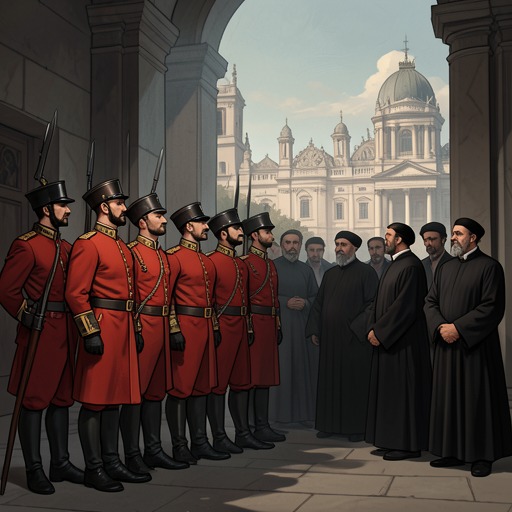
Before Cao Cao’s preparations reached the emperor, word spread that Li Jue and Guo Si were advancing on Luoyang. In alarm, the court began to retreat. The procession had only just passed out through the city gate when Cao Cao’s troops appeared. The emperor returned to the palace, and Cao Cao’s forces swiftly confronted and routed the advancing rebels, who fled into the mountains. His arrival thus answered the immediate threat and established him as the force on which the endangered court relied.
Dong Zhao’s proposal and the move
After Cao Cao had settled in the capital, Emperor Xian sent Dong Zhao to summon him. Cao Cao was struck by Dong Zhao’s vigor and apparent good condition amid the hardship affecting others in the city. In their discussion, Dong Zhao proposed moving the emperor to Xuchang. There, he argued, Cao Cao could exercise control without rivals such as Yang Feng standing between him and the court. The relocation plan joined a security argument to a political one: the emperor would leave a famine-stricken, exposed capital, while Cao Cao would gain a more direct position over imperial affairs.
Dong Zhao recommended presenting the move as a matter of provisions, saying that Xuchang had more food. This explanation was intended to allay the other commanders’ concerns. The emperor was told of the plan and assented, described as unable in practice to oppose a powerful man such as Cao Cao. His formal agreement allowed the court’s departure to proceed, but the circumstances emphasize how limited his freedom of decision had become.
The journey and Cao Cao’s growing control
On the route to Xuchang, Yang Feng tried to block the imperial procession, alarmed by the prospect of losing his influence over the emperor. His champion was Xu Huang. Cao Cao’s envoy persuaded Xu Huang that a capable hero should serve another hero rather than Yang Feng, invoking the proverb that a wise bird chooses its branch and a thoughtful servant his master. Xu Huang agreed to join Cao Cao’s side, but refused the suggestion that he kill Yang Feng and bring back his head. His refusal won the envoy’s admiration. Without his champion, Yang Feng withdrew and took refuge with Yuan Shu, leaving the road open for the procession.
Once the emperor was settled in Xuchang, Cao Cao’s control over him increased. The relocation had therefore produced more than a change of residence: it weakened Yang Feng’s position, removed the court from the immediate peril of Luoyang, and gave Cao Cao a commanding role in imperial politics. The episode’s central reversal is that the emperor’s appeal for protection brought the strongest military power into the capital’s affairs, while the journey designed to secure him also made him more dependent on that power.
Political significance
The episode reflects the wider fragmentation of the Han world, in which leading commanders carved out kingdoms as central government weakened. The novel’s account places the court’s desperate circumstances alongside the practical decisions and rivalries that shaped control of it: hunger and military danger prompt the move, while the management of the emperor’s location alters the balance among commanders. Cao Cao’s protection is effective against the immediate threat, but the relocation also advances his political ascendancy.
The story is presented within a historical epic whose events draw on the record of the period, while dramatic storytelling and the novelist’s shaping give them narrative force. Here, the route from the ruined capital to Xuchang concentrates a larger political transformation into one decision. The court survives the immediate advance of Li Jue and Guo Si, yet its safety is secured through a transfer that places the emperor increasingly under Cao Cao’s control.