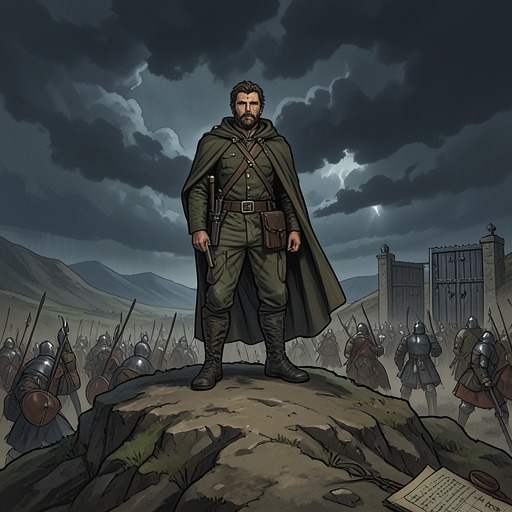
Cao Cao's Suppression of the Yellow Headband Remnants
The Romance of the Three KingdomsCao Cao’s suppression of the Yellow Headband remnants is significant not only because he defeats a large-scale rebellion, but because he incorporates surrendered rebels into the army with which he builds an independent power base. The sequence links the Han court’s need for a capable commander to Cao Cao’s rise: victory over the rebels supplies both soldiers and the means to establish his own center of authority in Yanzhou.
Rebellion and the call for Cao Cao
After Dong Zhuo’s death, unrest spreads across the realm. A rebel army of 100,000 marches on the capital but is defeated and driven away; then the Yellow Headband rebels rise again, gathering in armed bands numbering hundreds of thousands. Faced with this renewed uprising, Li Jue and Guo Si ask who can suppress it. Cao Cao is recommended as the commander to call upon.
The setting makes the rebellion more than an isolated military challenge. The Han court is contending with repeated uprisings, while the rebel leaders themselves have to seek help from a commander whose power will soon grow beyond their control. Cao Cao’s intervention answers an urgent need, but the result will also furnish him with resources of his own.
Defeat and incorporation
Cao Cao defeats the rebels within a short time and receives the surrender of more than 300,000 former Yellow Headband fighters. Rather than treating the surrender as the end of their role in the conflict, he chooses the best among them for service in his own army. The scale of the capitulation and the selective recruitment make pacification an act of military consolidation: a mass of defeated opponents becomes a source of organized manpower.
The account thus distinguishes Cao Cao’s response from simple dispersal of the rebels. His victory changes the composition and reach of his forces, allowing the commander summoned to meet a crisis to emerge with an enlarged army. The surrendered fighters’ incorporation is the consequential step that connects battlefield success to political ascent.
Yanzhou as a power base
Cao Cao bases himself in Yanzhou, away from the capital, and builds what the narrative describes as his own court. He draws many wise and worthy individuals into his service, so the new center rests on more than the soldiers recruited from the rebels. The combination of military strength and capable personnel turns a provincial base into an independent structure of rule.
The episode’s importance therefore lies in its double outcome. The renewed rebellion is suppressed, relieving an immediate threat; at the same time, Cao Cao gains troops and establishes authority beyond the capital’s direct reach. A response made in the name of restoring order becomes one of the steps by which a powerful commander prepares to act autonomously amid the Han dynasty’s fragmentation.
Recurrence and narrative pattern
The novel repeatedly presents military outcomes as products of intelligence, deception, and control of resources. In a later confrontation, Jia Xu watches Cao Cao’s attention to a vulnerable stretch of wall and advises Zhang Xiu to conceal crack troops there while displaying an apparent defense elsewhere. At Guandu, Cao Cao faces Yuan Shao’s much larger army with only about a tenth as many men; Xun You urges an immediate attack because Cao Cao’s supplies cannot support a prolonged campaign. These episodes are not part of the Yellow Headband suppression itself, but they echo its emphasis on how commanders turn limited circumstances into strategic advantage.
The novel also makes the consequences of military power legible through its treatment of civilians and territory. Cao Cao’s later invasion of Xuzhou, undertaken after he wrongly blames Tao Qian for his family’s death, becomes a campaign of massacre and destruction. Set beside his recruitment of surrendered rebels, that later violence shows that military capacity is not presented as virtue in itself: the narrative distinguishes the ability to command forces from the ethical consequences of how a commander uses them.
Significance
Cao Cao’s success against the Yellow Headband remnants marks an important transition from serving as a commander called upon to restore order to building a power center of his own. The more than 300,000 surrenders make the scale of that transition concrete, while his choice of the strongest for his army shows how defeat can be converted into renewed military capacity. His base in Yanzhou and the circle of able people gathered around him give that capacity political form.
The episode also belongs to the novel’s broader portrayal of a collapsing Han order, in which local commanders respond to disorder while accumulating the means to rival the court. Cao Cao’s suppression of rebellion is both a public victory and a foundation for personal power: the realm’s crisis is checked in the short term, even as the forces assembled to meet it help deepen the fragmentation that follows.