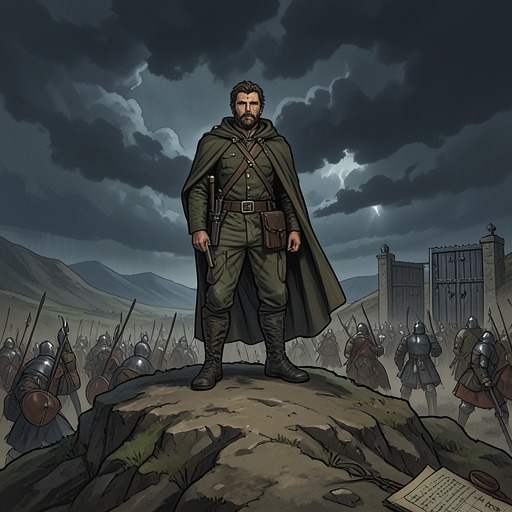
Cao Cao's conquest of Hanzhong
The Romance of the Three KingdomsCao Cao's conquest of Hanzhong is a campaign of contested passage, tactical deception, and shifting allegiance that brings the region under Cao Cao's control. The fight for the Yangping Pass turns on the dangers of misreading a retreat; the later struggle before Nanzheng turns on Cao Cao's ability to exploit distrust between Zhang Lu and Pang De. In the end, Zhang Lu's concern for the Han dynasty's stores wins Cao Cao's respect, while Yang Song's betrayals earn public execution.
Background and Strategic Aim
After Cao Cao's daughter becomes empress of Han, Cao Cao grows more powerful and turns his attention toward conquering Wu and Shu. Xiahou Dun advises against attacking either immediately. He proposes first attacking Zhang Lu in Hanzhong, then using that position to seize Shu; Cao Cao agrees. Hanzhong is therefore both the immediate target and a step in a larger design, rather than an isolated campaign.
Zhang Lu's commanders agree to defend the enemy's advance at Yangping Pass. The pass becomes the first decisive obstacle: Cao Cao's forces must contend with difficult terrain and a defense that can exploit the vulnerability of a tired army. When Cao Cao arrives in person, the landscape itself gives him reason to question the campaign, and the danger of pressing forward is soon made plain.
The Fight for Yangping Pass
Cao Cao's advance troops reach the pass after a long march in an exhausted state. On their first night opposite Zhang Lu's army, Yang Ang and Yang Ren launch a surprise attack, using fire to alarm the camp while Cao Cao's men are still getting up. The attack nearly wipes out the advance force. Survivors return to report the defeat, and Cao Cao goes to inspect the pass himself. The terrain is wild, and he wonders why he came; the following day, Yang Ang and Yang Ren nearly trap and capture him during another surprise attack. Xu Chu saves him by charging at the opposing commanders, whose men take fright and flee.
The confrontation then settles into a fifty-day impasse, with neither side making a significant move. Cao Cao tries to break it by staging what looks like a retreat, hoping to draw Zhang Lu's forces out. Yang Ang accepts the appearance and pursues, but Yang Ren suspects a ruse and cannot persuade him to hold back. Yang Ang takes most of the troops after the withdrawing enemy. Dense fog disorients the pursuing force; when it lifts, Zhang He and Yang Ang's men fight, and Yang Ang is forced to retreat.
The apparent withdrawal also draws Xiahou Yuan into the operation. Sent out as part of the attack, he wanders through the same fog and, by chance, finds the enemy camps nearly empty. He overwhelms the remaining guards. When Yang Ang attempts to find safety there, the camps are already occupied by Cao Cao's troops, and Zhang He kills him in battle. Cao Cao takes the pass and prepares to advance on Nanzheng.
Zhang Lu blames Yang Ren for the failure, and Yang Ren offers to attack Cao Cao personally. On the way, his force encounters Xiahou Yuan, who has been sent to reconnoitre. Yang Ren challenges him; neither initially gains the upper hand. Xiahou Yuan then feigns retreat, draws Yang Ren into pursuit, and turns to kill him. Yang Ren's men flee back to their base. The campaign has moved forward through repeated reversals: a surprise attack almost defeats Cao Cao, but his own staged retreat turns the defenders' disagreement into a loss of the pass and their commanders.
Nanzheng and Pang De's Defection
With the pass taken, Cao Cao advances on Nanzheng, the gateway to Zhang Lu's capital. Zhang Lu's forces call on Pang De, a formidable fighter who is given ten thousand men and promised great rewards if he can stop the advance. At Nanzheng, Cao Cao warns his own men that Pang De is dangerous. Several of the leading fighters try him in single combat and die without defeating him. Cao Cao comes to want Pang De not simply beaten but persuaded to defect.
Jia Xu proposes exploiting Yang Song's ambition and greed. Cao Cao's side secretly offers him gold and silk, then plans to draw Pang De out by abandoning a camp during an attack. A chosen soldier wears a golden breastplate beneath ordinary armor, disguising himself as one of Pang De's men. Pang De captures the camp, but Cao Cao's forces counterattack and drive him back toward the city. The disguised spy follows him inside and gives Yang Song the breastplate and a letter proposing that Yang Song open the gates to the enemy when the moment comes.
Yang Song accepts the arrangement and begins spreading rumors that Pang De has lost control of the camp because Cao Cao bribed him. Zhang Lu summons Pang De, condemns him, and nearly orders his execution before others intervene. Offended and angry, Pang De withdraws to his quarters. The rumors do not prove Pang De's disloyalty, but they isolate him from the ruler whose trust he needs.
The next day Xu Chu challenges Pang De and then flees at a crucial moment, drawing him onward. Pang De's horse falls into a pit, and he is captured. Cao Cao receives him with respect and offers him surrender. Pang De recalls Zhang Lu's anger, the false accusations, and how close he came to being executed; he accepts Cao Cao's offer. Cao Cao then rides with him before the city walls, making the defection visible to Zhang Lu and demonstrating how precarious his defense has become.
Surrender and Aftermath
Cao Cao's forces soon overwhelm the city. Before leaving, Zhang Lu orders the grain warehouses and treasury sealed and protected. He regards them as property belonging to the Han dynasty and its people, not as his own possessions. This decision distinguishes his conduct at the moment of defeat from Yang Song's pursuit of personal advantage.
When Cao Cao discovers that the stores have been preserved, he is impressed by Zhang Lu's honor and sends to Bazhong to ask him to surrender. Zhang Lu is willing, but his brother resists. Yang Song, meanwhile, offers Cao Cao help if he attacks. He tricks Zhang Lu into going out to confront Cao Cao's troops and then refuses to let him back into the city when he retreats from the battlefield. With re-entry denied, Zhang Lu has no option but to surrender. Cao Cao receives him with praise and honor.
Hanzhong consequently comes under Cao Cao's control, and those who surrender receive new posts. Yang Song, despite having aided Cao Cao, is publicly executed. A concluding poem condemns him as a spoiler of good men and a traitor to his lord, and asks what his greedy accumulation of gold and silver achieved. The final reversal makes clear that successful scheming does not itself earn lasting favor: Zhang Lu's preservation of the stores brings respect, whereas Yang Song's treachery ends in punishment.
Narrative and Political Significance
The campaign repeatedly makes intelligence and terrain decisive. Yangping's difficult approaches and the fog surrounding the staged retreat turn movement into a test of judgment; the defenders' disagreement lets Cao Cao's false withdrawal become an opportunity to take the pass. Before Nanzheng, the decisive advantage shifts from battlefield strength to the management of trust: rumors weaken Pang De's bond with Zhang Lu, and the golden breastplate gives Yang Song a tangible inducement to betray him.
The outcome also separates territorial victory from moral evaluation. Cao Cao achieves his strategic aim and gains Hanzhong, but the narrative gives particular weight to Zhang Lu's choice to protect the public stores even as his rule collapses. Cao Cao's respectful reception of Zhang Lu and execution of Yang Song distinguish the defeated ruler from the collaborator who betrayed him. The conquest thus advances Cao Cao's campaign toward Shu while ending on a judgment about conduct under defeat and the limits of self-serving intrigue.