Cao Pi
The Romance of the Three KingdomsCao Pi is Cao Cao’s successor and the first emperor of Wei. His rise converts his father’s military and political dominance into a new dynasty: he first consolidates power as king of Wei, then receives Emperor Xian’s formal abdication and takes the throne. The transfer is presented as a carefully managed act of succession, but it does not settle the question of legitimacy. Xuande, invoking his descent from the House of Han, claims to continue the Han line, while a storm during Cao Pi’s ritual observances gives the new reign an unmistakably troubled beginning.
Succession and consolidation
When Cao Cao dies in AD 220, the succession is immediately dangerous. Cao Pi’s advisers urge him to seize authority before one of his brothers can challenge him. Hua Xin arrives from Xuchang with an imperial decree that he has drafted himself and forced Emperor Xian to sign, confirming Cao Pi as king of Wei, prime minister, and governor of Jizhou. The decree gives formal shape to a transfer of power already being driven by force and court politics.
The threat soon becomes concrete: Cao Pi hears that his brother Cao Zhang is advancing with an army of one hundred thousand. Jia Kui questions Cao Zhang’s claim that he has come only to attend the funeral, pointing out that an army accompanies him. Cao Zhang dismisses his soldiers, enters the palace alone, embraces Cao Pi in tears, and hands over his forces. Cao Pi then sends him to Yanling as commander. With the military challenge contained, Cao Pi rules with greater confidence, appointing Jia Kui chief commander and Hua Xin prime minister, and rewarding other supporters.
The succession also determines how Cao Cao will be remembered and how his former subordinates will be treated. Cao Pi gives his father the posthumous title King Wu and buries him at Gaoling in Ye. He assigns Yu Jin responsibility for the tomb, but its walls depict Yu Jin’s defeat by Guan Yu, including the loss of seven armies and his capture. The account identifies the painting as a deliberate insult by Cao Pi; Yu Jin is so distressed by it that he falls ill and soon dies. Cao Pi’s new authority thus appears not only in appointments and titles but in his power to shape the memorial treatment of those who served his father.
The abdication and contested legitimacy
Cao Pi’s elevation from king to emperor is carried out through a formal abdication by Emperor Xian. Hua Xin enters the imperial court with officials and presses the emperor to prepare an announcement. The document describes the Han as having endured thirty-two years of turmoil and declares that Heaven’s signs and the people’s wishes show the Han era has ended and fortune has passed to the Cao family. It invokes the ancient ruler Yao, who yielded power rather than favouring his own son, to portray the transfer as a precedent for virtuous abdication.
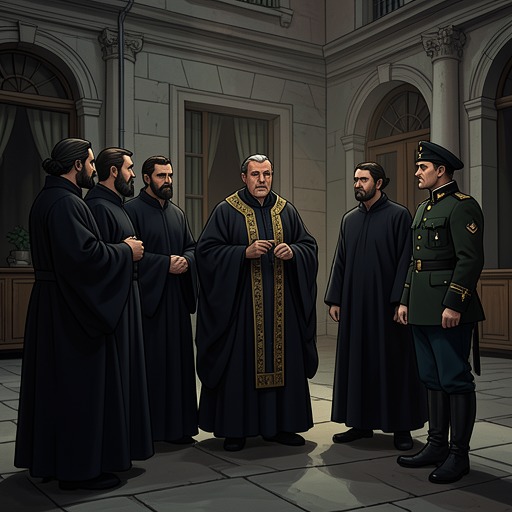
Cao Pi is eager to accept the throne, but Sima Yi counsels him to proceed slowly and refuse the first offer; Cao Pi refuses again when a further appeal arrives. Sima Yi then manoeuvres the court toward an Altar of Abdication. Before officials and soldiers, Emperor Xian hands over the jade seal of authority, and Cao Pi accepts the throne as emperor of Wei. The ceremony makes a transfer of power look like a willing, historically sanctioned surrender, while the need to stage repeated offers and refusals exposes how closely its appearance of consent is managed.
Emperor Xian is demoted to governor of Shanyang and ordered to leave at once. Hua Xin’s argument that two suns cannot shine at the same time gives the change a stark political logic: the former emperor can remain alive, but cannot continue to share the status of ruler. In Chengdu, reports of Wei’s emergence and rumours that Emperor Xian has been killed trouble Xuande. Kong Ming proposes that Xuande should take the title of emperor and continue the Han lineage, since he descends from its founder. Xuande initially regards this as disloyal and rebellious; Kong Ming argues instead that Cao Pi has usurped the throne and that Xuande has a duty to restore the House of Liu. Cao Pi’s accession therefore creates a rival claim rather than ending the contest over who may rule.
Portents and imperial rule
The new emperor’s first ceremony to worship Heaven and Earth is interrupted by a violent storm. Wind scatters dust and stones, darkness falls, and the ritual lanterns are blown over. Cao Pi is frightened and collapses; attendants carry him away, and for several days he is unable to act. Although he later appears again, he does not recover his confidence and comes to believe that the palace is haunted. He orders construction of a new palace at Luoyang.
The episode places the formal language of Heaven’s mandate beside a sign interpreted as Heaven’s displeasure. The abdication announcement claims that heavenly authority has moved to the Cao family, but the storm arrives at the moment Cao Pi tries to enact his new role through ritual. The novel does not treat the ceremony as a simple confirmation of legitimacy: the former emperor’s removal and Xuande’s competing Han claim remain politically active, while the portent turns the ritual itself into a source of fear.
War with Wu and death
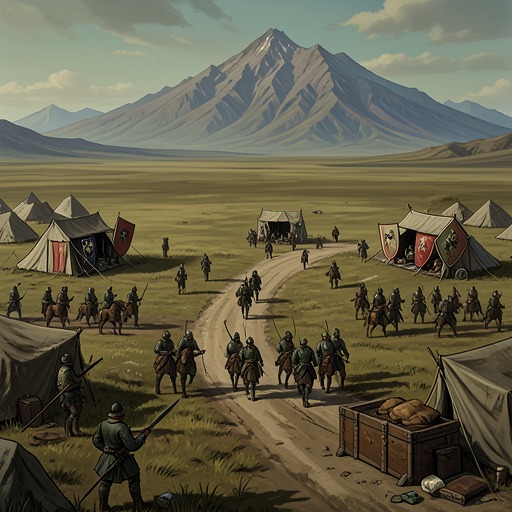
After the alliance between Shu and Wu is restored, Cao Pi rejects advice to delay an invasion and prepare military agricultural colonies first. He orders an immediate campaign. By autumn AD 224, Wei has assembled more than three hundred thousand land and naval troops, including ten enormous dragon boats, each over two hundred feet long and capable of carrying two thousand men, as well as three thousand warships. The scale of the preparations shows Cao Pi seeking to answer the renewed Shu–Wu alliance with a decisive show of force.
Cao Pi also watches the fighting between Xuande’s Shu forces and Wu. When he hears of Xuande’s deployment, he laughs at what he considers a foolish arrangement and predicts that Xuande will be defeated within ten days. He orders Wei’s front lines to prepare to attack Wu once Wu is fully engaged against Shu. This response treats the conflict as an opportunity to exploit the exhaustion of both rivals, extending Cao Pi’s ambitions beyond the transfer of the Han throne.
Cao Pi’s reign lasts seven years. In the autumn of AD 226, seriously ill, he summons Cao Zhen, Chen Qun, and Sima Yi and charges them with helping his young son Cao Rui become emperor and guiding him as he grows. Having secured this arrangement, Cao Pi dies at forty. Cao Rui succeeds him, while Sima Yi receives the western governorship he requests. Cao Pi’s death closes the first imperial reign of Wei, but the appointment of powerful guardians around a young successor carries the unresolved question of who will command the dynasty into the next generation.